
Why Word of Mouth Isn’t a Strategy
Being recommended by a satisfied client is arguably the best way to win new business. It costs nothing, requires no active effort, and those leads typically convert at a higher rate because trust is already established. Agencies should actively nurture these recommendations, and such projects should account for a healthy share of revenue.
However, treating word of mouth as your primary—or only—acquisition channel is a mistake. It is a passive approach: you are dependent on your clients deciding to recommend you, and there are limited active steps you can take when the pipeline runs dry. Many agencies find themselves in a panic when the phone stops ringing because they have no other mechanism for generating leads.
There is a second, subtler limitation. Word of mouth tends to produce similar clients. People generally recommend you to peers in comparable companies and roles. If you are content with that client profile, it is not a problem. But if you have ambitions to win larger or more prestigious clients, relying on referrals will hold you back. Reaching a specific kind of client requires a proactive strategy that word of mouth cannot provide.
Why Traditional Marketing Falls Short
The common alternatives to word of mouth are not inherently bad ideas, but many agencies struggle to get a return that justifies the investment. Each approach has structural weaknesses worth understanding before you commit time and money.
Cold Contacting
Cold outreach is often the most demoralizing form of marketing. People dislike being contacted unprompted, so the odds of winning work are poor. Timing must be perfect: you need to reach someone at the exact moment they are considering a project you can help with, or they will quickly forget you. On top of that, you have no status in the eyes of the recipient—you are just another random supplier, unlikely to grab their attention.
Advertising faces a similar credibility problem.
Advertising
When someone sees your ad, they have no prior context. They have not been recommended to you, and they likely have not heard of you elsewhere. Nothing makes you stand out from the crowd. Advertising also tends to attract smaller clients. Larger organizations generally rely on recommendations and reputation rather than ads.
Even when bigger clients do respond to advertising, they may simply be “making up the numbers.” Many large companies have procurement rules requiring them to approach multiple suppliers even when they already have a preferred one. You could waste significant time tendering for a project with little chance of success.
Procurement Sites
Large organizations often post invitations to tender on procurement websites. Responding to these can yield work, but you run the same risk of being included just to satisfy a quota. Smaller sites like Upwork or Fiverr can produce results, but they are highly competitive and extremely price-sensitive.
Networking
Establishing a relationship with a client before they need you is one way to stand out and strengthen your bidding position. Networking is a reliable method for finding new opportunities, but it is time-consuming and does not scale. That limitation is what drives many agencies toward content marketing.
Content Marketing
Blogging and social media are the primary marketing activities for many digital agencies. On paper, the logic is sound. Good content should:
- Boost search engine rankings if well written and targeted;
- Educate clients about best practices;
- Demonstrate expertise to readers;
- Build relationships with followers at scale;
- Reach large numbers of potential clients.
In practice, results are often underwhelming. Content marketing has become so popular that the space is crowded and highly competitive. There is so much material published that getting attention—let alone ranking on Google—is incredibly hard. Still, with the right focus, it can be one of the most effective techniques available.
Focusing Your Marketing Efforts
The core problem with most agency content marketing is a lack of focus. Posts go out sporadically on a range of subjects, with no clear audience or purpose in mind. Fixing that issue turns content marketing into a reliable source of leads—and lets you decide exactly which kinds of clients you attract.
This targeting happens in two stages. The first is defining your audience.
Step One: Define Your Audience
Too many freelancers and agencies publish content that seems designed to impress their peers rather than prospective clients. Instead, picture your ideal client. Are they a small business owner or an employee of a multinational? Are they senior management, or someone lower down who can influence decision-makers?
Do not stop at the type of person—also consider the sector you want to target. This can feel uncomfortable. Focusing on a single industry feels limiting, but without that focus your marketing will be lost in the noise online. Targeting a particular sector increases the chances of your content being seen and being relevant to the reader.
People typically need to encounter you multiple times before they pay attention, so your limited resources need to be concentrated on a smaller group to make that possible. This does not mean you can only do work in that sector. It simply means your initial outbound efforts should be aimed in one direction. You can pivot to another sector later if you get bored or work dries up—and you will certainly not turn away other work that comes in unsolicited.
Start with a sector where you already have experience. Ideally, look for one with an active community: chat groups, blogs, events, and conferences are good indicators that people in that space share information and will pass your content around.
Step Two: Understand Their Challenges
The uncomfortable truth is that nobody cares about you or your services. They care about solving their own problems. Your marketing needs to position your services as a way to address those problems, which means you first have to know what they are.
Talk to existing clients in your chosen sector, or run a survey. Find out what your audience is trying to achieve and what they struggle with daily. Once you understand their goals and pain points, you can align your services accordingly.
For example, a marketing manager at a service company is likely focused on generating more leads. You could position your UX services as a way to encourage more word-of-mouth recommendations. If you are targeting a fundraising manager at a charity, the same services could be framed as a mechanism for encouraging regular donations rather than one-off gifts.
With a clear picture of your audience and their needs, you can turn your attention to building a basic sales funnel.
A Four-Step Funnel That Keeps You Top of Mind
The shortcomings of sporadic marketing are clear: it doesn't demonstrate expertise consistently, it fails to differentiate you, and it doesn't keep you in front of prospects until they are ready to buy. A structured sales funnel solves these problems. A simple four-step model works well:
- Attract the attention of potential clients.
- Get their permission to stay in contact, buying time to build credibility.
- Nurture the relationship until they are in a position to hire you.
- Encourage your audience to contact you.
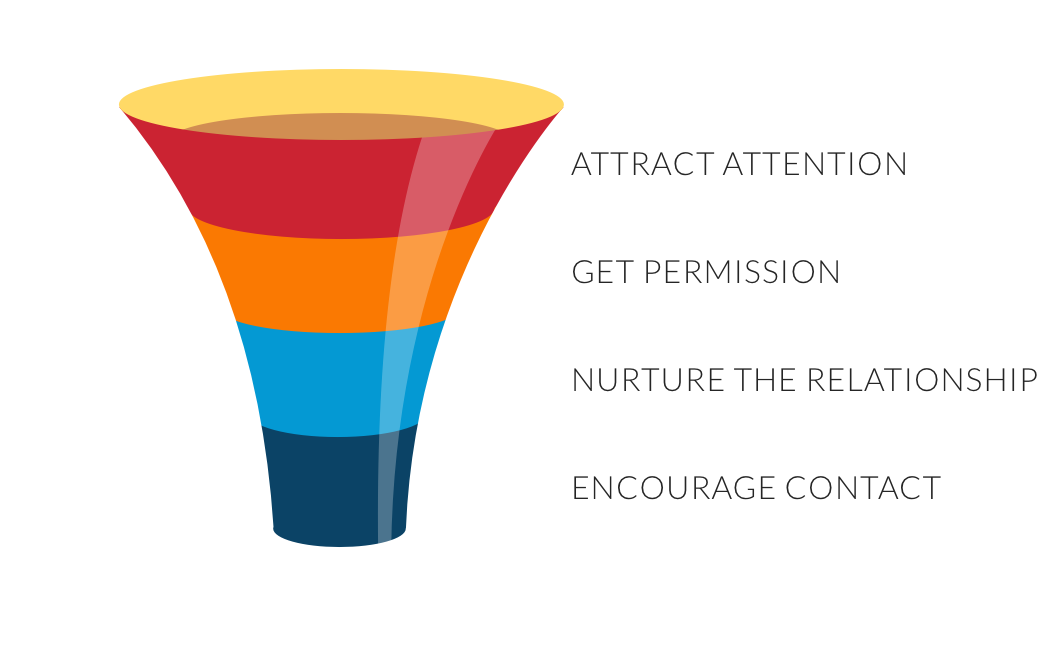
At the core of this funnel is an email course that shows prospective clients how to overcome pain points and achieve goals using services like yours. For instance, if you target charity fundraisers and offer UX services, create a course on improving fundraising through better user experience. An email course is the right vehicle because it gives you permission to email subscribers periodically and keeps you from being forgotten. It also makes the initial workload manageable: six to eight emails of about 800 words each, essentially short blog posts. If you prefer not to write, a video course works just as well as long as each lesson is delivered via email, which requires a sign-up.
Attract Attention
Step one uses conventional marketing channels blog posts with targeted keywords, guest posts on sites your audience reads, talks at relevant events, social media with appropriate hashtags, participation in industry communities, and optionally paid ads. The key difference is that all content is tightly focused on your audience, and every piece promotes the email course and points to a landing page.
This doesn't double your workload because the content you create for the email course is the raw material for the rest. A lesson on using UX to improve conversion can be reworked into a guest post, social posts, or a conference talk. This keeps your external content aligned with the course and saves time.
Get Permission to Maintain Contact
The landing page your content links to must clearly describe the course and its benefits, and emphasize that it was built specifically for the audience you're targeting. Promise the six to eight weekly lessons plus a monthly newsletter with advice relevant to your services. The newsletter is essential; without it, subscribers may disappear after finishing the course. Writing a few hundred words a month addressing a specific need is a small effort, often just expanding on a topic from the course.
To boost first-visit signups, offer an extra incentive, such as a downloadable guide that helps subscribers make a business case to their boss. When someone subscribes, they should immediately receive the first lesson, then subsequent lessons on a weekly schedule. Most email marketing platforms support this automation, ConvertKit is one example.

Once the course is complete, move subscribers to the monthly newsletter list so they continue to receive occasional emails.
Nurture the Relationship
The six to eight weeks of the course may not coincide with a prospect's buying cycle. Continuing with occasional emails ensures they remember you and reinforces your expertise. These emails must never be pure promotion; if they are, people will unsubscribe. Provide advice that helps subscribers meet their goals and address their pain points. Mentioning past projects is acceptable if done in the service of the audience's needs.
Nobody is interested in your company or your latest case studies. They are interested in how you can help them.
Encourage Contact
Invite subscribers to reach out. Ask questions, solicit feedback, and consider holding an occasional ask-me-anything webinar exclusively for your mailing list. These interactions build a personal connection that significantly increases the likelihood of future business.
Scaling the Funnel
The initial effort of building a funnel feels substantial, but it becomes easier with time. Once you've created assets for one sector, you can repurpose them for a second with minor adjustments. The email course itself can often be reused with slight tweaks, and the monthly newsletter remains the same regardless of the sectors you target.
The real payoff is the email list itself. With a list of prospective clients, writing on a specific topic almost always generates work in that area. This ability to generate projects on demand brings considerable peace of mind and supports long-term business stability. If you want to explore the broader challenges of selling services, Mike Monteiro's book Design Is A Job is a worthwhile follow-up.


