
Copilot Code Review Passes 60 Million Reviews
GitHub’s Copilot code review, launched last April, has seen usage grow tenfold since its debut and now accounts for more than one in five code reviews on the platform. The service has processed over 60 million reviews, and more than 12,000 organizations now run it automatically on every pull request.
Behind the scenes, GitHub has been running continuous experiments to improve comment quality, and recently shifted to an agentic architecture that retrieves repository context and reasons across changes. Developer feedback—from formal surveys to simple thumbs-up and thumbs-down reactions—has guided iterations on the user experience.
What makes a review good now
When GitHub began building Copilot code review in 2024, the goal was thoroughness. Over time, that definition has shifted. What developers actually value, the team learned, is high-signal feedback that moves a pull request forward quickly. The current system uses the best available models, memory, and agentic tool-calling, tuned through a continuous evaluation loop around three qualities: accuracy, signal, and speed.
Accuracy
The aim is sound judgment that prioritizes consequential logic and maintainability issues. Performance is evaluated internally against known code issues and through production signals from real pull requests. In production, GitHub tracks two key indicators: developer reactions on comments, and whether flagged issues are actually resolved before merging. These signals together help ensure that faster merges come from confident fixes, not reduced scrutiny.
Signal over volume
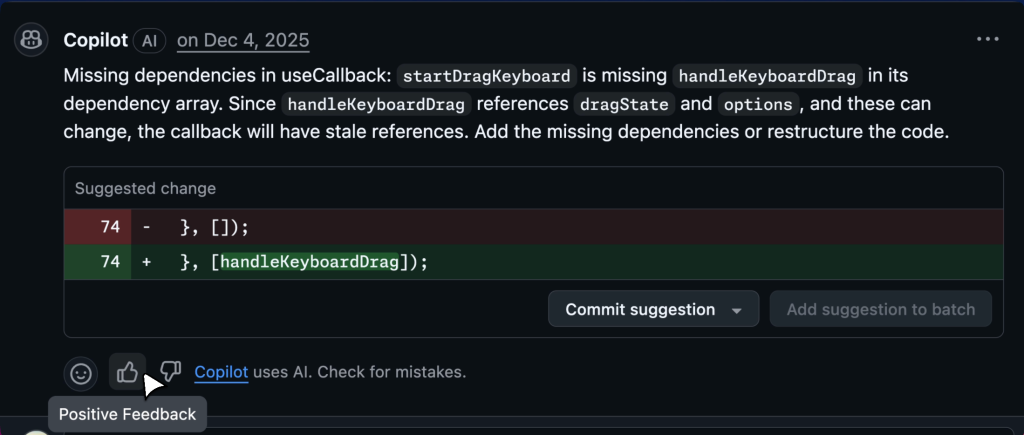
More comments don’t make a better review. The goal is surfacing issues that matter. A high-signal comment helps a developer understand both the problem and the fix:
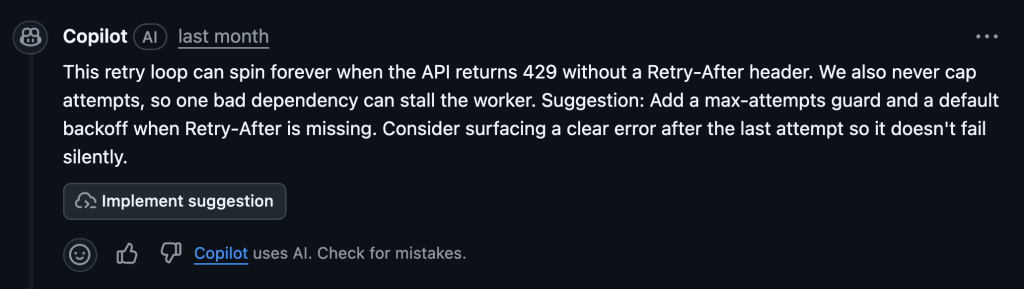
Silence is better than noise. In 71% of reviews, Copilot code review surfaces actionable feedback; in the remaining 29%, the agent says nothing at all. As identification of high-signal findings improves, the agent can comment more confidently, now averaging about 5.1 comments per review without increasing review churn or lowering the quality threshold.
The speed trade-off
Speed matters in code review, but signal matters more. Copilot code review is designed to provide a reliable first pass shortly after a pull request opens, yet meaningful reviews require analysis. As reasoning capabilities improve, the computation needed to surface deeper issues grows as well.
GitHub treats this as a deliberate trade-off. In one recent change, adopting a more advanced reasoning model improved positive feedback rates by 6%, even though review latency increased by 16%. A slightly slower review that surfaces real issues is worth more than instant feedback that adds noise. Latency is reduced wherever possible, but never at the expense of high-signal findings.
The agentic architecture shift
Redeveloping the code review system around an agentic design drove an initial 8.1% increase in positive feedback. The new architecture can retrieve context intelligently and explore the repository to understand logic, architecture, and specific invariants. Four capabilities stand out:
- Catches issues while reading, not just at the end: Previously, agents waited until the end of a review to finalize results, which often led to “forgetting” early discoveries.
- Maintains memory across reviews: Each pull request no longer needs to be an isolated event. If a pattern is flagged in one part of the codebase, that context can be reused in future reviews.
- Keeps long pull requests reviewable with an explicit plan: The agent maps out its review strategy ahead of time, significantly improving performance on long, complex pull requests where context is easily lost.
- Reads linked issues and pull requests: Extra context helps flag subtle gaps, including cases where code looks reasonable in isolation but doesn’t match project requirements.
Easier-to-navigate feedback
Iterating on how the agent interacts with pull requests has reduced noise and made feedback more actionable.
- Multi-line comments: Feedback is attached to logical code ranges rather than single lines, making it easier to see what’s being referred to and apply the suggested change.
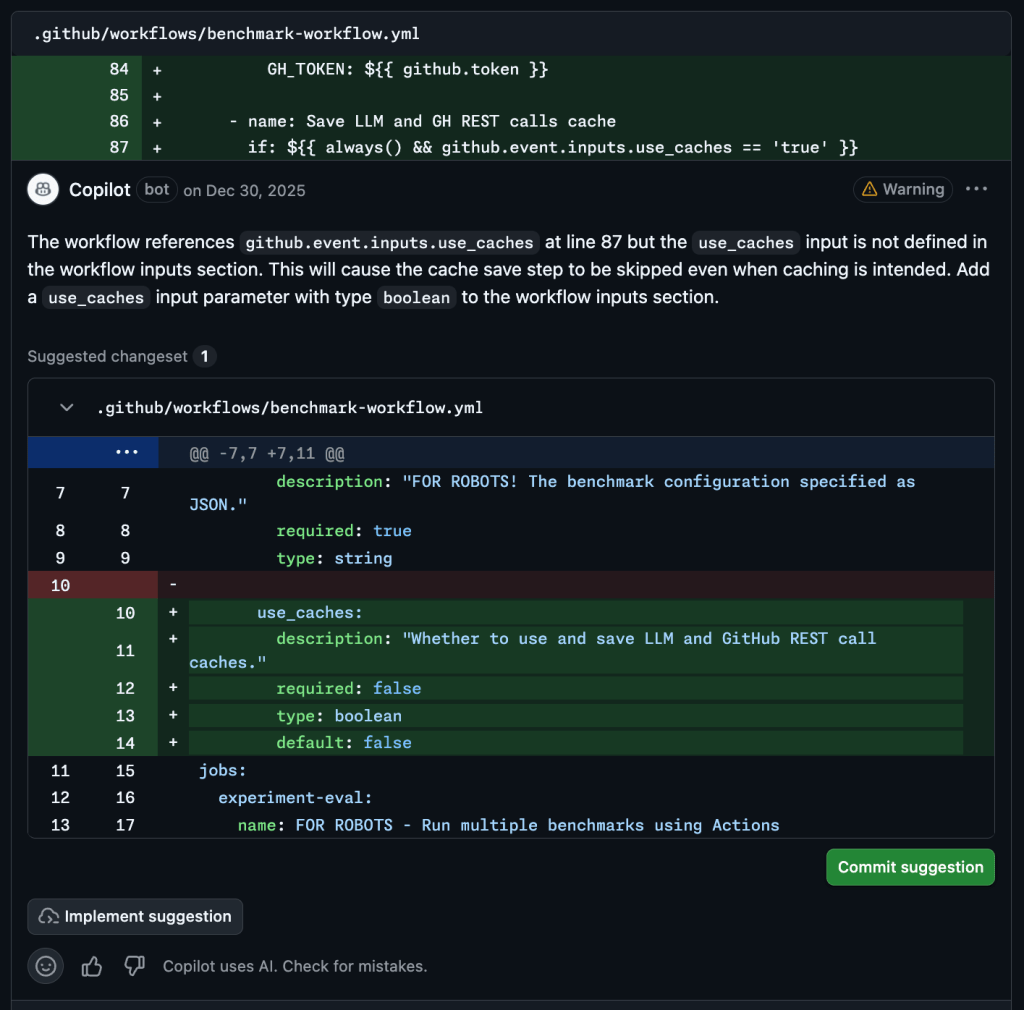
- Clustered comments: Instead of multiple separate comments for the same pattern error, the agent clusters them into a single, cohesive unit to keep the pull request timeline readable.
- Batch autofixes: Suggested fixes can be applied in batches, resolving an entire class of logic bugs or style issues at once rather than context-switching through dozens of individual suggestions.
Adoption and what’s next
Organizations running Copilot code review as a default on every pull request include General Motors, where the tool handles pull request reviews and summaries and lets teams focus on more complex tasks. At WEX, roughly two-thirds of developers now use Copilot, including the most active contributors. WEX has made Copilot code review the default across every repository, and developers are heavily using agent mode and the coding agent, helping WEX ship roughly 30% more code.
GitHub’s roadmap for Copilot code review focuses on deeper personalization and high-fidelity interactivity: refining the agent to learn a team’s unwritten preferences while enabling two-way conversations to refine fixes and explore alternatives before merging.
Copilot code review is available with Copilot Pro, Copilot Pro+, Copilot Business, and Copilot Enterprise. Automatic reviews can be configured on every pull request within a repository or organization via the GitHub docs, and organizations can also enable Copilot code review without a Copilot license.


