Meta tackles null-pointer crashes with a dedicated Java static analyzer
Null dereferencing remains one of the most common failure modes in Java applications. On Android specifically, NullPointerException (NPE) is the leading cause of crashes on Google Play. Java itself offers no built-in mechanism for expressing or verifying nullness invariants, so developers historically lean on testing and dynamic analysis—approaches that are slower to surface defects and can't cover every execution path.
Meta began addressing this in 2019 through a project called 0NPE, which aimed to improve null-safety in Java across its Android codebases using static analysis. Over two years, the team developed Nullsafe, a custom static analyzer that detects potential NPE errors, integrated it into the core development workflow, and ran a large-scale automated code transformation to make millions of lines of Java code compliant with the tool's checks.
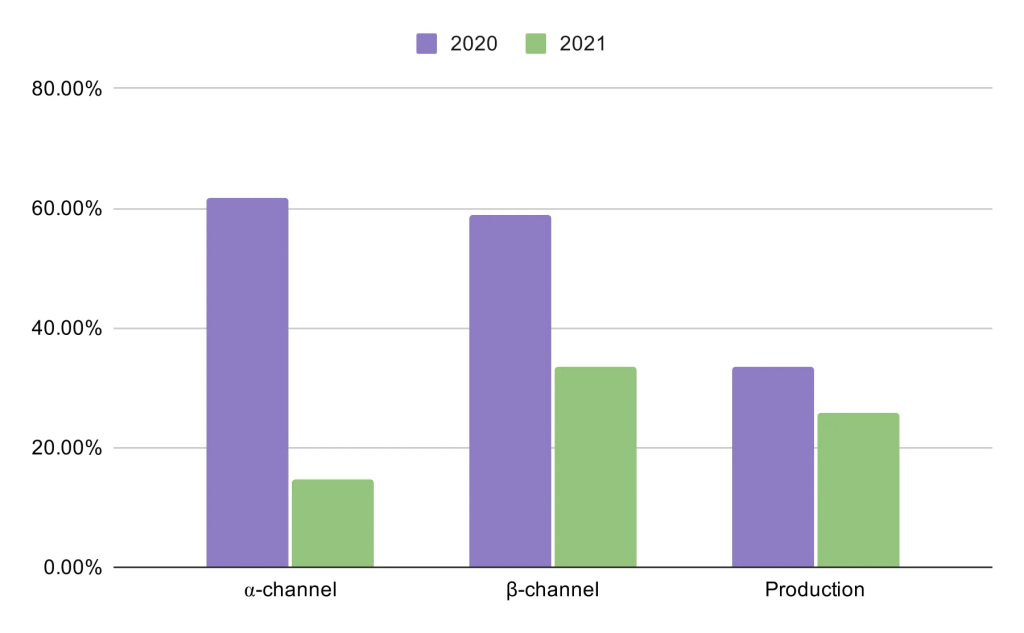
The results have been measurable. Taking Instagram, one of Meta's largest Android apps, as a reference point, production NPE crashes fell by 27 percent during the 18-month transformation period. NPEs have since dropped out of the top causes of crashes in both alpha and beta channels, which Meta attributes to improved developer productivity and a better onboarding experience for engineers modifying code.
Why nulls are hard to eliminate
The core difficulty isn't the null value itself—it's the absence of explicit nullness information in APIs combined with a lack of tooling to verify correct handling. Consider a simple method:
Path getParentName(Path path) {
  return path.getParent().getFileName();
}
There are two distinct failure patterns here: getParent() can return null, causing a crash locally within the method, or getFileName() can return null, which may propagate through the call stack and crash elsewhere. The first is easy to debug; the second becomes increasingly difficult to trace as the codebase grows to millions of lines with thousands of daily changes. At that scale, manually tracking nullness invariants is infeasible.
Java 8 introduced java.util.Optional<T> as a potential remedy, but its performance overhead and poor compatibility with legacy APIs ruled it out as a general-purpose replacement for nullable references. Instead, Meta turned to annotations—@Nullable and @NotNull—to extend Java types with explicit nullness, avoiding the downside of Optional while keeping the code idiomatic.
An annotated and corrected version of the earlier method looks like this:
// (2)                          (1)
@Nullable Path getParentName(Path path) {
  Path parent = path.getParent(); // (3)
  return parent != null ? parent.getFileName() : null;
            // (4)
}
This approach rests on a few key conventions:
- Unannotated types default to non-nullable, reducing the annotation burden—but only for first-party code.
- Return types that can be
nullare marked@Nullable. - Local variables remain unannotated; the static analyzer infers their nullness.
- Checking a value for
nullrefines its type to non-nullable in the corresponding branch. Known as flow-sensitive typing, this allows developers to write code naturally and handle nullness only where required.
With annotations in place, a static analyzer can check the code systematically, preventing regressions and giving developers confidence to iterate faster.
Kotlin coexistence still requires a Java solution
Kotlin offers a different model: nullness is part of the type system, and the compiler enforces it at build time with immediate feedback. Meta uses Kotlin heavily for exactly these reasons. However, a large body of business-critical Java code remains that cannot—or should not—be migrated overnight. Java and Kotlin must coexist in the same codebases, which means there is still a real need for a robust null-safety solution targeting Java itself.
How Nullsafe Wires Into javac
Meta’s second-generation Java nullness analyzer, Nullsafe, is implemented as an extra pass on top of the standard Java compiler. Using the compiler API introduced by JSR-199, Nullsafe hooks into the compilation pipeline and runs its analysis after normal type-checking, collecting and reporting nullness diagnostics.
The analyzer builds on two core data structures:
- The abstract syntax tree (AST), obtained directly from the compiler API along with type and annotation information. The AST gives the syntactic shape of the code without punctuation or other lexical noise.
- The control flow graph (CFG), constructed from the AST using the Dataflow library. The CFG represents the code as blocks of instructions connected by control-flow edges, which is essential for flow-sensitive reasoning.
Analysis itself proceeds in two phases.
Type inference runs over the CFG and produces a mapping from expressions at each program point to a nullness-extended type:
state = expression x program point → nullness-extended type
The engine walks the CFG and symbolically executes each instruction. For a method like getOrDefault:
String getOrDefault(@Nullable String str, String defaultValue) {
  if (str == null) { return defaultValue; }
  return str;
}
Inference starts at the entry point with a mapping such as {str → @Nullable String, defaultValue → String}. When the analysis hits a comparison like str == null, control flow splits and the two branches get separate mappings: the then-branch keeps str as @Nullable String, while the else-branch refines it to String. When paths join, the inference engine over-approximates by taking the least precise type across branches, so String and @Nullable String merge into @Nullable String.
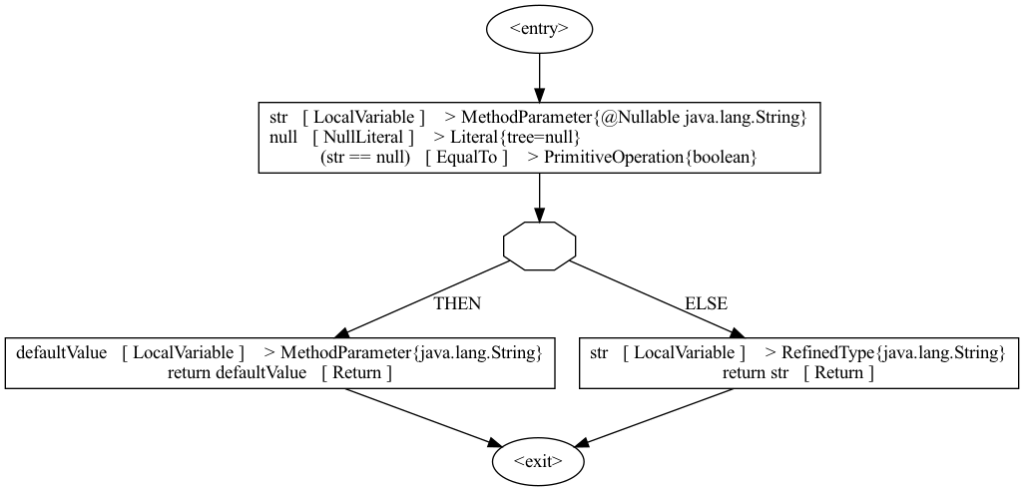
This flow-sensitivity is what makes the analysis practical. Beyond simple null checks, Nullsafe supports advanced features such as method contracts, SAT-solving for complex invariants, and interprocedural initialization analysis, though these are outside the scope of this overview.
Type checking operates on the AST instead of the CFG. By walking the tree, the analyzer compares what the source code declares against the inferred types. For a return str node, Nullsafe fetches the inferred type of str and validates it against the method’s declared return type. For object dereferences, the inferred type of the receiver must exclude null; implicit unboxing is handled the same way, and method arguments are checked for compatibility against the invoked method’s parameter types.
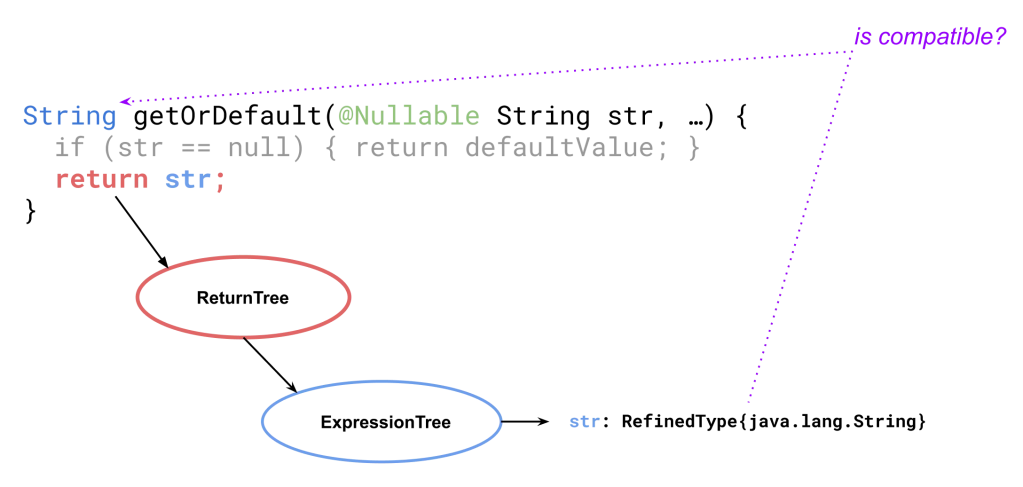
Type checking is comparatively straightforward. The difficult part is error rendering — presenting a type mismatch with enough context — type trace, code origin, and a possible quick fix — so the developer can act on it.
Generics Multiply the Inference Problem
The examples so far only cover root nullness: whether the value itself can be null. Generics introduce the question of nullness at every level of a type argument. For a plain type like Map<K, List<Pair<V1, V2>>>, a non-generic checker only needs to answer one question:
// NON-GENERIC CASE
   ␣ Map<K, List<Pair<V1, V2>>
// ^
// \--- Only the root nullness needs to be inferred
With generic support, however, the inference must fill in nullness annotations at every depth:
// GENERIC CASE
   ␣ Map<␣ K, ␣ List<␣ Pair<␣ V1, ␣ V2>>
// ^     ^    ^      ^      ^      ^
// \-----|----|------|------|------|--- All these need to be inferred
That additional expressivity compounds an already flow-sensitive analysis. There is also a subtle interaction with Java’s own type inference. Because generics are invariant, the inferred types must line up precisely with what javac derives. For instance:
interface Animal {}
class Cat implements Animal {}
class Dog implements Animal {}

void targetType(@Nullable Cat catMaybe) {
  List<@Nullable Animal> animalsMaybe = List.of(catMaybe);
}
In isolation, List.<T>of(catMaybe) could be inferred as List<@Nullable Cat>. But since List<@Nullable Cat> is not a subtype of List<Animal> under invariance, the assignment would incorrectly fail. Java avoids this through target typing, where the expected type on the left-hand side guides inference. A forward CFG-based analysis doesn’t naturally accommodate this back-propagating constraint, so Nullsafe needed extra machinery to handle it. The compiler also has known bugs with type annotations — one example is JDK-8225377 — that require workarounds in both Nullsafe and other annotation-based tools.
Despite the cost, generic support is worth it. Without it, developers cannot express null-safe collections, functional interfaces, or streams, and they end up working around the checker, which produces brittle code. At Meta, the lack of null-safe generics was a recurring source of bugs. Generic-aware analysis is also a prerequisite for safe Kotlin interop, since Kotlin’s own null-safety extends through type arguments. A nullness checker for Java that stops at the root level leaves a gap that shows up precisely at language boundaries.
Three Tiers for a Gradual Rollout
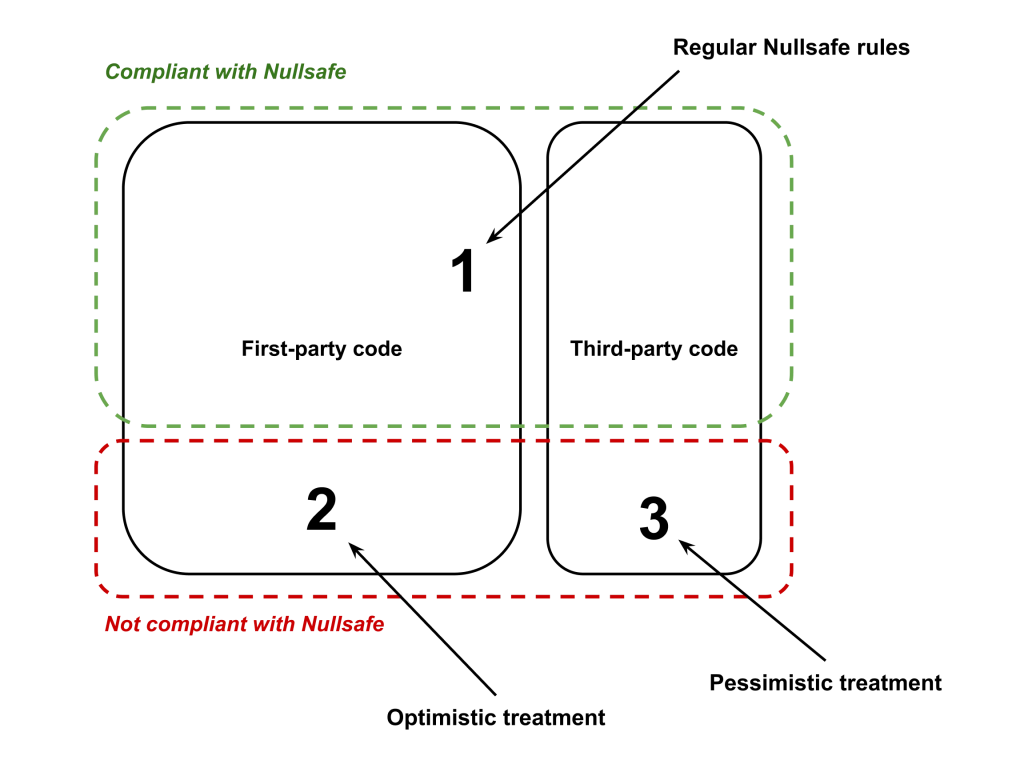
Nullsafe effectively adds new semantic rules to Java. In an ideal world, all code would follow them, but Meta’s codebase predates the checker and contains large amounts of null-unsafe code that would produce noise, not signal, if analyzed naively. To handle this, Nullsafe partitions code into three tiers:
- Tier 1: Nullsafe-compliant code. First-party code marked
@Nullsafewith no errors, plus third-party code that is annotated or modeled for nullness. - Tier 2: First-party code not yet compliant. Internal code that wasn’t written with explicit nullness tracking; Nullsafe checks it optimistically.
- Tier 3: Unvetted third-party code. Libraries Nullsafe has no information about. Uses of this code are checked pessimistically, and developers are encouraged to add proper nullness models.
The tier of the callee dictates how strictly the caller is checked. Calls from Tier 1 into Tier 2 are optimistic, so compliant code may still sit on unsafe dependencies. Calls from Tier 1 into Tier 3 are pessimistic, and Tier 2 code calling into Tier 1 is checked according to the Tier 1 component’s annotations.
The optimistic treatment of Tier 2 is a deliberate unsoundness that made adoption practical — stricter checks created too much friction at Meta’s scale. As code migrates into Tier 1, the concern diminishes. Pessimistic handling of third-party code adds friction on adoption, but in practice the cost was acceptable, and the safety gain at the boundary was real.
Beyond the Checker: Tooling and Adoption
Static analysis only works when developers actually run it and fix what it reports. Meta found three factors essential to making Nullsafe effective at scale:
- Quick fixes. Much of the codebase has trivial violations. Automated fixes let developers clear large amounts of low-value debt quickly and reserve manual effort for meaningful correctness problems.
- Developer adoption. Nullsafe must integrate with the standard workflows — build tools, IDEs, command-line tools, and CI. Equally important is a feedback channel between the application developers and the static analysis team so the tool evolves with real usage.
- Data and metrics. Tracking the percentage of compliant code, progress over time, and the highest-impact remaining violations helps keep migration on course and focused.
Eighteen Months of Instagram Data
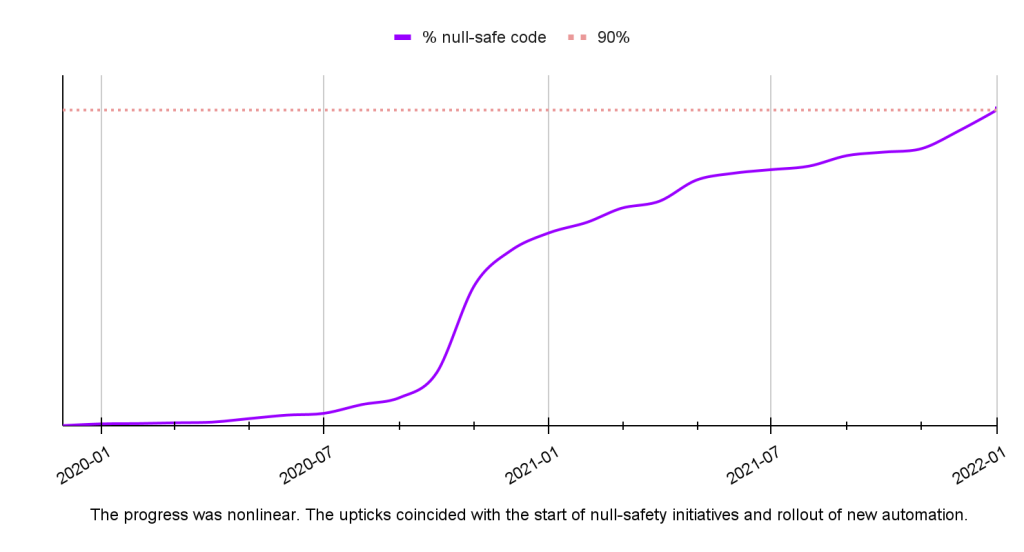
Meta tracked 18 months of reliability data for the Instagram Android app to gauge Nullsafe's longer-term impact. Over that window, the portion of code compliant with Nullsafe rose from 3 percent to 90 percent. The relative volume of NullPointerException (NPE) errors dropped significantly across all release channels; in production, NPE volume fell by 27 percent. That reduction held up when validated against other crash types, pointing to a genuine reliability gain rather than a statistical artifact.
Individual product teams reported even larger effects after cleaning up nullness errors that Nullsafe surfaced, with production NPE reductions ranging from 35 percent to 80 percent depending on the team. The alpha channel saw a particularly sharp decline, which Meta attributes to developers catching nullness issues before code ever reached broader testing. That early signal, they argue, reflects a real productivity improvement from relying on a nullness checker.
Why NPEs Won't Hit Zero
Meta's north star is eliminating NPEs entirely, but the production data reveals several reasons that ideal remains out of reach:
- Null-unsafe code still accounts for a large share of the top NPE crashes, though those residual hotspots are now addressable with targeted fixes.
- Crash volume is a misleading metric: a single bug that goes hot in production can skew results. Counting new unique crashes per release is more meaningful, and there Meta sees an n-fold improvement.
- Client-server mismatches generate NPEs that no amount of app-side static analysis can prevent.
- The analysis itself rests on unsound assumptions that let some bugs slip through.
Meta is careful not to credit Nullsafe alone for the gains. The aggregate numbers reflect hundreds of engineers using the tool alongside other reliability initiatives. Still, based on internal reports and several years of observation, the company is confident Nullsafe played a significant role.
The Industry-Wide Annotation Problem
Null-dereference bugs are hardly unique to Meta. The null reference has inflicted damage across the industry, and languages have responded in different ways. C# added explicit nullness to its type system; Kotlin shipped with it from day one. Java has no such built-in support, and attempts to bolt it on, such as JSR-305, never gained wide adoption.
Several strong static analysis tools for Java exist today — CheckerFramework, SpotBugs, Error Prone, and NullAway among them. Uber took a path similar to Meta's by using NullAway to make its Android codebase null-safe. But every checker performs nullness analysis slightly differently, and the absence of standard annotations with precise semantics has limited how much Java codebases across the industry can benefit from static analysis.
The JSpecify workgroup was created in 2019 to fix exactly that. It brings together individuals from Google, JetBrains, Uber, Oracle, and others; Meta joined in late 2019. The nullness specification is not yet final, but substantial progress has been made on both the spec and supporting tooling. JSpecify participation has also shaped how Meta thinks about nullness in Java and how the company expects its own codebase to evolve as the standard matures.