Prediction stability is a different reliability problem
Meta’s ads ranking stack serves millions of ML-driven recommendations per second, and keeping that pipeline stable is not the same problem as keeping a conventional online service available. A recommendation model can be up, responding, and still be quietly wrong. That blur between availability and output quality is why Meta has built what it calls prediction robustness: a set of guards, diagnostics, and design changes meant to keep predictions stable without throttling model freshness or performance.
Several properties of ML systems make this harder than traditional SRE work. Models are stochastic, so a quality dip is hard to distinguish from normal traffic variation. Models and features are refreshed constantly to track user interest, which makes it hard to localize a regression. Small shifts in feature or training data distributions can produce large, nonlinear swings in predictions, and the final prediction depends on a long chain of processing across many systems — so the source of a problem may be several hops upstream. Rapid modeling innovation only adds to the moving target.
A framework in three layers
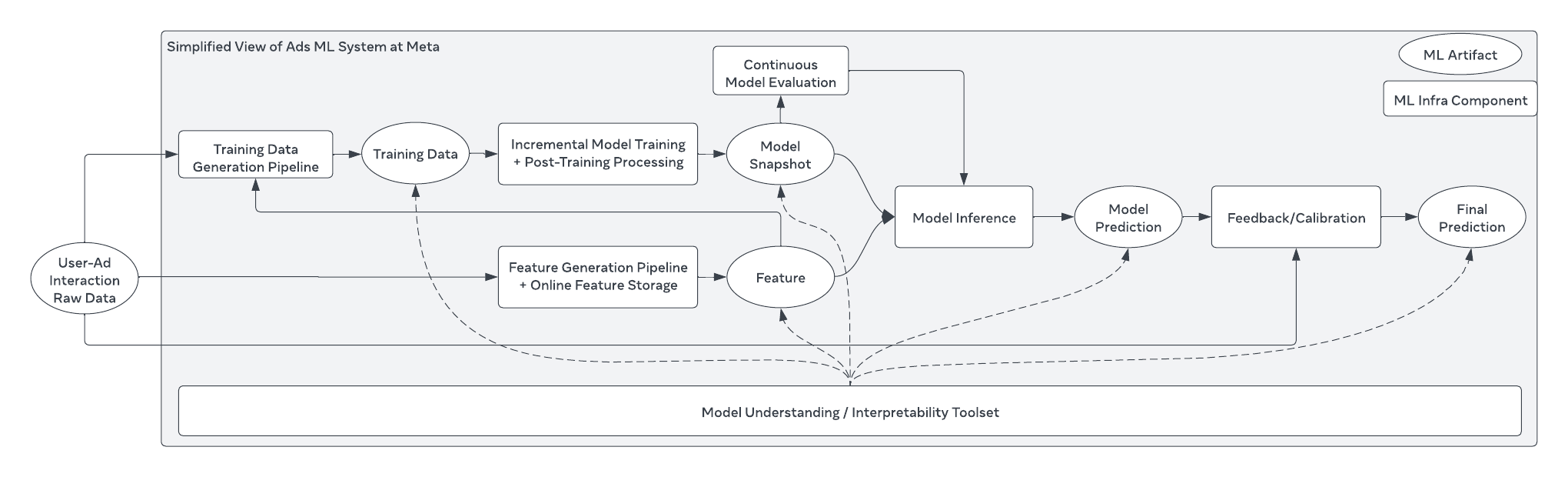
Meta's approach combines prevention guardrails built from outside the model, fundamental understanding of failure modes, and intrinsic robustness techniques applied inside the models themselves. The work spans the full recommender stack: training data, features, models, calibration, and interpretability.
Model robustness
For models, the main failure modes are snapshot quality, snapshot freshness, and inference availability. Meta runs an internal real-time evaluation system called Snapshot Validator that checks each newly published model snapshot against holdout data before it can serve production traffic. The tool has reduced model snapshot corruption by 74% over the past two years and now protects more than 90% of Meta’s ads ranking models without slowing down real-time model refresh.
On the intrinsic side, Meta engineers have added techniques to prune less-useful modules inside models, improve generalization against overfitting, apply more effective quantization, and keep predictions stable even when a small slice of input data is anomalous. Together these changes target overfitting, loss divergence, and other training-time instabilities before they reach production.
Feature robustness
Feature-quality work focuses on coverage, distribution, freshness, and consistency between training and inference. Production monitoring continuously scans ML features for anomalies, with detection tuned to the specific traffic and prediction patterns of each feature rather than using a generic threshold.
Automated mitigations stop abnormal features from being used in serving. A real-time feature-importance system provides the diagnostic layer, correlating feature-quality signals with prediction-quality outcomes. Meta says these controls have effectively contained issues caused by feature coverage drops, data corruption, and training-inference inconsistency.
Training data robustness
Meta’s ads products use distinct labeling logic per product, which complicates training-data quality. Label sources can also drift because of the logging infrastructure and organic changes in traffic. Dedicated training-data-quality systems detect label drift over time, then automatically suppress abnormal data so models never learn from it. Work on label consistency has also fed back into optimizations for how training data is generated.
Calibration robustness
Calibration is technically distinct because it trains on unjoined data in real time, making it more sensitive to traffic distribution shifts than joined-data mechanisms. The protection here is a high-precision alert system to shorten detection time, paired with automatically orchestrated mitigations to shorten recovery time.
ML interpretability
When something does break, Meta leans on Hawkeye, an internal debugging toolkit that provides an end-to-end diagnostic path across ML artifacts. It now covers more than 80% of ads ML artifacts and has become one of the most widely used tools in Meta’s ML engineering community.
Beyond debugging individual incidents, Meta is investing in understanding model internals. The company uses model graph tracing — examining internal states, activations, and neuron importance — to explain why models become corrupted. There is no standardized approach here yet. Combined, the interpretability work has cut the time to root-cause ML prediction issues by 50%.
Applying robustness beyond incident prevention
Meta is now pushing prediction robustness techniques beyond stability into performance and developer productivity. Making models intrinsically robust — via stabilized training, less normalized entropy explosion, resilience to data shift, and stronger generalization — has already produced ranking gains through better gradient clipping and quantization methods. Tighter consistency between serving and training environments, plus more aggressive staleness SLAs, are expected to add further gains.
On the productivity side, Meta is building an intelligent ML diagnostic platform that uses the same robustness context to help engineers with little ML background locate the root cause of stability issues in minutes. The platform is designed to evaluate reliability risk continuously across the ML development lifecycle, embedding reliability checks from idea exploration through online experimentation and launch.