From obligations to executed tasks: Meta's compliance work distribution
Meta processes more than 100,000 compliance-related tasks each year. Managing that volume across tens of thousands of engineers requires a centralized system — one that translates regulatory obligations into concrete, trackable engineering work. Meta built the Federation Platform for this purpose, together with a batching program called Privacy Waves that packages tasks into predictable monthly cycles.
Both systems are now central to how the company structures privacy work. Meta reports that the approach has produced higher engineer satisfaction than ad-hoc task assignment and saved hundreds of thousands of engineering hours through improved task quality and automated tooling. The model has since expanded beyond privacy into security, accessibility, and broader compliance efforts.
Why a centralized distribution system was necessary
Privacy compliance at Meta's scale splits into thousands of small, specialized tasks that individual engineers must complete across hundreds of product areas. Handling this without a coordination layer creates problems that compound quickly: task fatigue, missed deadlines, duplicated efforts across teams, and difficulty verifying that work was done correctly.
Task distribution that engineers see as poorly managed also drives down morale and productivity. A well-designed workflow keeps developers focused and reduces the operational burden of compliance work — which, in turn, produces better outcomes. Meanwhile, Meta must be able to show regulators and auditors that compliance work happens consistently, with standardized practices and verifiable documentation. The Federation Platform supports that requirement by logging completed work in a uniform format.
What the Federation Platform does
The Federation Platform is not a single workflow but a configurable framework. Engineering teams that need to push compliance work across the company define a workstream in code, which drives six phases of task lifecycle management:
Scraping flags. A workstream identifies potential privacy issues ("flags") and ingests them into the platform, often through Meta's reusable detection frameworks. Scraping can run automatically on a daily schedule, and each workstream filters and configures which flags to accept.
Ownership resolution. The platform maps flagged assets — code files, data tables, and similar artifacts — to their responsible owners through Meta's central catalog.
Optional grouping. Workstreams can bundle related flags, for example those owned by the same team or located in the same directory, into a single task to permit bulk remediation.
Actioning. Each workstream configures whether a flag gets a task file assigned to the owner or receives an automated code change (diff) that the owner must review before landing.
Task content and distribution. Tasks must explain the underlying requirement, reference the supporting privacy initiative, and walk the assignee through the fix. Workstreams decide what enters a task and whether distribution runs through Privacy Waves.
Resolution logic. The platform auto-closes completed tasks and reopens them when the underlying issue remains unfixed.
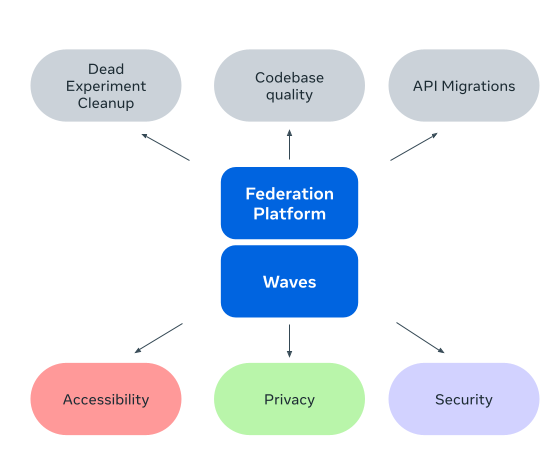
That generic configuration has found uses outside privacy. Security teams apply it to vulnerability remediation, accessibility teams to product compliance matters, and engineering groups to internal migrations, code-quality cleanup, and the retirement of obsolete experiments.
How Privacy Waves adds structure
Privacy Waves wraps the distribution layer with a predictable monthly cadence. Work that gets batched into a wave shares the same deadline for all teams, which makes reminders, status reports, and escalation easier to standardize. The main benefit is predictability: product organizations get visibility of upcoming privacy work from Facebook, Instagram, WhatsApp, and other units so teams can plan and commit to delivery well in advance. Task load is assigned through a matching algorithm that weighs each team's existing responsibilities against the assets it owns.
Task design and quality control
Task content goes through a quality gate before wave distribution. A review committee assesses each workstream's output, and every workstream is measured on metrics covering completion rate, open task count, deferral rate, and developer friction.
Structured tasks often take a wizard-style approach: a sequence of multiple-choice questions guides engineers to the right resolution, which can end in automated remediation such as direct code changes or click-to-fix tooling. Meta reports that wizards reduce the effort required to finish a task by about half. Tasks link to support forums and to examples of similar work where engineers can find inspiration, placing AI assistants directly in tasks to be searched against relevant documentation and to produce code drafts for human review before they go to final use. A startup case remains full discretion for whether engineers can query it.
Lint logic prevents low-value tasks from being sent out in the first place — for example, work assigned to assets that are queued for deletion or that hold no data at all. Engineer sentiment is captured per workstream through targeted surveys, and an executive summary is generated from survey data with AI technology so that workstream owners can respond quickly, letting them course-correct later waves — right. On a quality level, completion rates are the primary control and are transparent across the organization to executives responsible for delivery.
Post-distribution processes
Execution is kept on an explicit script following distribution. Deadlines resist deferral indefinitely. Automated nudges go to the assignees, and escalation to succeeding teams or higher-level tracks occurs only where needed. Accounting for new overhead is impossible without the pressure of the deadlines near date sensitivity. After the waves complete, the platform audits a standardized report and external documentation aligned to the internal compliance posture for internal review. Performance recognition is credited explicitly to engineers who complete compliance tasks and recorded in their performance evaluations, covering the engineering voice supporting an integral part of the Meta code review and incentives structure.
The privacy domain proved the validity of this model at scale; those operating frameworks are now extended elsewhere to security and accessibility and finally absorbed into broader compliance business units. The move holds together a product-level "ecosystem-wide accountability during separate deadlines" that ultimately separates broad responsibility at all levels of Meta engineering effort from a deliverable execution task that otherwise spreads beyond recognition.
Extending federation and privacy workflows to new domains
Meta is expanding the Federation Platform and Privacy Waves programs into areas such as security, accessibility, and broader compliance efforts. These new domains bring a different workload: more task types, multi-step remediation flows, and less uniform deadlines. The core design — centralized task distribution, execution tracking, and clear accountability — carries over as the foundation for handling that variety.
The rollout into fresh territory means the underlying tooling needs to adapt without losing consistency. Meta is refining its processes to fit each domain's specific requirements while holding to the same quality benchmarks used in privacy work. That balance between domain-specific support and standardized operation is what keeps the system reliable as it scales, with the stated goal of protecting user data and maintaining uniform operations across every area the platform touches. The work positions Federation Platform and Privacy Waves as reference points for compliance standardization.
Acknowledgments
The authors thank the reviewers of this post, listed in last-name alphabetical order: Chris Adams, Bob Baldwin, Denys Besedynskyy, Herb David, Dylan Drop, Katriel Cohn-Gordon, Xenia Habekoss, Mohit Jha, Ryan Pratt, Matt Pregozen, Jessica Retka, Thomas Richards, and Chris Wiltz, many of whom contributed significantly to Federation Platform and Privacy Waves.
Credit also goes to the many current and former Meta employees who shaped Federation Platform and Privacy Waves over the years, with special thanks to: Quinn Armstrong, Gunnar Arnesen, Cecilia Baek, Yashdeep Bindal, Anusha Buchireddygari, Chris Buckley, Adam Campbell, Katriel Cohn-Gordon, Ruo Ding, Jason Fennell, Andrew Fong, Riccardo Govoni, Abhishek Gulati, Tucker Hart, Jason Hendrickson, Aleksandar Ilic, AJ Jahansouz, Shruthi Katakam, Risa Kawai, Bruce Liu, Emile Litvak, Amira Malpass, Idan Michael, Jason Nawrocki, Anthony O’Sullivan, Yuval Oren, Disha Parekh, Nisha Paryani, Uday Patireddy, Vimalkumar Patel, Riley Pinkerton, Matt Pregozen, Mateen Saifyan, Pallavi Saraswati, Jay Shah, Or Sperling, Sana Surani, Rajesh Vantipalli, Avi Varadarajulu, Michelle Xu, Robbin Xu, Rui Xue, Nikki Wasikowski, Sara Wei, Feiyue Wu, Anna Zeng, and Hansen Zhang.