
Messaging Interoperability in Europe: How WhatsApp and Messenger Are Approaching It
With the Digital Markets Act (DMA) taking effect on March 7, 2024, designated messaging services in Europe must open up to third-party providers. WhatsApp and Messenger, both designated by the European Commission, are now required to offer interoperability (interop), provided the third-party meets eligibility, technical, and security standards. Meta has been working with the EC for nearly two years to implement this feature without compromising its own security guarantees.
The scope for year one is limited to core functionality: 1:1 text messaging and sharing of media files (images, voice messages, videos, attachments) between individual end users. Group chats and calling come later. While Meta must technically be ready to enable interop within three months of a request, real-world rollout may take longer.
WhatsApp's Reference Offer for third-party providers has now been published, outlining the requirements to interoperate. The Messenger Reference Offer was released on September 6, 2024.
Encryption Architecture for Interop
Both WhatsApp and Messenger rely on the Signal Protocol as the foundation for end-to-end encryption (E2EE). For interop, Meta would prefer third parties to use the same protocol, but will accept a compatible one—provided it can demonstrate security guarantees equal to Signal.
Third-party providers build message protobufs, encrypt them with Signal, and package them into XML stanzas. Meta's servers push these messages over a persistent connection. Media files are hosted by third-party servers, and Meta clients download them encrypted via a Meta proxy.
One critical caveat: Meta's E2EE promise for its own users depends on controlling both clients at the endpoints. With interop, Meta can protect messages in transit but cannot guarantee what a third-party provider does with messages at either end. The same security promise therefore cannot be made.
Building on Existing Infrastructure
Meta chose to integrate third parties into its existing client/server architecture rather than designing something new. This approach yields several benefits:
- Integrity checks for third-party users mirror those already applied to Meta users
- A "plug-and-play" model reduces setup costs for new providers
- User data is exposed only to Meta's servers, limiting privacy risk
- Reliability scales with Meta's global infrastructure, which handles over 100 billion messages daily
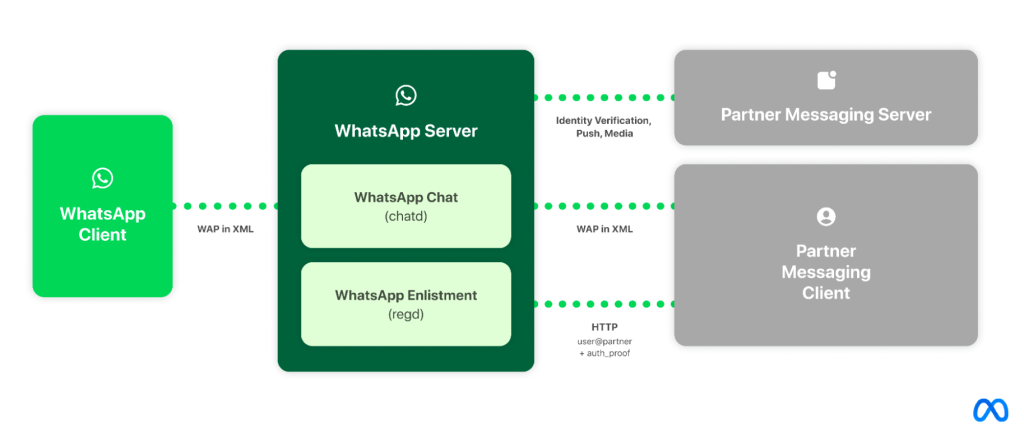
Concretely, third-party clients connect to WhatsApp's servers using an XMPP-based protocol. The WhatsApp server communicates with third-party servers over HTTP for authentication and push notifications.
WhatsApp exposes an Enlistment API that third-party clients must execute to opt into the network. A third-party user keeps their original user-visible identifier but is also assigned a unique WhatsApp-internal identifier for infrastructure-level operations. When connecting, the client must prove ownership of that identifier via a cryptographic signature on an authentication token—using the OpenID protocol (with minor modifications) and a JSON Web Token. The third-party's public keys are periodically fetched to verify the identifier.
All data between third-party client and WhatsApp server is protected via the Noise Protocol Framework. Each connection requires a Noise Handshake, part of which delivers the JWT to the server. Chat communication uses WhatsApp's optimized XML stanza protocol.
A Potential Proxy Option
Discussions with third-party providers have explored giving them the option to insert a proxy or intermediary between their client and WhatsApp's server. This could give providers more control over what their clients receive and remove the need to implement WhatsApp's client-to-server protocol—that is, preserve their existing chat channel on their devices.
But this arrangement would break Meta's direct connection to both clients, sacrificing connection-level signals essential for spam and scam detection, like TCP fingerprints. Compensating controls for this scheme would become part of the Reference Offer. Additionally, all chat metadata would pass through the proxy, increasing the chance of accidental or intentional data exposure.
User Communication and Shared Responsibility
Meta recognizes that this is the first time users will be part of an interoperable network on its services. Clear communication about how interop works is essential, especially since users need to understand that the security and privacy guarantees—and the feature set—will not exactly match chats between two WhatsApp or Messenger users.
Delivering a secure interoperable ecosystem ultimately cannot be achieved by Meta alone. It requires continued collaboration with third-party providers to maintain safety and privacy for all users across the network.



