Start with the people, not the platform
You secured the budget and picked the product. Now comes the harder part: getting your developers to actually use it. Rolling out a security tool is as much a cultural exercise as a technical one. Whether you are introducing a developer-first platform like GitHub Advanced Security or a more traditional tool aimed at security specialists, success depends on making engineers feel empowered, not policed.
Write everything down
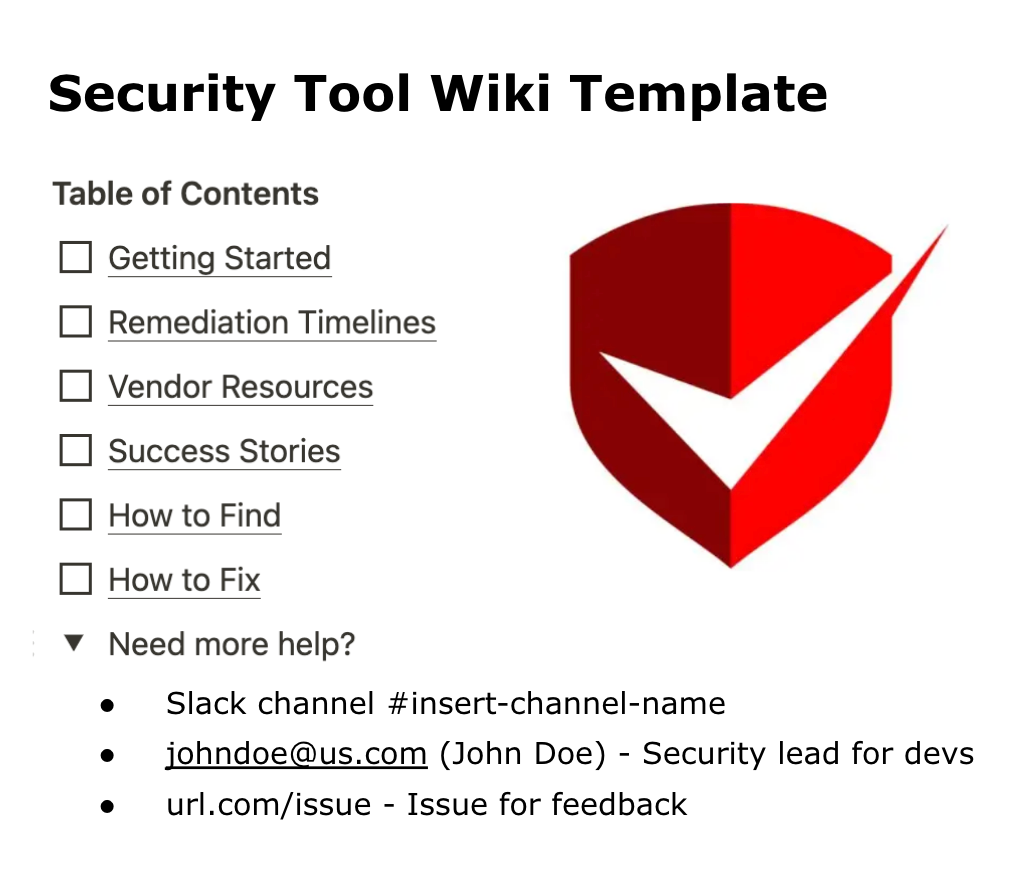
Good documentation is the first line of support. Build an internal wiki with FAQs and flow charts that walk developers past predictable blockers. Pull material from vendor docs and your own trial-and-error experiences. Put a single champion in charge of keeping it current, and be explicit about how developers escalate issues that documentation can't solve.
Define success before you communicate it
Management must set clear goals before socializing the tool internally. Decide what success looks like, how it will be measured, and why the initiative matters. Set realistic timelines and make sure expectations flow through the organization. Treat this as a cross-team initiative from day one, involving security, operations, and engineering leadership. When multiple teams with different priorities co-author shared objectives, the tool is more likely to become part of ongoing process instead of shelfware.
Amplify the winners
Celebrate teams that adopt the tool well or find creative uses for it, rather than shaming teams that lag behind. Early on, frame the tool as an opportunity to stand out, not another obligation stacked on a full backlog. Stick to the numbers when you make announcements; cite closed vulnerabilities or mean time to remediation for credibility. This approach can organically cultivate security champions among developers who show aptitude or career interest, while modeling correct behavior for the rest of the organization.
Meet developers where they already pause
Sustained cultural change comes from building security into an engineer's current workflow, never bolting it on as an extra pipeline stage. Look for spots where developers are already in an "edit" or "awaiting review" state, such as the pull request, and surface vulnerabilities there. This reduces context switching and annoyance. Treating security findings like functional bugs taps into skills developers already have while shortening feedback loops.

Bring in the C-suite
Executive sponsorship signals that security is a company-wide, business-critical priority. Ask leadership to raise security topics on their calls or open the monthly engineering meeting with a few words. Good sponsorship works in both directions: individual contributors see that the effort is serious and durable, while leadership stays informed of the risk reductions the tool is delivering.
Hackathon as a jumpstart
A one-day, gamified event can supplement long-term enablement efforts. Hold an internal bug bounty bash focused on tool education and clearing high-severity vulnerabilities. If you can marshal time from remote-learning days or spare moments in the sprint cycle, this format builds immediate familiarity and enthusiasm that carries over into day-to-day work.

Let developers teach developers
Peer enablement breaks down the common mistrust between engineering and security. Give individual contributors from a successful pilot or proactive early adopters the floor to demonstrate how the tool works in their own environment. This builds confidence in the presenters and shows the broader audience that the security workflow is compatible with their daily reality. Use peer-led sessions as standalone training or weave them into management-driven programs.
Security is increasingly a core part of the developer's job. Bringing engineers along as partners instead of subjects makes the difference between a tool that gets adopted and one that gets ignored.