Meta Hands Evenstar Radio Reference Design to OCP
Meta is transferring its Evenstar radio unit design and associated firmware to the Open Compute Project (OCP), marking the first open, white box radio unit solution for the telecom industry. The move is intended to accelerate adoption of open radio access network (RAN) technologies by giving ecosystem partners a common hardware base specification to build from.
Evenstar began as a Meta-led collaborative effort with industry partners to create a stable, interoperable supply chain for RAN infrastructure. After three years of development, Meta engineers have matured the design to a point where the wider telecom community can use it fully. Earlier this year, Meta contributed Open M-Plane, Evenstar’s software component for configuring and managing RANs, to the Linux Foundation as part of the LF Connectivity project.
“OCP is very pleased to be the home of the hardware specification along with firmware for [Evenstar], a completely open RAN radio unit,” said Bijan Nowroozi, CTO of the Open Compute Project Foundation. “It is an absolute milestone towards a truly open RAN…OCP strives to foster a community where anyone can contribute, anyone can improve, and anyone can innovate.”
Reference Design Highlights
The Evenstar hardware specification centers on a modular architecture for a disaggregated radio unit platform. Key elements include an advanced 4T4R MIMO transceiver capable of 40W per stream of RF power, with a design that reduces the number of SKUs needed for worldwide deployment, according to Nowroozi.
The radio unit architecture was designed with modularity as a core principle, allowing components such as power amplifiers, power supply units, and radio silicon from different suppliers to be mixed and matched. The modular assembly also provides flexibility for rebanding across different radio unit variants, and each power amplifier module (PAM) can be independently controlled for optimized power savings and improved efficiency.
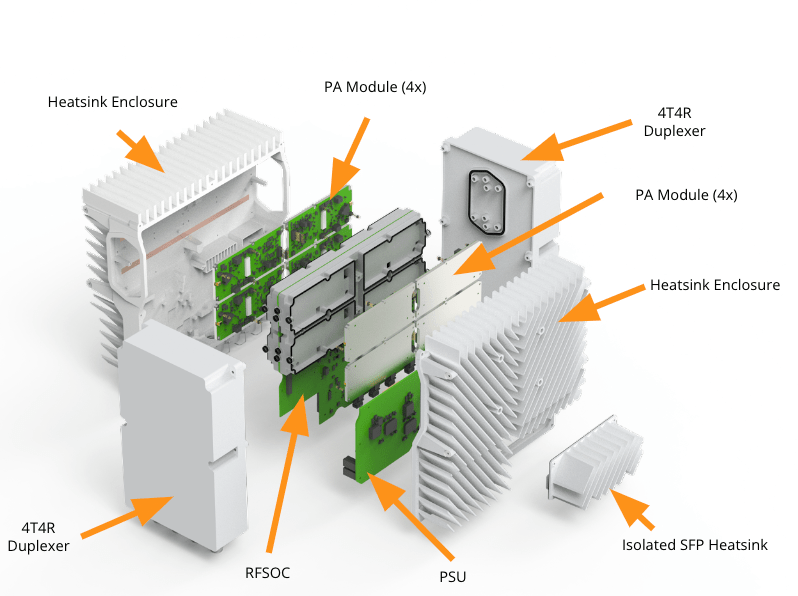
The design uses off-the-shelf discrete components, which is expected to lower the bill of materials (BOM) cost. The hardware addresses electrical and mechanical challenges linked to high-power, dual-band radio units in the open RAN ecosystem. The open-sourced firmware handles complex signal processing algorithms including digital pre-distortion (DPD) and crest factor reduction (CFR).
The reference design’s modules have been individually designed, manufactured, and lab-tested for viability. The following design files and test scripts are accessible via the OCP website:
- Power amplifier modules (PAMs)
- Power supply unit (PSU)
- Digital control module (board)
- Resonant cavity duplexer filter module
- Mechanical design
- DPD firmware
- CFR firmware
- Test automation scripts (including Massive MIMO)
Commercialization Path
Manufacturing partner Jabil has been a key player in the Evenstar program, leading development and production of modular, standards-based radio units based on operator requirements. Jabil brings more than two decades of experience producing 5G radios for the telecommunications industry.
Vodafone, another significant contributor to Evenstar and open RAN efforts, provided requirements and supported the radio unit development program with Jabil. The operator has announced plans to deploy at least 2,500 open RAN sites in rural areas across the UK by 2027 and is now finalizing plans to take the first Evenstar units into the lab for testing and validation before field trials. Vodafone already has open RAN sites live in the South West of England.
“This major contribution from Meta will provide the open RAN ecosystem with the right level of stimulus and encouragement to scale the radio unit portfolio in the industry,” said Yago Tenorio, Vodafone fellow and director of network architecture, and TIP Chairman. “We look forward to how this contribution will enable some of the best radio solutions out there for upcoming open RAN deployments.”
The OCP community will evolve Evenstar based on broader ecosystem requirements, with the goal of developing a multi-vendor supply chain. The TIP Open RAN community will use the Evenstar reference designs to drive productization, validation, and commercialization of new hardware variants. Meta expects accelerated field trials and scaled deployments for open RAN in 2023, with the reference design providing a time-to-market advantage for radio unit supply partners developing products that improve cost, size, and power efficiency of RAN components.