One cable, 23 countries: inside the 2Africa build
Facebook has joined forces with leading African and global operators on 2Africa, a subsea cable system designed to become the most extensive connectivity route serving Africa and the Middle East. With roughly 3.5 billion people worldwide still offline and Africa the least connected continent — just over a quarter of its 1.3 billion people have internet access — the project targets a pressing infrastructure gap.
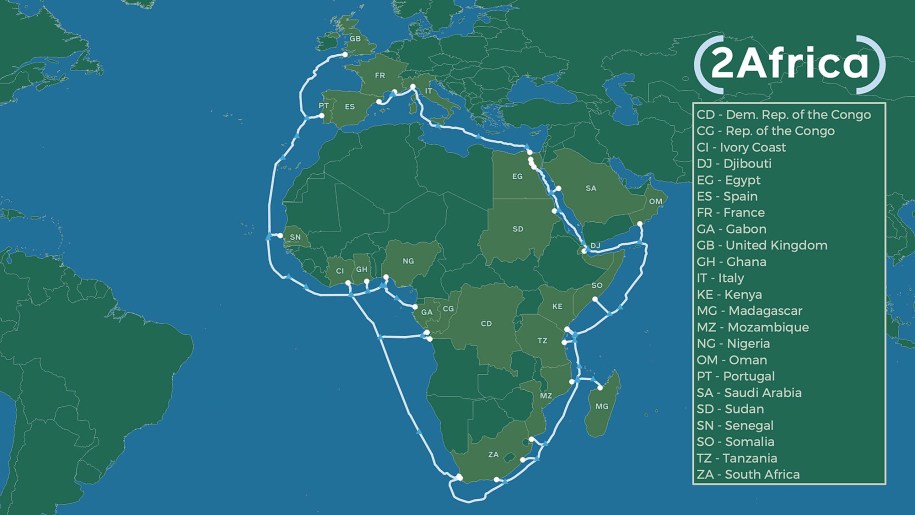
At 37,000 kilometers, 2Africa will approach the circumference of the Earth, interconnecting 23 countries across Africa, the Middle East, and Europe. More significant than its reach is its capacity: the system will deliver nearly three times the total network capacity of all subsea cables currently serving Africa. That added headroom is meant to satisfy a rapidly growing demand for capacity in the Middle East, provide redundancy and reliability across Africa, and support the rollout of 4G, 5G, and broadband for hundreds of millions of users.
Fuelling digital economies
The cable is being built around an open-access model. In every country where it lands, service providers will be able to obtain capacity at carrier-neutral data centers and open-access cable landing stations on fair and equitable terms. 2Africa is also the first subsea system to connect East and West Africa seamlessly through a single open system, opening up coast-to-coast communication routes that previously required separate infrastructure. In addition, the project introduces a new Red Sea–Mediterranean crossing, the first in that region in over a decade.
This investment follows earlier Facebook-led infrastructure efforts across the African continent, including projects in South Africa, Uganda, Nigeria, and the Democratic Republic of the Congo, and dovetails with a partnership with the Internet Society to build internet exchange points and provide technical training and equipment. The company points to the ongoing COVID-19 pandemic as a stark reminder of how many now depend on working connectivity for jobs, schooling, and personal communication, making the timing of 2Africa relevant to post-pandemic economic recovery.
New cable tech, deeper protection
Several technical choices distinguish the project. 2Africa is the first system of its scale to use an aluminum conductor for submarine cables, a material innovation that improves resource efficiency. On the fiber side, the system adopts Spatial Division Multiplexing (SDM1), which doubles the maximum fiber pair count supported by older technology. With up to 16 fiber pairs, 2Africa far exceeds conventional cable capacity. It will also mark the first use of Wavelength Selective Switching (WSS)-ROADM technology in Africa, giving operators more flexible control over capacity allocation.
Resiliency was a core design criterion. The cable is laid with a 50 percent increase in burial depth, reaching up to three meters, to reduce exposure to damage from fishing and anchoring activity. Route planning also used advanced survey techniques to steer clear of known areas of subsea disturbance.
2Africa continues a broader pattern of partnership-driven infrastructure projects from Facebook, which has collaborated with operators worldwide on subsea routes notable for their reach, capacity, and flexibility. The model, the company says, spreads the cost of large-scale infrastructure while sharing the specialized engineering expertise required to build it.