
The Case for Cloud Gaming
Cloud gaming's core appeal is accessibility: it lets people play games on whatever device they have, wherever they are, without buying new hardware or waiting through large downloads. Putting games in the cloud also enables seamless cross-play between desktop and mobile, simplifies distribution, and gives developers a single target instead of multiple hardware platforms to optimize for. Security teams benefit too, since centralized hosting reduces concerns about cheating and piracy.
Delivering that experience is a hard infrastructure problem. Games require low end-to-end latency and steady video/audio streams with minimal jitter. Servers must run multiple game instances cost-effectively. And the whole system has to stay secure and robust under attack.
Bringing Compute Closer to Players
Meta's approach starts with geography. Rather than relying only on its data centers, it deploys cloud gaming infrastructure at edge sites in metropolitan areas close to large player populations. That network distance matters more than almost any other optimization for keeping latency low.
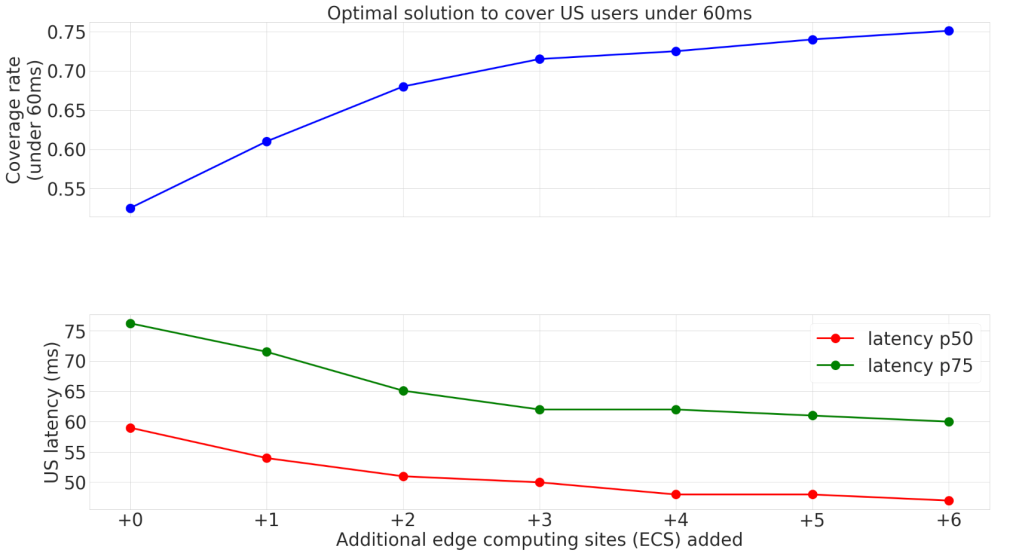
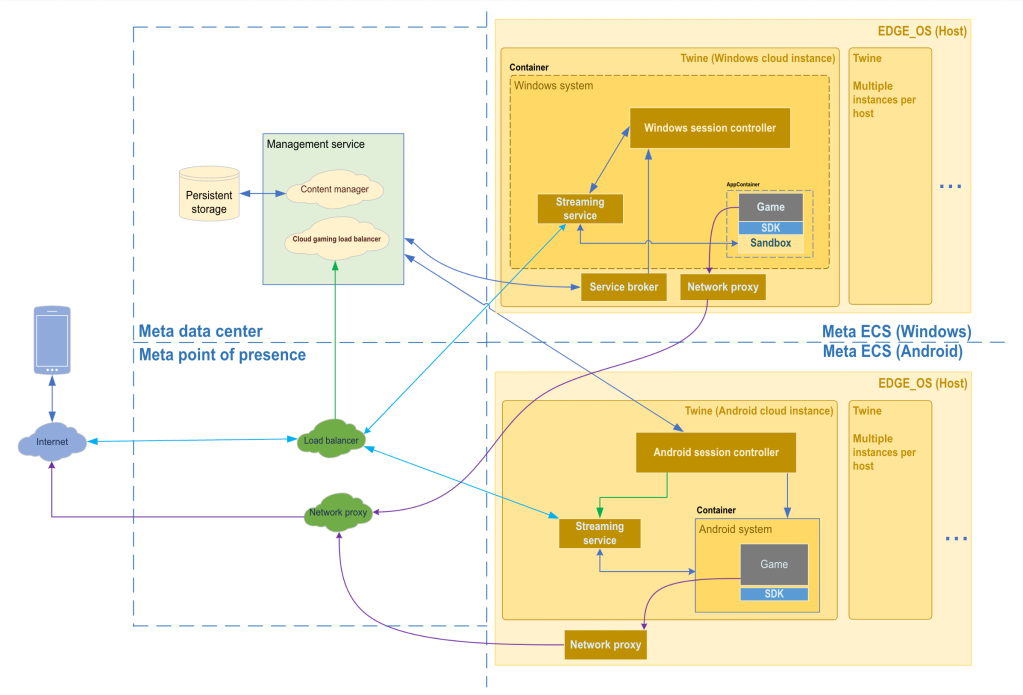
Each edge site runs a unified hosting environment built on NVIDIA Ampere architecture GPUs. Meta partnered with NVIDIA to create this environment, since today's games are designed for GPUs and need the fidelity and low latency that GPUs provide for loading, running, and streaming. Cluster management relies on Twine, Meta's orchestration system, running on top of its edge computing OS. Orchestration services manage the streaming signals while Twine coordinates game servers across the edge.
The hosting layer uses container technologies for both Windows and Android games. Windows and Android have separate hosting solutions — the Windows one integrates PlayGiga — but a consolidated orchestration system manages both. That gives Meta more flexibility in how it delivers games and manages capacity across platforms.
Streaming Video and Audio
The streaming pipeline is where latency can creep in, step by step. Meta settled on WebRTC with Secure Real-Time Transport Protocol (SRTP) for transmitting user inputs and media frames, based on the technology's maturity and compatibility.
The initial flow worked like this: a player's click was captured and sent to the server, where the game processed it and rendered a frame. The frame was then copied out of the GPU, encoded, packetized into UDP packets, and sent over the network. On the player's side, a jitter buffer smoothed incoming packets before decoding and rendering. Each step is tiny, but they add up.
The current model cuts that overhead with GPU encoding. A rendered frame now stays in GPU memory until it's encoded; it never crosses the PCI bus to the main server as a raw frame. The encoded frame is also smaller, so the whole pipeline using the GPU's memory is more efficient.
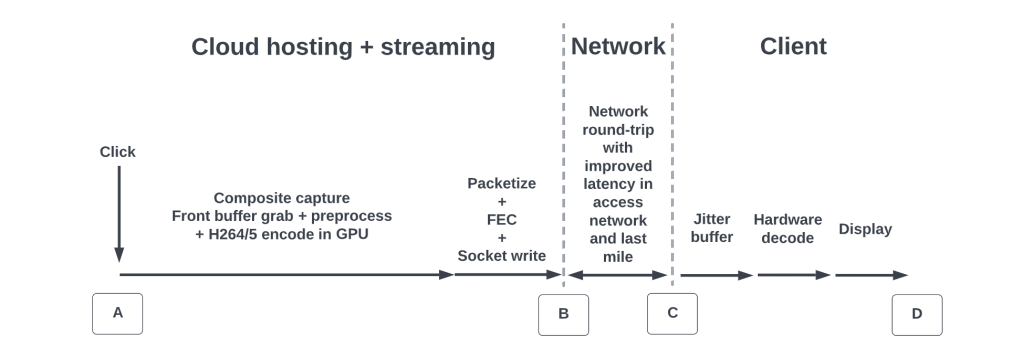
Network proximity still provides the biggest latency win. On the player side, hardware decoding reduces decode time, and Meta syncs video ahead of audio slightly. It also exploits the display's refresh cycle: frames appear at fixed intervals (30fps or 60fps), and the imperceptible gaps can absorb jitter and smooth playback. Devices that support higher frame rates can push latency lower still.
Security by Design
A system built on Windows, Android, edge computing, GPU virtualization, and real-time streaming inherits the security challenges of each of those pieces, plus exposure to DDoS attacks. Meta assesses security at every stage — design, implementation, testing — using threat modeling, code reviews, fuzz testing, and security testing. The cloud gaming infrastructure is fully isolated from Meta's core data infrastructure so it can't be an entry point into other systems. An internal team, working with external firms, runs regular security assessments.
The Road to the Metaverse
Metaverse experiences will demand even more from networks than today's AAA games: ultra-low latency, high scalability, high throughput, and federated data storage. That likely requires a step-change in network architecture — reliable, QoS-aware peer-to-peer links for people in the same proximity, a unified topology that bounds latency and packet loss globally, and a QoS management strategy spanning every network segment and protocol layer. Engineers may need to redistribute compute and routing resources across end-to-end networks. Meta is working with mobile operators, chipset makers, and other partners on these problems now.
Near-Term Plans
Over the next two to three years, Meta expects to expand internationally, work with carriers to improve access network latency, and collaborate with chipset makers to reduce latency in user devices. Container technology improvements target streaming efficiency, security work continues as the system scales, and the development toolchain is getting better support for testing, debugging, experimentation, and analytics. The goal remains unchanged: letting people play together whenever and wherever they want, with experiences that keep improving.


