A 130 MB app, reconsidered
Messenger's first standalone release arrived in 2011, at a time when the goal was to pack every possible capability into the product. That approach worked — payments, camera effects, Stories, GIFs, and video chat all found a home in the app — but the underlying architecture grew to support it. By the time the engineering team took a hard look at the result, the .app binary exceeded 130 MB and the core codebase had swelled to more than 1.7 million lines of code. The size took a toll on cold-start performance, especially on older hardware, and the nine-tab navigation surface made the app harder to use.
The interface got a simplification pass with Messenger 4 in 2018, but the underlying problems remained. So the team decided to ask a different question: how would a messaging app be built if it were designed from scratch in 2019? The answer was Project LightSpeed — a ground-up rewrite of both the client core and the server framework. The result, now rolling out globally on iOS, starts the app twice as fast at cold launch and takes up one-fourth the storage of the previous version. The core Messenger code shrank by 84 percent, from 1.7 million lines to roughly 360,000.
Why a full rewrite made sense
Messenger operations usually don't start with a complete codebase replacement. The engineering cost is enormous, and the typical payoff doesn't justify the disruption. But in this case, early prototypes showed that the gains could be substantial — enough to justify bringing in over 100 engineers to complete what a small team initially started.
A necessary constraint shaped the rewrite: keeping the most-used features intact, including group video calling. That ruled out the easy path of simply stripping the app down to a few functions. Instead, the team rebuilt Messenger's features to fit a simplified, unified architecture. The leaner codebase is not just a matter of storage and startup math; a smaller, more focused core also shortens test cycles and makes future modifications faster to implement.
The technical foundations
Four architectural decisions drove the size and speed improvements:
- Native OS services first. Messenger now leans on the operating system's built-in capabilities wherever they suffice, reducing the volume of custom code the app needs to carry.
- Template-driven UI backed by SQLite. Rather than defining screens as bespoke view hierarchies, LightSpeed reuses a small set of dynamic UI templates that are instantiated based on data.
- SQLite as a universal tool. SQLite handles data persistence not just for messages but as a general-purpose layer across the client's data needs.
- A server broker as a universal gateway. Messenger’s client-side code now speaks to a single server-side broker, which routes requests to the appropriate backend features instead of requiring the client to manage multiple integration points.
The result is a codebase that the team describes as sustainable for another decade. It is also positioned for the company’s push toward private messaging standards and interoperability: fewer lines of client code and a unified gateway mean future features have a single, simpler point of integration.
Reframing a messaging app's footprint
The reset hinged on a simple premise about what a messaging app is for. Messages are short text payloads that transmit in milliseconds. Unlike a video streamer or a game, a messaging app is not an immersive session that justifies a hefty storage footprint — it's a utility that should sit among the lightest apps on a phone. A download that is smaller in bytes installs, updates, and launches faster, regardless of the user's device model or network quality, and it takes up less space on low-capacity phones.
The rewrite was not an attempt to delete feature history. It was an attempt to find a version of those features that could run on a much smaller foundation. With the core now at 360,000 lines, the engineering team plans to reintroduce additional functionality at a steady pace — on a codebase that makes each addition cheaper than it was before.
Note: Startup time figures reflect internal tests performed against production data.
Four Principles for a Unified Codebase
To keep the rebuilt Messenger from becoming as tangled as its predecessor, the team adopted a unified architecture built on four principles: lean on the OS, reuse UI structures, centralize data in SQLite, and offload logic to the server where possible. The goal was to stop each feature from optimizing locally at the expense of the whole app.
Lean on the OS
Mobile operating systems add features quickly, driven by user demand and competition. It is tempting to wrap the OS in custom abstractions to fill capability gaps, add flexibility, or force a uniform cross-platform experience. But the native OS already handles rendering, transcoding, threading, and logging well. Even when a custom solution wins on local performance, using the OS keeps global metrics healthier.
The team applied this same thinking to UI frameworks. Frameworks can boost developer productivity, but they also require constant maintenance as the underlying OS changes. Instead of bundling large custom-built frameworks, Messenger uses each platform's native UI framework. That cuts binary size by avoiding cached or loaded framework code, and it removes the translation layer between sub-frameworks. The project also adopted OS libraries where practical — including the system JSON parser — rather than maintaining its own.
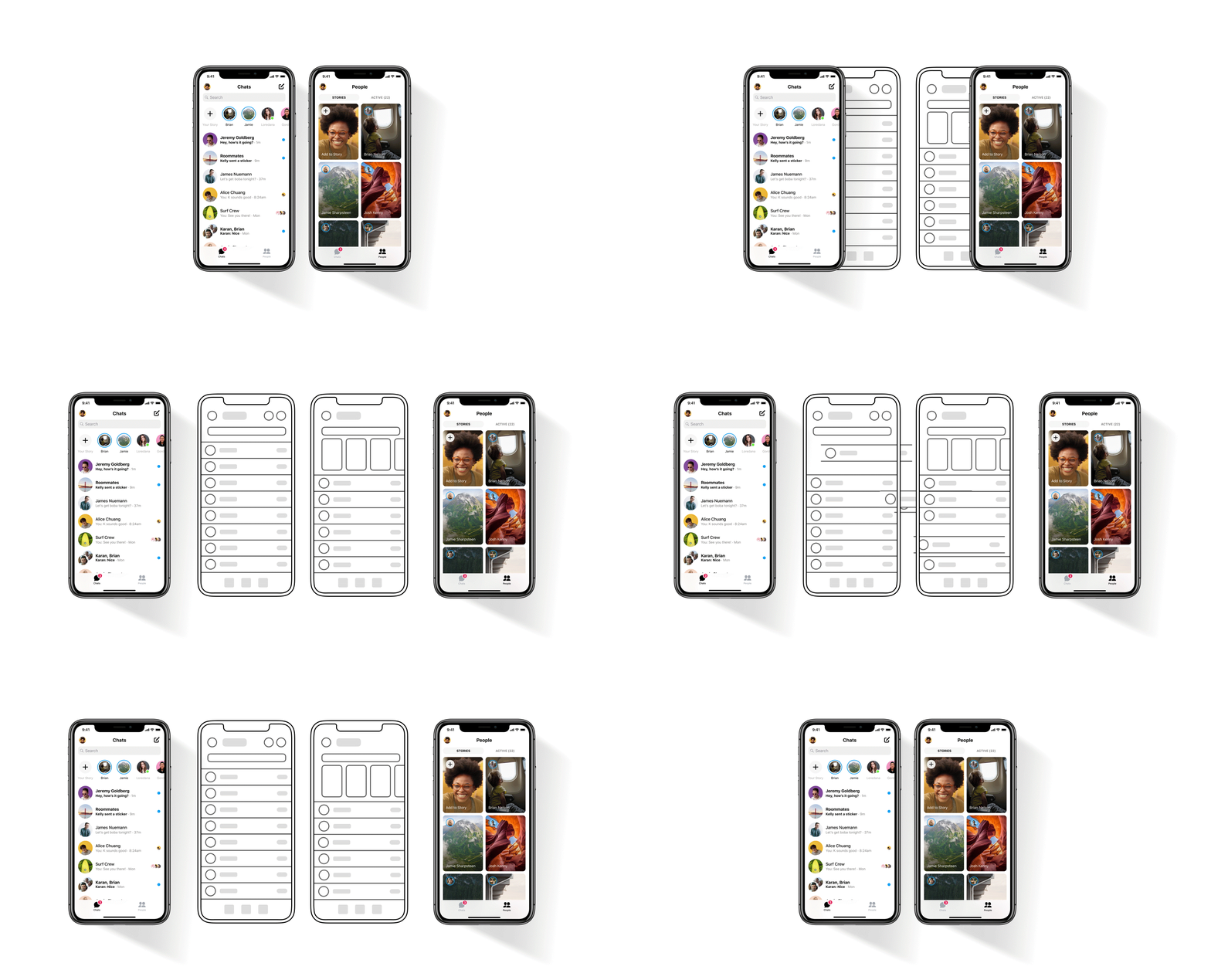
If the OS handled something well, it got used — without waiting for a framework to expose the right API. If it didn't, the team wrote or found the smallest possible library to fill only that gap. Platform-specific UI and tooling were embraced rather than papered over. The one notable exception is a native C extension that handles cross-platform logic anything OS-like that is globally suboptimal or not covered by the OS. All of Facebook's networking logic, for instance, runs in that C extension.
Reuse the UI
The old Messenger shipped multiple implementations of the same UI. At the start of the project there were more than 40 contact list screens, each with slight design deviations. Supporting landscape mode, dark mode, and accessibility across those variants doubled the maintenance burden. Views made up a large share of the app's size, so reducing that surface mattered.
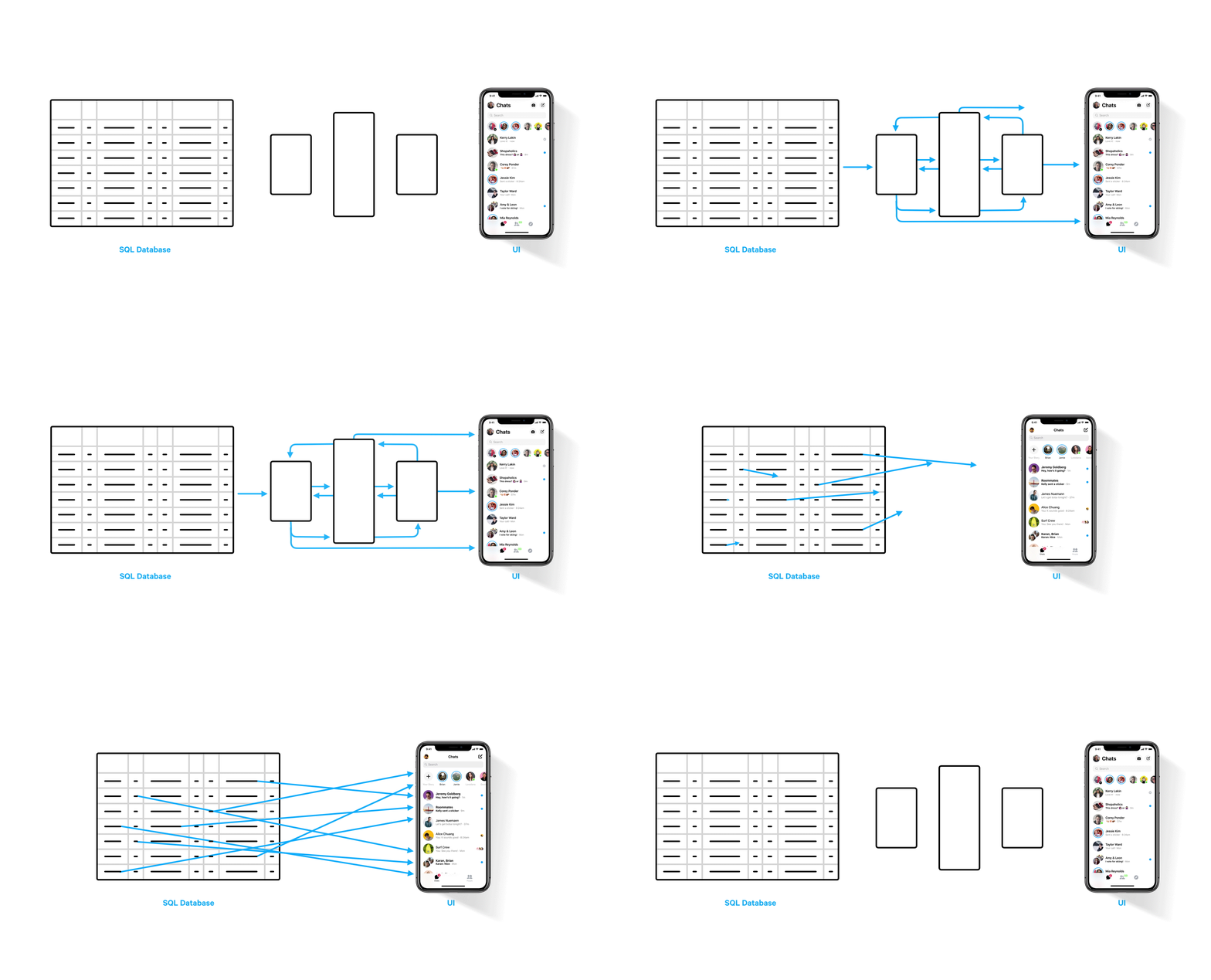
The fix was to constrain design so the same structures drive different views. Messenger now needs only a few categories of basic views, each backed by distinct SQLite tables and driven by the data. The contact list is a single dynamic template — one view controller on iOS — that changes appearance based on the database contents. A single screen now supports contact management, group creation, search, privacy settings, and sharing. Storing layout logic in the database instead of in app code let the team delete a substantial amount of code.
SQLite as the Engine
Most mobile apps store data in SQLite, but as features grow, each tends to design its own storage access and caching scheme. Messenger discarded that organic mess. Borrowing an idea from desktop development, the team treats SQLite as a universal system serving the whole app.
Coordinating data sharing between features had previously meant custom in-memory caches and hand-rolled transaction subsystems. That logic pushed work back and forth between the database and the UI, slowing everything down. The new approach lets SQLite handle concurrency, caching, and transactions directly. Requests to update active friends, refresh profile pictures, or fetch new messages are now self-contained queries. The UI simply reflects what's in the tables — there is no separate coordination layer.
The design goes beyond a shared database file. All features use one integrated schema. The team extended SQLite to support stored procedures so feature developers can write portable, database-oriented business logic. A platform called MSYS orchestrates every database interaction — queued changes, deferred or retriable tasks, and data sync support. MSYS is a cross-platform C library that centralizes all core operations: one way to send messages, one way to send media, one way to log.
A single access point also enables global, rather than feature-local, prioritization. Loading the message list can outrank a low-priority read receipt update from an old thread, and the queue adjusts accordingly. Centralizing all this logic made quality work easier. Automated tests for MSYS achieved a 100 percent line coverage rate — an unusual milestone in the industry — making the core data layer exceptionally reliable.
Push Logic to the Server
Anything that fits none of those three principles gets pushed to the server. This required new infrastructure: a server version of the coordination layer that MSYS plays on the client.
The old Messenger app ran like a traditional app. Each feature defined its own wire protocol; the client implemented it and synchronized its database tables accordingly. During a single received message, the client might need to update message tables, refresh the thread snippet, fix last-modified timestamps, cancel optimistic inserts from notifications, handle decryption, and manage any pending tasks — with similar complexity across every feature. Over time, those interactions produced inconsistent runtime behavior and duplicated problem-solving.
The rebuilt client-server interaction is uniform. A universal sync system lets the server define business logic and sync behavior, and the server broker acts as a single gateway between app features and all back-end services. Clients no longer coordinate directly with feature-specific server endpoints, which removes much of the old platform-specific logic.
Keeping the Codebase from Growing Back
By the end, the Messenger codebase had dropped from more than 1.7 million lines to 360,000, and the binary shrank to one-quarter of its original size. But the team knew the job wasn't done unless the codebase stayed that way.
Before the new version hit production, the team set size budgets per feature and made architectural compliance part of acceptance criteria. A tracking system measures the binary weight each feature introduces. Engineers are accountable for staying within budget, and quality targets — binary size included — weigh as heavily as shipping on time. Starting a thread prefix appears before the article text below.


