
Why Meta built its own codec
Real-time communication at Meta's scale spans WhatsApp, Instagram, and Messenger, serving billions of callers on highly variable networks and devices. The audio codec is a core building block of that experience: raw mono audio at 48 kHz sampling and 16-bit depth runs about 768 kbps, and modern codecs compress that down to roughly 25-30 kbps while trying to preserve quality.
Meta has long relied on Opus, the open-source codec released in 2012 that became the internet's default for RTC. But observing real-world conditions across billions of calls revealed a gap: many calls hit poor network conditions for part of their duration. When bandwidth estimation detects degradation and the call also carries video, audio bitrate gets squeezed even further. Opus bottoms out at 6 kbps in NarrowBand mode, which only covers the 0-4 kHz range and fails to capture the full human voice spectrum, producing audio that sounds muffled and artificial.
Newer machine learning-based codecs, including Meta's own Encodec from October 2022, deliver impressive quality at low bitrates but demand heavy computational resources. That leaves lower-end devices out, and they remain a significant share of Meta's traffic: over 20 percent of calls run on ARMv7 devices, and tens of millions of daily WhatsApp calls come from phones more than a decade old. The conclusion was that only a new codec with very low compute requirements could raise quality at the lowest bitrates for the full range of devices.
MLow: quality at a fraction of the bitrate
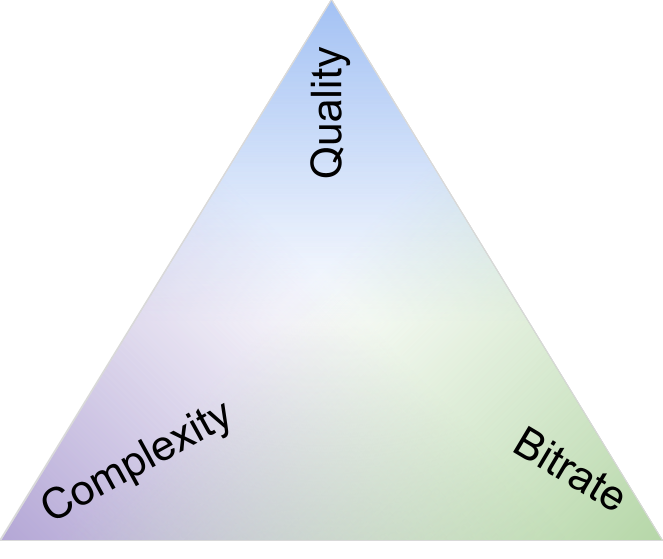
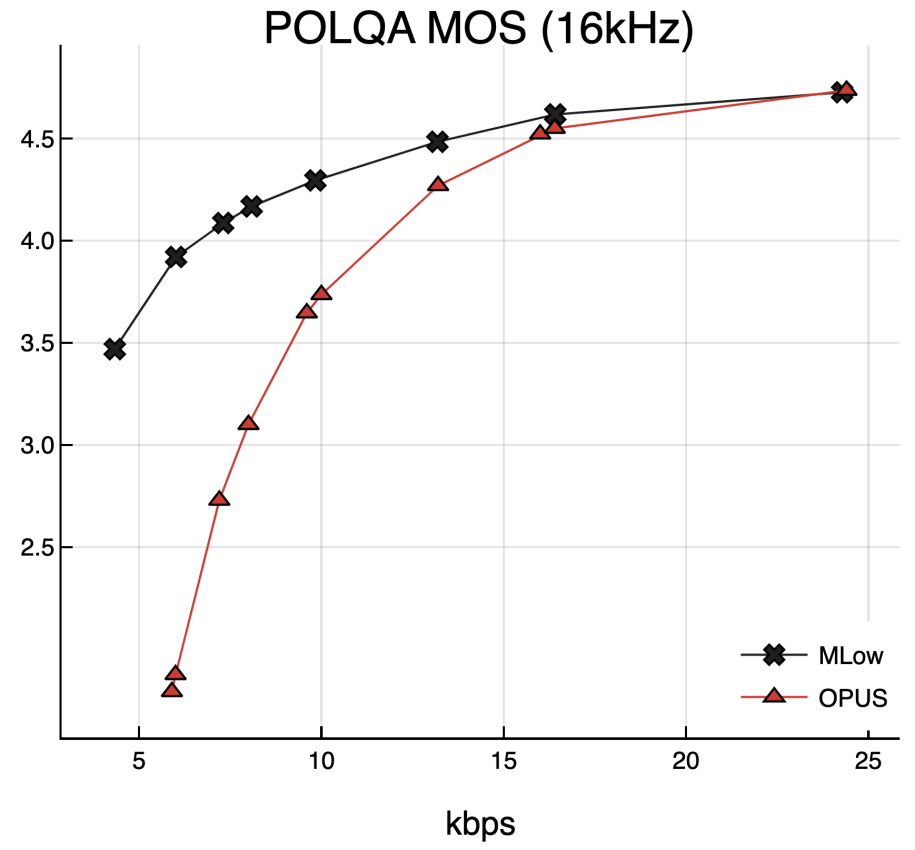
Development of the Meta Low Bitrate codec, MLow, began in late 2021. After nearly two years of work, the codec delivers two-times-better quality than Opus, measured by POLQA MOS: 1.89 for Opus versus 3.9 for MLow at 6 kbps WideBand. That quality improvement comes with computational complexity about 10 percent lower than Opus, keeping it viable on the oldest hardware.
At higher bitrates, MLow saturates quality faster than Opus, giving it the biggest advantage exactly where the Opus curve is weakest.
MLow is fully deployed on Instagram and Messenger calls and is rolling out across WhatsApp. The audio samples below give a sense of the difference.
| Opus 6 kbps NB | MLow 6 kbps WB | Reference |
Better redundancy under packet loss
The codec's efficiency also unlocks stronger forward error correction. Because MLow needs less bitrate for the primary audio, there is room to pack FEC data at much lower operating points than Opus. Opus requires a minimum of 19 kbps for any inband FEC at 10 percent packet loss, leaving it unprotected at lower bitrates. The samples below compare the two codecs at 14 kbps with 30 percent receiver-side packet loss.
How MLow works
MLow is built on classic CELP (Code Excited Linear Prediction) principles with improvements in excitation generation, parameter quantization, and coding schemes. The encoder splits the incoming PCM signal into separate low- and high-frequency bands, encoding each independently while sharing information between them to achieve better compression. The combined output then passes through a range encoder to produce the final payload; the decoder reverses the process.
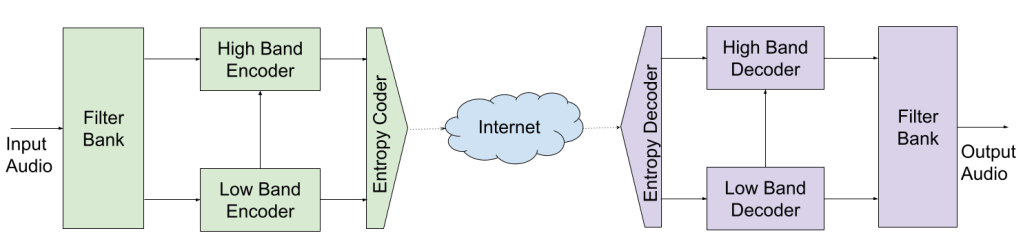
The split-band approach pays off in the high band, which can be encoded with very few bits while still delivering SuperWideBand audio at 32 kHz sampling for a fraction of the usual bitrate.
Next steps
Meta continues to refine audio recovery under heavy packet loss by leveraging MLow's efficiency to send more redundant audio. The company expects to share more as it works to maintain call quality across its global user base.


