
Why SEO Feels Opaque—and How Next.js Removes the Guesswork
Search engine optimization is often treated as a black box. You implement changes, wait, and hope. But the technical core of SEO is actually predictable and measurable—once you strip away the mystery, it becomes a repeatable engineering discipline rather than a matter of luck.
Next.js running on Vercel gives you a foundation where the most important SEO mechanisms are explicit and controllable. This means you can focus on implementing best practices with confidence, knowing that each change has a direct, observable effect on how search engines crawl and index your application.
Start With the Basics: Metadata and Semantic Structure
Before worrying about advanced techniques, ensure your pages communicate their purpose clearly. Search engines rely heavily on structured signals to understand your content.
- Metadata: Every page needs a unique, descriptive
<title>andmeta description. These are your first impression in search results and directly influence click-through rates. - Semantic HTML: Use heading tags (
<h1>through<h6>) to establish a logical content hierarchy. Search engines parse these to determine the main topics of a page. Overusing or skipping heading levels confuses that parse. - Canonical URLs: Prevent duplicate content issues by defining a canonical URL for each page. This signals to search engines which version of a page is the authoritative one to index when similar content exists at multiple paths.
Leveraging Next.js for SEO-Critical Performance
Search engines consistently rank faster, more responsive sites higher. Next.js provides several performance features out of the box, but you must opt into them correctly to see SEO benefits.
Server-Side Rendering vs. Static Generation
Your choice of rendering strategy determines how quickly search engine bots receive your content. Choose per page based on how often the data changes:
- Static Generation (SSG) is optimal for pages that don't change frequently. Content is rendered once at build time, served as a static file, and is instantly available to crawlers.
- Server-Side Rendering (SSR) is necessary for pages that must reflect real-time data per request. The tradeoff is higher latency and more compute, so reserve SSR for genuinely dynamic content.
Next.js also supports Incremental Static Regeneration (ISR), which allows you to update static pages after deployment without rebuilding the entire site—a good middle ground for pages that change occasionally but need static performance.
Optimizing Client-Side Navigation and Core Web Vitals
Once a search engine’s crawler visits your site, it evaluates the experience using metrics like Largest Contentful Paint (LCP) and Cumulative Layout Shift (CLS). Optimizing these is a direct investment in your ranking.
Next.js automatically code-splits your routes. This means each page only loads the JavaScript it needs, dramatically reducing initial load time. To leverage this, always use the Link component from next/link for internal navigation. It enables prefetching and client-side transitions, which feels snappy to users and reduces the amount of work the crawler sees when it follows connections between your pages.
For images, the built-in next/image component is a significant SEO ally. It handles responsive sizing, lazy loading, and automatic format conversion—eliminating the most common causes of CLS. Use it instead of raw <img> tags for every image on your site.
Structured Data and Sitemaps: Speaking the Crawler’s Language
Beyond HTML content, you can add machine-readable signals that help search engines present your pages in richer formats. This is where technical SEO becomes very concrete.
JSON-LD Structured Data
Embed application/ld+json script tags in your pages to describe entities like articles, products, or FAQs. This data may enable rich results (star ratings, breadcrumbs, event listings) in search engine results pages. While it doesn't directly change a keyword ranking, it increases the visibility and footprint of your listing.
XML Sitemaps
A well-formed sitemap.xml is a roadmap for crawlers. It lists all your canonical URLs and indicates their priority and last-modified dates. Next.js provides dynamic API routes (app/sitemap.ts) to generate this file programmatically, ensuring it always reflects your current site structure without manual updates after each deployment.
Monitoring and Verifying Your SEO Health
Optimization is ongoing. You need visibility into how bots see your site once it is live. Tools like Google Search Console are essential to verify your sitemap and monitor for indexing errors or manual penalties. Pair this with auditing using a tool like Lighthouse, running it across your key templates rather than just the homepage—that’s where your different content types sit, and where SEO problems often hide.
Finally, review your redirects and trailing-slash conventions. Unless you handle them explicitly, you risk splitting your page authority across two URLs for the same content, weakening your ranking signals.
SEO with Next.js is not about magic—it's about systematically plumbing the architecture to hand the crawler precisely what it needs, as fast as possible. By managing metadata, choosing the right rendering mode, and feeding clean structured data, you build a foundation where growth is both achievable and repeatable.
How Next.js turns SEO best practices into defaults
Next.js treats SEO as a first-class concern, shipping with tooling that makes it easier to implement patterns that search engines reward. Analytics are built directly into the framework, and pairing it with Vercel’s Edge Network yields automated, per-deployment performance data.
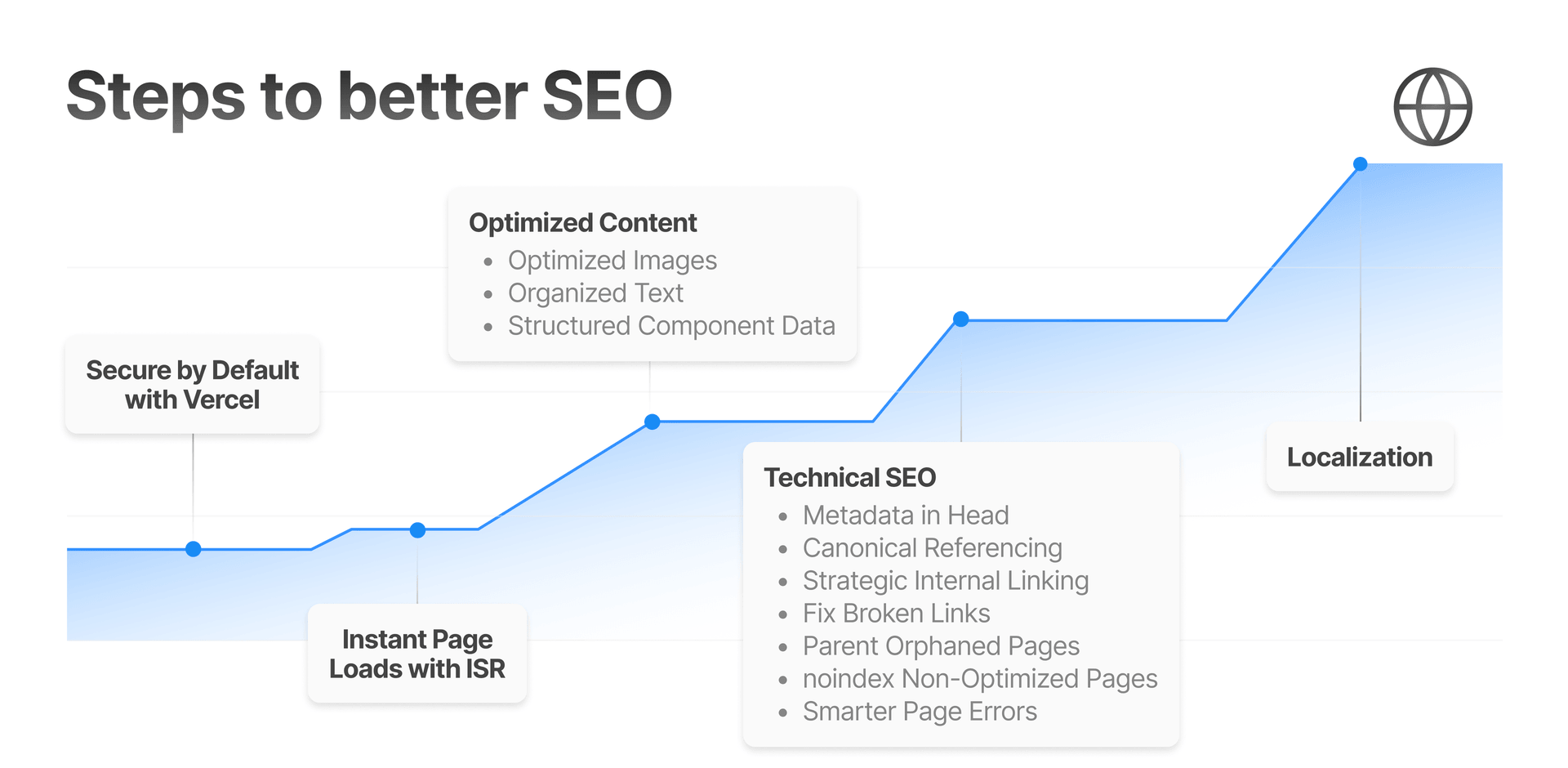

SEO is an incremental process: each step lets you rank higher while improving the user experience at the same time.
Why rendering strategy drives crawlability
Search engines don’t browse pages the way people do. They crawl source code in the order it’s written and queue the links they find for indexing. Client-side JavaScript, by contrast, goes into a render queue, which takes longer and more compute to index.
Prerendering—either statically or on the server—is therefore the SEO-friendly default, because it encourages crawlers to reindex your site more often. But both prerendering approaches have known trade-offs. Static Site Generation (SSG) can balloon build times, and Server-side Rendering (SSR) without caching can slow initial page loads while blocking on data fetches.
Next.js positions Incremental Static Regeneration (ISR) as the middle path: it prerenders all pages like SSG does, but lets you refresh individual pages on demand without redeploying. You get dynamic content with the speed and indexability of static pages. The Next.js 13 App Router deep dive covers more on rendering dynamically fetched data.
Speed is a ranking factor everywhere
ISR’s benefit isn’t only crawlability. Faster pages serve users better, and in SEO, speed compounds:
- User experience: faster sites hold attention longer and convert better; shaving milliseconds can translate into serious revenue.
- Search ranking: Google treats site speed as a strong ranking signal, so a faster site with equal relevance outranks a slower competitor.
- Mobile: most discovery happens on mobile, and Google crawls with a mobile browser by default, so mobile speed affects rankings on both device classes.
Beyond ISR, Next.js provides specific levers for performance:
- Image optimization: the
next/imagecomponent formats images for the requesting device with minimal extra JavaScript, attacking what is often a site’s biggest speed bottleneck. - Code splitting with dynamic imports: defer scripts—including third-party ones—down to the component level so users only download code that runs.
- Font optimization: built-in Automatic Webfont Optimization removes extraneous fetches so custom fonts render on schedule.
- One codebase for all devices: no separate Accelerated Mobile Pages (AMP) needed; responsive Next.js runs fast across desktop and mobile.
Each speed improvement is an SEO win, and Vercel Analytics lets you track results in real time.
Content structure and structured data
Headings, subheadings, lists and tables do more than break up text for human readers; crawlers use the same structural cues to derive page context. A deliberate content hierarchy helps you rank for specific topics.
Structured data, following Schema.org recommendations for events, businesses, products, places and reviews, lets Google display your content natively in search results—setting you apart from competitors and giving users a direct path to relevant content. Google’s SEO documentation is the authoritative reference for content architecture, and the Structured Data Markup Helper generates usable HTML from your content requirements.
Engineering navigation and metadata for crawlers
Content quality goes only so far. Next.js lets you encode a site architecture that echoes your content priorities and improves user flow at the same time.
Dynamic metadata. The HTML head is a prime SEO surface: titles, descriptions, meta tags, logos, open graph images and structured data all shape how search engines present your page. Managing that per page gets messy, so Next.js offers a dynamic next/head that splits head logic across as many components as needed. The built-in key attribute prevents duplicate properties from conflicting. With the App Router, metadata can be generated at the component level and exported based on the structure of your application.
Smarter navigation. Crawlers map your site by following links, with priority inferred from how often pages reference each other. Your homepage is likely back-linked from every page, making it highest priority; landing pages linked from all subpages come next. Links from external sites matter too. To make this architecture concrete:
- App Router: the
appdirectory mirrors the final site structure, making page hierarchy explicit in your code and reinforcing it for SEO. - Layouts: nested layouts template both the site and sections of it, so nav bars, footers and backlinks live in one place.
- Dynamic routing: Dynamic Segments programmatically name and template all subpages under a directory, which keeps URLs sensible and indexable as CMS content grows.
- The
Linkcomponent: prefetches pages in the background to speed navigation and centralizes dynamic route linking. TheuseRouter()hook handles programmatic route changes.
Consistent linking also exposes near-duplicate content or inconsistent navigation. Where similar pages must coexist, designate a preferred version and signal it to Google via canonical linking.
Fix dead ends. Broken links and orphaned pages frustrate users and confuse crawlers. A well-organized codebase helps, and Google’s Page Indexing report reveals pages the crawler struggles to locate.
Handle errors deliberately. Next.js provides customizable default error pages. Route missing pages to a 404 instead of looping users back home; be direct about the error; link to your strongest content from the 404 page; and keep it simple. For pages under construction or private content you don’t want indexed, use the noindex attribute to block search indexing.
Going global with regional ranking
Internationalization (i18n) and localization let your site climb rankings across regions. i18n is technical: preparing the codebase for multiple languages and serving the correct version to each user and crawler. Modern CSS must handle any text directionality, and Next.js builds on that with automatic locale detection, locale transitions and the proper lang attribute on the <html> tag.
Next.js can’t know about language variants of a page, though, so add hreflang meta tags yourself via next/head; Google’s documentation covers the exact syntax. Localization, the cultural and linguistic adaptation of content, is often handled by browser auto-translation once i18n is solid—but for targeting a specific market, human adaptation remains necessary. Machines can’t fully master a region’s linguistic, political, cultural and legal nuances.
Measuring SEO impact with Vercel Analytics
Tracking the results of your SEO work is essential. Next.js Analytics gives you page-level performance data based on Lighthouse and Core Web Vitals. Because Vercel is the native deployment platform for Next.js, all Next.js features are supported on the day they ship.

That integration means you can collect a Real Experience Score—a continuous metric of how your site performs for actual visitors—with no added configuration on Vercel deployments. This realtime data from real users is shown in Vercel Analytics.

Beyond analytics, Vercel's Git-centric workflow and live team commenting on Preview Deployments give you a full feedback loop without modifying your codebase. Advanced notifications round out the toolset for keeping your team aligned on SEO changes.
Getting started with a Next.js SEO rollout
After deploying to Next.js on Vercel, the Next.js SEO course walks through SEO implementation step by step. If you're evaluating a larger migration, Vercel's team specializes in helping large teams move without losing existing search engine rankings. A product tour or a conversation with an SEO expert can clarify the path forward.


