Origins: a second language for the Web
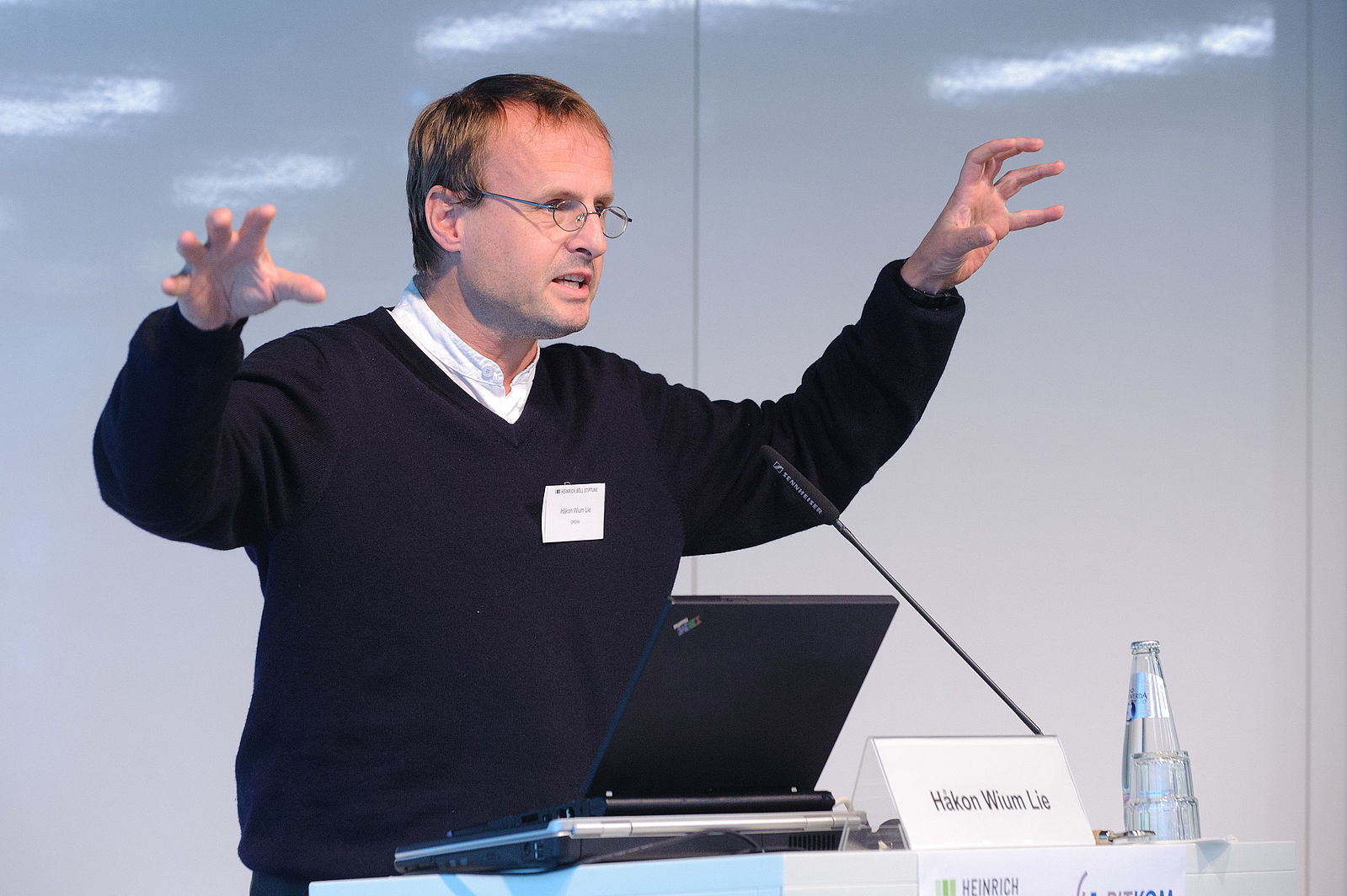
On the morning of Thursday, October 20, 1994, on the second floor of Chicago's Ramada Hotel, the Second International WWW Conference opened its final day with a panel titled "HTML and SGML: A Technical Presentation." Attendance was modest; the conference's commercial bustle—Netscape staff in attendance days after announcing a free, beta "Mosaic killer"—drew more attention than the early session. Tim Berners-Lee led the panel. Its last speaker was Håkon Wium Lie, who had joined Berners-Lee and Robert Calliau at CERN, and who presented a proposal for a separate design language: Cascading HTML Style Sheets, or CHSS.
Lie had drafted it under deadline pressure, urged on by standards editor Dave Raggett, and posted the first draft ten days before the conference.
Lie had arrived at the Web early, having used Nicola Pellow's line-mode browser to telnet into the first website, and joined CERN after graduating from the MIT media lab in 1992.
The need was urgent because HTML was being stretched beyond description. Once Mosaic allowed inline images, the Web "became a new graphical design medium," as Chris Lilley posted to www-talk at the time; he warned that without style sheets the "inevitable price will be documents that only look good on a particular browser." Publishers added color, font and layout tags, and browsers followed with their own extensions. Lie later described the worry bluntly: "It was like: 'Darn, we need something quick, otherwise they're going to destroy the HTML language.'"
CHSS's answer was a second language made of style sheets: separate documents describing presentation while leaving structure untouched, so content and design could change independently. Other proposals existed—from Rob Raisch of O'Reilly and from Pei-Yuan Wei, creator of Viola—but CHSS had CERN's profile and a simplicity that appealed to browser makers. Its distinguishing feature was the cascade: separate style sheets for the browser, the user and the author, with rules evaluated against one another to decide the winner, keeping web design simple, inheritable and adaptable to new environments.
The cascade dominated discussion after Lie's talk and carried over onto www-talk, where Bert Bos picked it up.
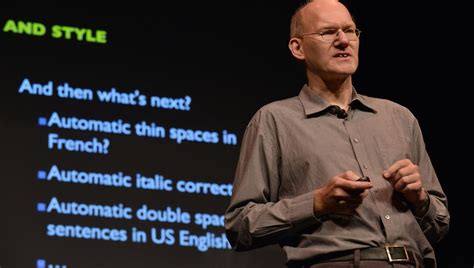
Bos, then studying mathematics at the University of Groningen, had written a browser called Argo, notable for an early form of applets and for Bos's own style sheet implementation, close in spirit to CHSS. Lie and Bos merged their proposals, met in person for the first time at the third WWW conference in Darmstadt in spring 1995, and presented Cascading Style Sheets—CSS, the H dropped. The contrast with current practice was sharp: without CSS, designers produced "page layout via tables and Netscapisms like FONT SIZE," a Suck columnist wrote, quoting that such pages loaded slowly and were hard for accessible devices like screen readers to interpret. That same writer praised CSS for "simple elegance, but also… its superfluousness and redundancy." Bos joined Lie at the W3C shortly after, and they drafted the specification that summer. Lie recalls the work in Sophia-Antipolis: "Most of the content of CSS1 was discussed on the whiteboard… Whenever I encounter difficult technical problems, I think of Bert and that whiteboard."
An implementation arrives: Internet Explorer 3
Chris Wilson, a veteran of the NCSA Mosaic team who had worked at Spry on Internet In a Box, was on the Internet Explorer team by 1996, just before version 2 shipped. Microsoft trailed Netscape badly. Wilson saw a differentiator: "There's this thing called style sheets," he told his boss, "it lets you control the fonts… Netscape isn't even looking at this stuff." Approval was immediate.
The specification was unfinished, so Wilson met regularly with Lie, Bos and other W3C members—later including Vidur Apparao of Netscape—testing each draft revision in his browser. That informal group eventually became the CSS Working Group.
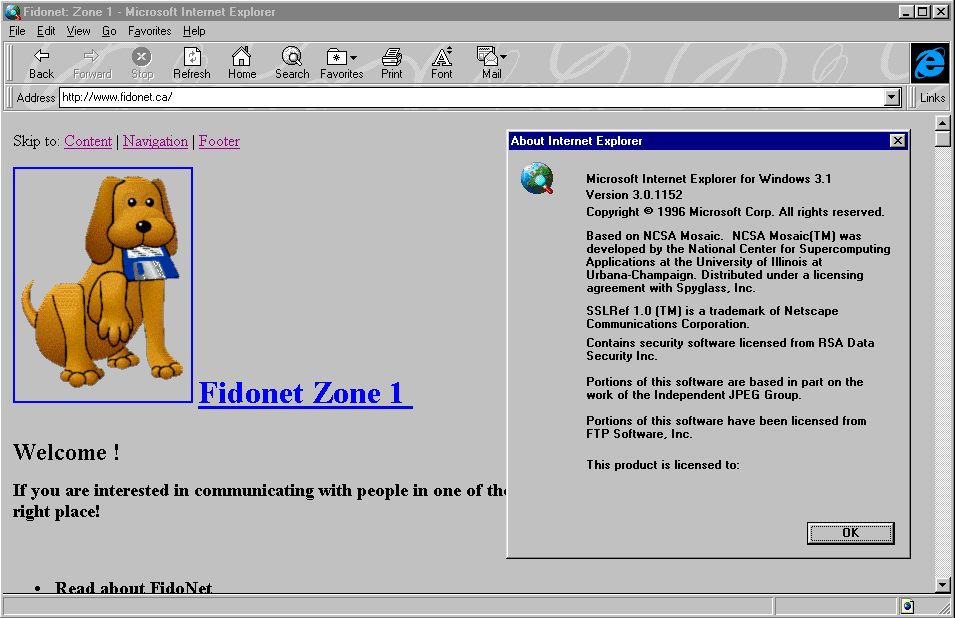
Internet Explorer 3 shipped in August 1996 as the first browser with any CSS support, before the W3C had formally recommended the language. That head start became a liability; years later Lie noted that "there are still a lot of IE3s out there, and since they don't conform to the specification, it's very hard to write a style sheet that will work well with IE3 while also working well with later browsers."
Still, a working implementation at the world's largest software company lent stability. Table layouts and Netscape-only tags remained dominant, but CSS had a foothold. In 1997 the W3C split the HTML working group into three, giving CSS its own working group, drawn from the ad-hoc IE3 team and chaired by Chris Lilley; its first formal Recommendation followed in December 1997, with CSS version 2 arriving six months later.
Testing, advocacy and the legacy problem
Eric Meyer had been at the Chicago conference but missed Lie's session; he first saw CSS at the fifth WWW conference in Paris, watching Chris Wilson—sick with a cold—demonstrate it in IE3 alongside Lie and Bos. "By the time that panel was over, the top of my head felt like it had blown off," he later said. "I was instantly sold."
Experimenting at home, Meyer found no documentation and behavior that often diverged from the spec. He built test pages isolating single features, ran them across browsers and documented the inconsistencies.
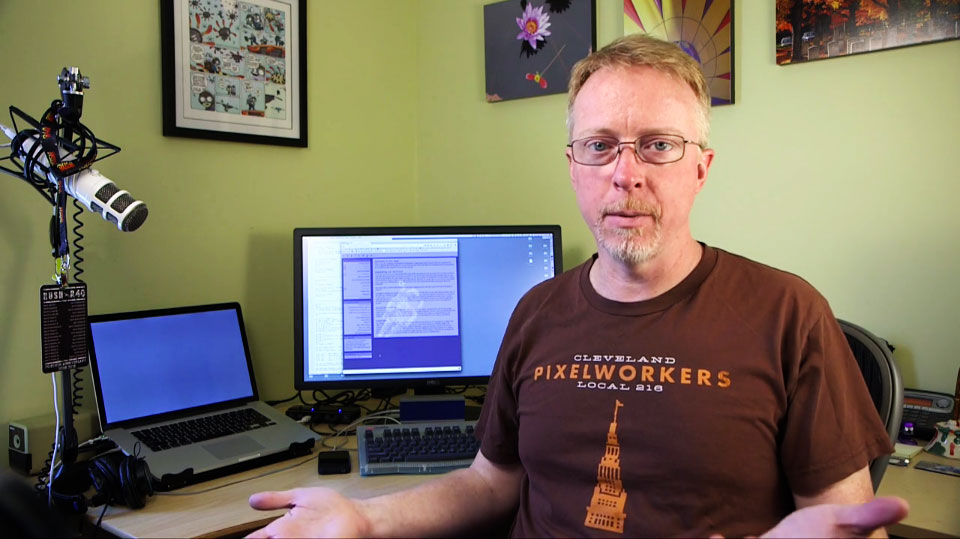
Those pages became, with the CSS Working Group's help, the official W3C CSS Test Suite. His site grew into columns, then O'Reilly's CSS: The Definitive Guide. When John Allsopp was asked by the Web Standards Project to form a CSS committee, he recruited Meyer alongside Sue Sims, Ian Hickson, David Baron, Roland Eriksson, Ken Gunderson, Brade McDaniel, Liam Quinn and Todd Fahrner: officially the CSS Action Committee, commonly the CSS Samurai. They published reports on missing browser support, met browser makers privately, and educated developers directly.
Netscape was the hardest case. Its dependency on JavaScript led it to JSSS, a non-standard, forgotten dialect that styled pages dynamically through script, uneven in support and slow to load; JSSS survived until the Gecko rendering engine arrived in the early 2000s, after which Mozilla came around to a functional CSS implementation. Elsewhere—especially across the growing share of Internet Explorer versions—WaSP made headway.
The doctype switch
One coffee conversation in 1999, between CSS Samurai Todd Fahrner (who had helped Meyer with the test suite and built the Acid Test for CSS support) and Microsoft's Tantek Çelik (later a WaSP steering committee member and CSS Working Group participant), addressed an existential problem. If browsers applied the new, correct W3C rules to sites built on years of ad-hoc CSS, those pages would break. Fahrner proposed a toggle: the doctype declaration at the top of an HTML page (the one Dan Connolly had spent years standardizing) could signal which rules a document expected. The practice, doctype switching, debuted in Internet Explorer for Mac version 5 and quickly spread, opening the door to standards-compliant CSS.
The hacks era and the CSS Zen Garden
"We have not learned to design the Web," Molly Holzschlag wrote in the introduction to her 2003 book Cascading Style Sheets: The Designer's Edge, noting that the web's short history had forced borrowed guidelines, hacks and broken markup.

At the end of 2000 came Netscape 6 and, shortly after, Internet Explorer 6. Their style sheets outstripped anything before, but Microsoft would not release another browser for five years, while Netscape regrouped and reformed as the standards-compliant Firefox. Developers caught between a buggy past and an imagined future kept relying on tables and Netscape-specific tags; "Netscape Navigator 4 was holding everyone back," Dave Shea said, and the business case for supporting it was "too strong to ignore." Web developer Eevee's description of the era: browsers handled CSS "somewhat poorly," and the fixes "were arcane, brittle, error-prone, and/or heavy."
Community solutions nonetheless flourished in blogs, mailing lists and books—the "Holly Hack" and clearfix from Holly Bergevin and John Gallant's Position is Everything; Douglas Bowman's "Sliding Doors of CSS," Dan Webb and Patrick Griffith's "Suckerfish Dropdowns" and Dan Ciederholm's "Faux Columns" on Jeffrey Zeldman's A List Apart; Meyer and Allsopp's CSS Discuss list. The first edition of CSS Anthology by Rachel Andrew devoted a whole chapter to Netscape 4. The culture drifted toward the how over the why, valuing hacks for their own sake. Holzschlag: "It's going to be the people using CSS in the next few years who will come up with the innovative design ideas we need to help drive the potential of the Web in general."
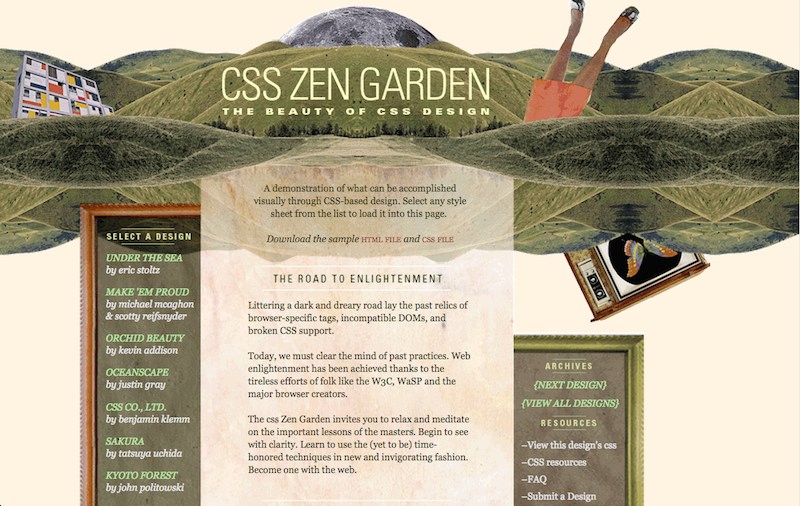
Galleries of inspiration kept that community moving—Domino Shriver's WebNoveau, later maintained by Meryl Evans, and Chris Casciano's Daily CSS Fun, which restyled one HTML file daily. In May 2003 Shea launched the CSS Zen Garden: a single HTML file and its content, restyled by solicited style sheets from developers worldwide. Starting with five designs, it grew into dozens and then far more, a gallery ranging from minimalism to the baroque. Jeffrey Zeldman later wrote in Designing with Web Standards that "hundreds of designers have made their mark—and sometimes their reputations"—through it, and "tens of thousands all over the world have learned to love CSS because of it." Shea and Holzschlag turned the project into The Zen of CSS Design in 2005.
CSS 2.1 and the move to modules
In 1998 Netscape had made public its decision to open source its browser under a new project, Mozilla, which led to Firefox in 2003. David Baron and Ian Hickson started there in the late 1990s as QA volunteers, later interns, hunting standards-compliance bugs before joining the CSS Samurai, writing and running CSS Test Suite tests, and becoming active on www-style and then the CSS Working Group. Their precision later helped Meyer through "the wilderness of my own misunderstandings."
Browser behavior traces back to W3C specification wording, so vagueness yields incompatible implementations. Hickson and Baron, with Bert Bos, Tantek Çelik, Håkon Lie and others, undertook a revision of CSS 2—CSS 2.1—what Elika Etemad described as "a long process of plugging the holes, fixing errors, and building test suites for the core CSS standard." What was expected to be a minor revision took nearly a decade, though editors once joked at a conference that a single late night might finish it.

Etemad, known then as 'fantasai', had spent years on www-style and the Mozilla bug tracker reporting spec errors and was invited to join the working group at the 2004 W3C Technical Plenary in Mandelieu-la-Napoule. The group had to contend with a stalled IE6; in 2006 Hickson still posted that "we're almost out of issues," years from a final specification. Learning from the exhaustive, monolithic CSS 2.1, the group changed course—"we succeeded," Hickson said, "but boy are they insanely complicated"—and shifted to specifications that evolve with real-world browser implementations.
Beginning with CSS3, specs became modules, each covering one area—color, font, text, media queries and more—with its own editors, developed independently and at variable pace. Etemad called some early modules "'concept albums,' specs that are sketching out the future of CSS." The modular approach set up a decade of sweeping change.
The people behind the spec
At @media 2006 in London, Eric Meyer's keynote "A Decade of Style" traced CSS through its own history and his own. His conclusion: "Never underestimate the effect of a small, select group of passionate experts." CSS, he argued, thrived not because of the technology but because of the people who built it and with it. Fifteen years later, nearly three decades after its creation, that remains true.