Two models of web publishing: community versus editorial control
Josh Quittner's 1994 HotWired article "Way New Journalism" predicted a shift in reporting driven by intertextual links, concise narratives and interactive media, with a more intimate and immediate voice that readers would recognize and trust. Not every prediction played out, but the claim about voice held. Writers went on to define web publishing in a fundamental way.
HotWired: inventing a medium on the job
Wired's founders had spent years selling their countercultural take on the digital revolution. The magazine had already drawn attention for controversy, notably William Gibson's 1993 essay "Disneyland with a Death Penalty," which led Singapore to ban the publication. When Wired was blocked in the country, two motivated residents manually converted each issue to HTML and posted it for download — an unofficial project publishing copyrighted content it did not own. Within months Wired launched an official site with back issues, a placeholder for greater ambitions.
Andrew Anker, Wired's CTO with a background in engineering and Wall Street banking, led the web planning effort. The team rejected a straight digital copy of the magazine. Instead the site was divided into content channels that had an influence on each other. Editorial channels like Kino (film) and Signal (tech news) carried columns sourced from the magazine's writers; Piazza hosted chat rooms and message boards filled with comments from ordinary web users. Against the plain, black-text-on-white homepages of the era, the site displayed a bold aesthetic, advertised under a brand derived from but separate to Wired. HotWired launched in October 1994.

The team, housed in a corner of the Wired office, faced technical problems like web servers that could scale to thousands of views a day, and the challenges of designing interfaces read only on a screen. It built a dedicated email list early on. HotWired is often cited as the first website to carry banner ads; advertising revenue was in Anker's business plan from the start, and each ad shipped with a landing page built for the advertiser. A marketer, Jonathan Nelson, later said the launch included the first magazine, automobile, travel and consumer telephone company sites online, along with the first advertising model.
The registration fight
Early recruits included Howard Rheingold, creator of the WELL, along with his intern Justin Hall, Jonathan Steur, finishing his Stanford Ph.D on Internet communities, and Brian Behlendorf, later a creator of the Apache server. Behlendorf has said the draw for him was the idea of community — drawing people to content and giving it context through their contributions, so that users felt empowered to be in control. This group built features like user-generated art galleries and multi-threaded chatrooms, which would be ahead of their time even a decade later.
Rosetto favored a more cultivated approach. He believed that writers and editors must provide a strong point of view, that user participation would muddy the waters, and that visitors came to the web to read, not contribute. The conflict surfaced over registration: Rosetto wanted user profiles to unlock content, enabling control over the experience and the possibility of personalization. Rheingold's team opposed it as violating the open nature of the web. The idea was dropped, but not entirely for ideological reasons: registration meant fewer readers and less advertising revenue.
Anker made the final call. HotWired would operate as a magazine, since Anker knew that advertisers understood editorial direction, while still allowing community-driven elements. Rheingold and several others left soon after launch, leaving a style drawn from Wired's point of view and a community ethos. The Wired tone became more conversational, readers were invited to comment and email, and humor became a shield against a staid medium.
Pathfinder: consolidation without a brand
At the National Magazine Awards, where Wired took General Excellence, Rosetto told Time's New Media Editor Walter Isaacson that the web was the exciting part of the Internet. Isaacson's Online Steering Committee had a Gopher site and Telnet work in progress, plus a souring AOL partnership. Inside Time Warner the one person already working on the web was Chan Suh, who had built a site for the hip-hop and R&B magazine Vibe. Suh funded things cleverly. According to Kyle Shannon, Suh would offer advertisers a website ad deal, and when they said they had no website, he would offer to build one; content he built this way became content for Vibe Online. Suh later left with a business plan and backers, adding a co-founder, Omar Wasow, later creator of Black Planet, and Shannon, a theater actor he drew in to launch one of the first digital agencies, Agency.com.
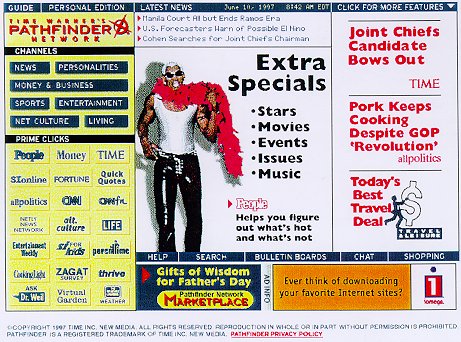
Suh's work had proven two things: advertising worked as a web business model, at least until online subscriptions could succeed, and web readers wanted content from established publications. Rather than building each publication independently, Time Warner's steering committee rolled all its properties into one destination. Pathfinder launched in October 1994 with distinct channels for Sports Illustrated, People, Fortune, Time and others.

Pathfinder drew 200,000 visitors in its first week, when only a few million people used the web, and it would soon be among the most popular sites on the web. Within a year it was attracting 14 million visitors per week, refreshing content and experimenting with formats and advertising deals that brought in revenue. Still, the problems went back to the beginning.
Coordinating publication schedules with editors at nationally syndicated magazines was difficult, and some executives worried, not without reason, that digital content would eat into the print business. Others saw the web as a passing fad, so content was sometimes missing and the site was treated as an afterthought.

The deeper failure was overreach and underreach at the same time: Pathfinder tried to assert control over an untested medium while consolidating everything under one brand. No one knew Pathfinder's name. They did know Sports Illustrated, People and Time, and each title might have found its own footing online; merged, the publications turned anonymous. When Isaacson left the project to edit Time, he was never fully replaced, and Pathfinder went neglected. A rumored $15 million a year went into the site, and the planned subscription charges never came; as Wired learned, web users did not want to pay. Analyst Melissa Bane, quoted when Pathfinder closed in April 1999, said the site had become "an albatross around Time Warner's neck." Its properties were split among other sites and shut down.
Pathfinder had one outlet producing regular, exclusively online content. Called Netly News, it was founded by Noah Robischon and Josh Quittner — the author of the "Way New Journalism" article. It published short pieces and commentary rather than magazine content: a webzine hidden behind a corporate exterior. The second half of the decade would be defined by webzines.
Who actually read the web
Mid-90's usage data is clear enough. Even early adopters rarely spent more than 30 minutes a day online, mostly logged in to portals like AOL or Yahoo! to check email and skim a few headlines. A second, outlier group spent hours each day reading small text on low-resolution screens, collecting links into lists to share, and exploring the long tail well beyond Yahoo!'s front page. These readers were the webzine audience.
Suck and the webzine voice
Carl Steadman, a Rheingold disciple who had joined HotWired in 1994, used server-log data to argue against registration for Anker and Rosetto with some success. After hiring Joey Anuff as his production assistant, Steadman came to an understanding with the more outgoing Anuff; the two sometimes clashed over details but shared what Anuff called a love of the web. HotWired employees got server access for personal sites, so at night, after the office emptied, the pair launched a site that rejected their day job's aethetic and enthusiasm for technology. It published one article a day under pseudonyms and ran a plain format with a critique of the status quo. They called it Suck.

Suck belonged to a wider group of webzines, as they were often called at the time — a term that within ten years would become "blogs." Webzines published daily or several times a day from mostly young writers, tackling politics and pop culture, almost always with a tech angle. They rarely reported or broke stories; they styled themselves as critics of the mainstream, and wrote personally, conversationally, with wit and a distinct perspective.
Generation X had entered a recession-era job market, studying rhetoric, semiotics and comparative literature. It gave them a strong grounding in postmodern and literary theory and few job prospects. The traditional major-publication job that supported a modest lifestyle had been replaced by freelance work that paid little. With little to lose, they learned some HTML, recruited friends and started sites. Writer Rebecca Schuman later called it "a democratization of the widely-published word in a world that had heretofore limited its purview to a small and insular group of rich New Yorkers."
By the mid-90's there were dozens of webzines, with powerful personalities in many cases working in pairs. Jamie Levy launched Word with Marissa Bowe as editor; Stephanie Syman, Yale educated, paired with semiotics major Steven Johnson on Feed; the couple Rufus Griscom and Genevieve Field ran the salacious Nerve; Suh started UrbanDesires with Shannon; the Swanson sisters launched ChickClick; the list goes on.

They shared a tone. Heather Havrilesky, who began her career at Suck, described reading such content as "like finding an eye rolling teenager with a Lit Theory degree at an IPO party and smoking clove cigarettes with him until you vomited all over your shoes." References to Walter Benjamin or Jean Baudrillard in reviews of a Cameron Crowe film were perfectly normal. The webzine voice was, in Havrilesky's phrase, a "coy, ironic kind of style"; Schuman called it "weaponized sarcasm." Posts were short and digestible, sized for a screen rather than a page, published without fixed schedules so readers had something new every day. Word experimented with page layouts and an extremely popular chatbot named Fred.
Remaking the tools
Webzines redefined how web technologies were used. A hyperlink could undercut or emphasize a point, as when a quote about deceptive advertising linked to a cigarette company's homepage; Suck always linked the word "sell-out" to itself. Steven Johnson, co-founder of Feed, devoted a chapter of his book on user interfaces to the link as punctuation, a new grammatical tool for online writers: "What made the link interesting was not the information on the other end — there was no ‘other end' — but rather the way the link insulated itself into the sentence."
Webzine writers positioned themselves as sideline critics of corporate interests and inauthentic influence from companies like Time Warner, but the most enthusiastic web users were equally young and jaded. Casting readers against the mainstream made these sites among the web's most popular destinations for a loyal audience. In tearing down the old culture, they became part of the new one. In the next generation of Internet time, their style was packaged, commoditized and sold to a wider audience, with analysts and consultants paid to teach slow-moving companies how to imitate webzines. Sites turned to advertising to pay writers and meet demand; those writers went on to start blogs or become editors at larger media sites. Some founders became known for switching to corporate life and IPOs. Few sites lasted and many names were forgotten, but the voice and the style became as familiar as a well-used hyperlink.
Newspapers move online
Newspapers have long been family properties. The Meyer-Grahams ran The Washington Post from 1933 until Jeff Bezos bought it in 2013; Advance Publications has been controlled by the Newhouse family since the 1920s; News Corp. has the Murdochs. Adolph Ochs bought and revived The New York Times in 1896, beginning the dynasty that preceded Arthur Ochs Sulzberger Jr., who became publisher in 1992 after working as a Washington correspondent and through various departments. The web arrived almost as soon as he did.
Experiments from newspapers were already under way. The M.I.T. student-run The Tech launched in 1993, the earliest online newspaper on record. The San Jose Mercury Times, covering Silicon Valley, set up its site at the end of 1994 around the time Pathfinder and HotWired launched. By the end of 1995 dozens of papers had websites, among them the Chicago Tribune and Los Angeles Times, and readers who once were excited to find a web address at the bottom of a newspaper came to expect it.
In 1995 the Times brought in Martin Nisenholtz, a former Ogilvy staffer, to lead its digital arm. Nisenholtz had worked in computing since the late 70's and helped build an early Prodigy prototype; he did not need to experiment with the web. One colleague said he "saw and predicted things that were going to happen on the media scene before any of us even knew about them." He had also moved traditional media organisations into technology before and was used to skeptical colleagues; Sulzberger later recalled many thinking digital was "getting in the way of the mission." Nisenholtz embedded himself in the newsroom, learning the language of news and how a lasting newspaper operation fits a new medium.
An ISP and an aggregator from Raleigh
In 1990 Frank Daniels III became executive editor of the Raleigh News & Observer, which his great-grandfather had bought and saved in the 1890's. He soon wired the newsroom to the Internet for research feeds and tools, and launched an ISP for the Raleigh area called NandO.net (News and Observer) so locals could buy Internet access and browse N&O content.

As the web turned commercial, the paper launched the Nando Times, which syndicated news and sports from newswires converted to HTML alongside N&O articles. It is the earliest record we have of a news aggregator — a nationally recognized news source run from a local paper's newsroom and bundled with an ISP, aimed at a single digital home on the web. Others held the same ambition.
The Wall Street Journal went the opposite way with a paywall. Its Interactive Edition, paid from launch, stood out in a crowded field and was largely a success. But its readers had a peculiar willingness to pay for financial news. Plenty of others tried paywalls and few succeeded; for most publications, advertising revenue had to work as it had in print.
The fork in the road
Nisenholtz saw a split: "That was the big fork in the road," he later said. "Not whether, in my view, you charged for content. The big fork in the road was publishing the content of The Times versus doing something else." "Doing something else" could have meant the aggregator model of the News & Observer, a WSJ-style paywall or an editorial portal to compete with Yahoo! and AOL. Nisenholtz and the Times took a different route, using the same voice it had used for more than a century. When nytimes.com launched in January 1996, it mirrored the day's print edition, rendered in HTML.
Just after launch the site ran a contest to pick a slogan, much as Ochs had done with readers in 1896. The winner was "All the News That's Fit to Print" — the very slogan the paper's readers had chosen a century earlier. For Nisenholtz this confirmed that readers wanted the same thing from the website as from the printed page: strong editorial direction, reliable reporting and all the news. The Times would not only compete with other newspapers; "the news" would be big business on the web, and it would compete for attention with the newswires like Reuters, cable channels like CNN and tech-influenced media like CNet and MSNBC. The site's success rests in showing that the web is not always a place of reinvention. Sometimes, it is just one more place to speak.
A second webzine wave, funded by tech
In the mid to late 90's, a surge of investment in tech companies pushed them into publishing in their efforts to capture a market they did not fully understand. In 1995 Apple, and later Adobe, funded Salon, founded by San Francisco Examiner veterans led by David Talbot. The next year Microsoft hired New Republic writer Michael Kinsley to launch Slate. The two were often pitted against each other specifically because of their origins: media ventures for big tech players, started by print professionals, online only.
These webzine-inspired magazines kept a print DNA. Kinsley wanted each structured issue on Slate to display page numbers, even though they were meaningless on a screen. The concept of "issues" and their page numbers were gone within weeks, but the impulse made it clear he believed print's legacy deserved a place on the web. This second generation of webzines leaned grown-up: less webzine, more online magazine, a little more "serious." Gen X outsiders still wrote the posts, essays and critiques rather than straight investigative reporting, and the snark remained, but the writing had been grounded in fully developed subject matter and print sensibility. Salon's first article was a roundtable on race relations and the O.J. Simpson trial: countercultural, critical and conversational, but bringing in expert voices to tackle one of the day's most important issues.
The second half of the 1990's came to define publishing on the web. Most would have to reimagine themselves after the dot-com crash, but the voice of the web gave way, at the turn of the century, to an independent web run by writers, editors and creators who started out when the web did.