The meeting that started the war
In June 1995, a Microsoft delegation visited Netscape's offices with what looked like a cooperation agenda. On the Netscape side were Marc Andreessen, already a web celebrity, and newly appointed CEO James Barksdale; Microsoft sent product managers and engineers eager to push the company onto the Internet.
The talks opened amicably with a look at Windows 95, then soured. According to Netscape's account, Microsoft offered an investment plus key technical information about Windows and asked, in exchange, that Netscape not build a browser for Windows 95. Andreessen later dramatized the encounter in his Department of Justice deposition, invoking The Godfather: "I expected to find a bloody computer monitor in my bed the next day." Microsoft called the meeting a "setup" that Netscape had initiated to bait them into a compromising position.
The start of the browser wars could be dated several ways — the release of Internet Explorer 1 in late summer 1995, or the day Andreessen dismissed Microsoft as a "poorly debugged set of device drivers" in early 1995. But June 21, 1995, when the two companies met as conceivable friends and left as bitter foes, may be the most definitive marker.
"Free, but not free": how Netscape sold a browser
Netscape's browser carried an official fee of $39 per copy, yet fully functional beta versions were free to download, and universities and non-profits could get zero-cost licenses with little effort. For the web's upstarts and the open-source tradition, that was free enough; for corporations buying in bulk with specific contractual needs, paying for licensing and maintenance was expected. "It looks free optically, but it is not," a Netscape employee later described it.
Andreessen framed the logic as "basically a Microsoft lesson": ubiquity creates options. Without quick and easy access, Netscape would never spread. He had learned that lesson a year earlier at the NCSA research lab at the University of Illinois, where he and his friends built the cross-platform Mosaic browser.
From a hotel lobby to Mountain View
Frustrated by NCSA superiors trying to capitalize on Mosaic's success, Andreessen moved west at the end of 1993 and met James Clark, the recently departed founder of Silicon Graphics. Clark gathered an inner circle of tech visionaries for regular meetings and increasingly moved Andreessen toward its center; the duo's ideas kept returning to one: building the world's first commercial browser.
On a snowy day in mid-April 1994, the two flew to Illinois and went straight to a hotel lobby near the university, where Clark met one by one with five members of the original Mosaic team plus Lou Montulli, the student creator of Lynx, printing contracts with lucrative salaries and stock options on the spot. The mandate recalled by an employee was simple: Beat Mosaic! They flew back the next day with six employees of the soon-to-be-named Netscape.
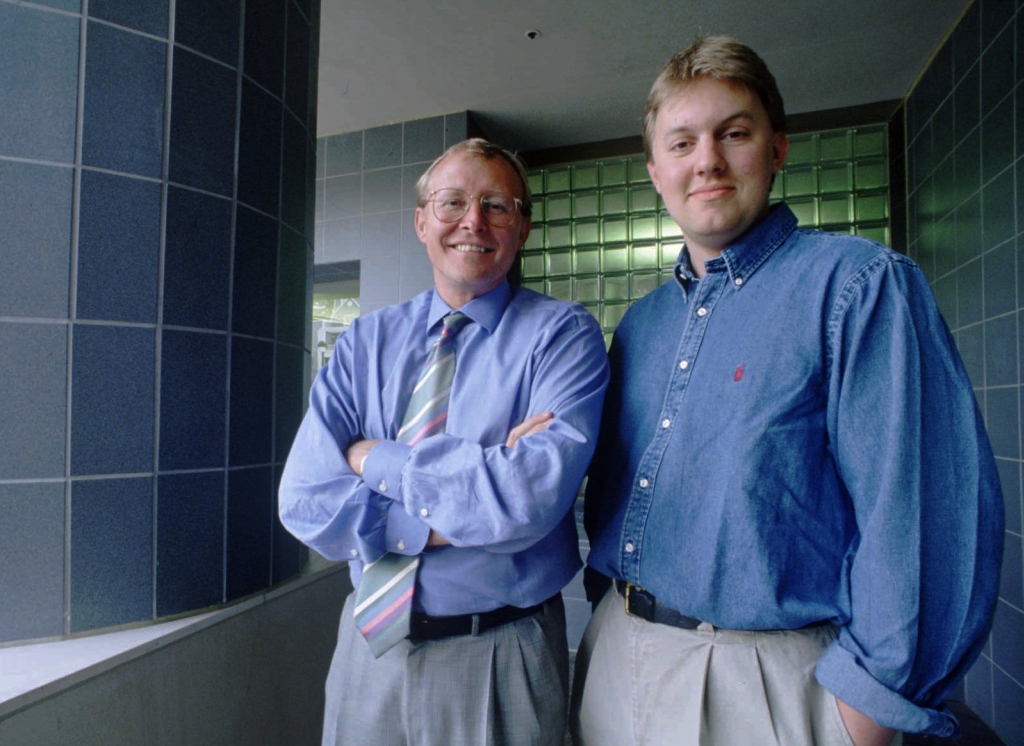
Within six months the company released its first browser, Netscape Navigator; six months after that, the easy-to-use, easy-to-install browser overran the market and brought millions of users online for the first time. Clark later said Netscape gave "anarchy credibility" — which, as writer John Cassidy put it, meant a group of college kids could team up with a rich eccentric, raise venture capital, and build a billion-dollar company in eighteen months.
Waking Microsoft up
As early as 1993, three Microsoft employees — Steven Sinofsky, J. Allard, and Benjamin Slivka — were sounding alarms inside a company with an operating-system monopoly that was nonetheless being passed by the web. "I dragged people into my office kicking and screaming," Sinofsky told Bloomberg's Kathy Rebello in 1996.
Part of Microsoft was distracted by the idea of owning the whole networked experience through its proprietary Microsoft Network (MSN), which ultimately failed. Slivka argued that Microsoft should build with the Internet rather than against it: "Microsoft needs to ensure that we ride the success of the Web, instead of getting drowned by it." Allard went further with an internal memo titled "Windows: The Next Killer Application for the Internet," proposing what became the cornerstone of Microsoft's strategy: embrace the web's open standards, extend them into the Microsoft ecosystem, and innovate on web technologies.
After a failed bid to acquire BookLink's InternetWorks browser — AOL outbid them — and with the Netscape meeting producing nothing, Microsoft licensed Mosaic from NCSA's commercial partner Spyglass. Internet Explorer 1.0 shipped in August 1995 as part of an Internet Jumpstart add-on: code Spyglass had licensed to dozens of partners, bare-bones and clunkier than Netscape's offering.
On December 7, Bill Gates held a large press conference — on the anniversary of Pearl Harbor — opening with the Microsoft Network but also demoing Internet Explorer, borrowing language directly from Allard's memo: "the competition will be kind of, once again, embrace and extend."
Selling the story, then selling the stock
Rosanne Siino, Netscape's employee number 19 and first PR hire, had worked closely with Clark at Silicon Graphics before jumping to his new venture. At the Mountain View offices she sat down with each engineer to hear the vision first-hand, and drew a different conclusion: she couldn't sell good code, but she could sell a group of young, hard-working engineers from rural America making a run at entrenched Silicon Valley — and a "twenty-two-year-old kid who was pretty damn interesting."
Netscape's board and executives were already discussing an IPO, and timing was critical with Microsoft advancing and Spyglass already public. As Cassidy explains, if Netscape was going to issue stock, it made sense to do so while competition was sparse — and a flashy IPO would make headlines nationally.
Siino crafted Andreessen's public image as a leader of the software generation, the "new Bill Gates," an antidote to the hardware generation of the 60s and 70s. "My other real challenge was to build up Marc as a persona," she later said; Andreessen sometimes resisted the interviews but recognized their necessity. He toured with Barksdale to meet investors, and the hype inflated.
On August 9, 1995, employees were too nervous to watch the financial news — "like saying don't notice the pink elephant dancing in your living room," Siino recalled. They needn't have worried: on its first day of trading, Netscape stock rose 108%, the best opening day on Wall Street to that point, and some founding employees went to bed millionaires.
JavaScript in ten days
Netscape 2 followed shortly: the company's most ambitious release, bundling tools for email, chatting, and writing documents, sleek and fast. It was the first version to ship with Java applets, small applications running directly in the browser — a bid to compete directly with Microsoft's operating system. To accompany it, Netscape recruited young programmer Brendan Eich to create a scripting language riffing on Java; he produced the first version of JavaScript in 10 days as a way to make pages more interactive and dynamic. It was primitive but easy to grasp and powerful.
Netscape felt confident. As Andreessen put it, in a fight between a bear and an alligator, terrain decides the victor — "What Microsoft just did was move into our terrain."
Version 3, and the machinery behind it
An old Microsoft adage holds that it never gets something right until version 3.0. IE 1 was a rushed port of Mosaic; IE 2, released just after Netscape's IPO, iterated quickly but lagged; with IE 3, Microsoft began to get the browser right.
Behind the big press conference, the effort resembled a skunkworks: six people on the original product team, in a company of tens of thousands. "A bit like the original Mac team, the IE team felt like the vanguard of Microsoft," lead Brad Silverberg said, "the vanguard of the industry, fighting for its life." That changed once Microsoft recognized the web's potential and shifted its weight behind the browser. As Josh Quittner and Michelle Slatalla describe in Speeding the Net, quality hardly mattered at first: if a generation flopped, Gates could assign better programmers and try again, with nearly unlimited resources.
By version 3 the team numbered a hundred, including Chris Wilson of the original NCSA Mosaic team; within a few years it would reach the thousands. The software closed the gap rapidly, matching features that had given Netscape an edge and adding its own HTML extensions, dynamic animation tools, and rudimentary CSS support. In summer 1996, Walt Mossberg — who months earlier had called Navigator the "clear victor" — wrote that he gave the edge to Internet Explorer 3.0 for its easier use and cleaner, more flexible interface.


Features would never be enough. In December 1996, senior VP James Allchin emailed his boss Paul Maritz conceding, "I don't understand how IE is going to win" against an endless chase of Netscape's feature set. "My conclusion is that we must leverage Windows more," he wrote, adding, "We should think first about an integrated solution — that is our strength." The focus became integration and distribution.
IE 4 was more tightly integrated with the operating system than any previous version and nearly inseparable from it: it could browse files and folders, its "push" technology streamed the web even when the software wasn't active, and it used internal APIs unavailable to outside developers to be faster and smoother. Distribution followed. Days after Netscape and AOL shook hands on a deal, AOL abruptly switched to Internet Explorer; it later emerged that Microsoft had made an "offer they couldn't refuse," dropping prices to the floor and promising AOL prominent placement on the desktop of every copy of the next Windows. Compaq, which had shipped Netscape pre-installed on Windows, also switched after Microsoft threatened — as later revealed in court documents — to suspend its Windows license. By Windows '98, IE 4 came pre-installed, free, and impossible to remove.
Mozilla, the lizard and the licence
The name came from a naming meeting in Netscape's early days, when one employee suggested the browser would crush Mosaic like a bug. Jamie Zawinski offered "Mozilla — as in Mosaic meets Godzilla," and though marketer Greg Sands settled on Netscape, the nickname stuck around the office; early web marketing materials featured a green lizard mascot before a more professional image replaced it.



Zawinski, employee number 20, had been hired right after Siino to take over the X-Windows version of Netscape that Andreessen had worked on at NCSA. He arrived with a reputation for solving complex technical challenges: programming since eighth grade, a poor student who kept an after-school programming job, later working at the startup Lucid, Inc. on Common Lisp and the Emacs IDE — work that gave him instant credibility in the small programming community.
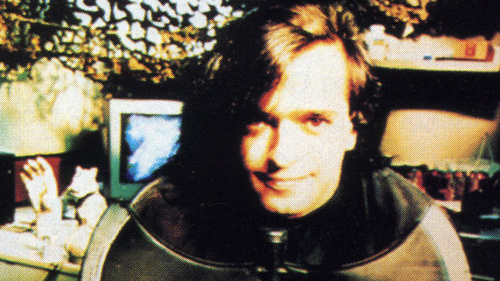
Engineering sat at the heart of how Netscape worked — which is why Siino built the company's story around it. The result was a high-pressure atmosphere whose pace people called "Netscape Time." "It was really a great environment," Zawinski recalled. "Because everyone was so sure they were right, we fought constantly but it allowed us to communicate fast." But tempers flared — one account describes him throwing a chair at a wall and leaving for two weeks after his computer crashed — and many engineers later reflected on the toxic workplace. "It wasn't healthy," Zawinski said simply.
Engineers had real sway, and many, Zawinski among them, advocated free software. For Zawinski, software was meant to be free, and he and others on the team were at least partly responsible for the creative licensing behind the "free, but not free" model. In 1997, technical manager Frank Hecker revived the idea with a 30-page whitepaper proposing to release the browser's entire source for free: "The key point I tried to make in the document was that in order to compete effectively Netscape needed more people and companies working with Netscape and invested in Netscape's success." With CTO Eric Hahn's help, Hecker and Zawinski took the case to the top, and by the time they reached James Barksdale most of the company had come around. Barksdale agreed.
On January 23, 1998, Netscape made two announcements. The expected one: after nearly a year of struggling against a free IE 4 bundled into Windows, Netscape would give its browser away too. The shock: the browser's entire source code — millions of lines — would be released publicly and opened to contributions from anyone. Led by Netscape veterans including Michael Toy, Tara Hernandez, Scott Collins, and Zawinski, the team had three months to excise the code base and ready it for distribution. The effort was named Mozilla.
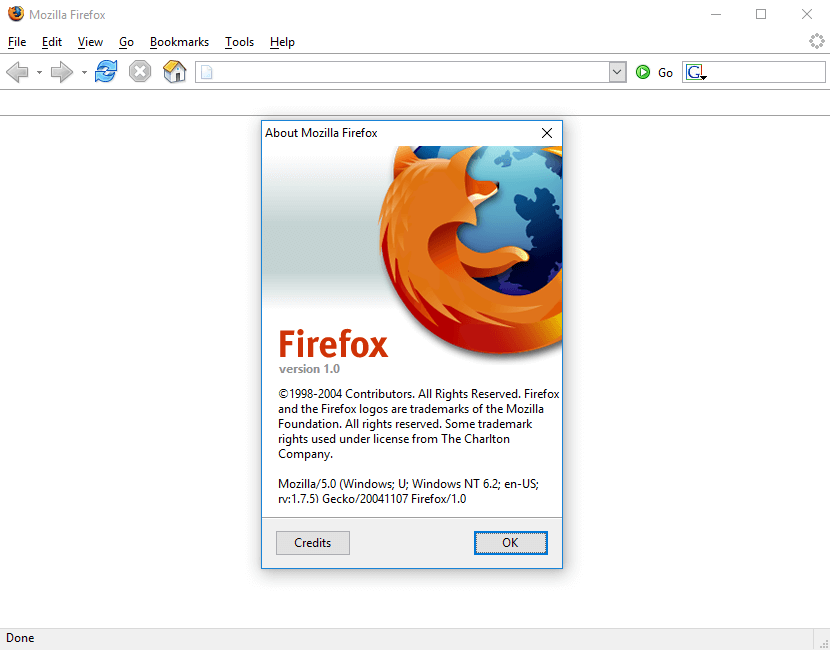
Internally the three months were frenetic, recapturing the earliest spirit of Netscape as engineers patched bugs and readied the code, finishing only by the skin of their teeth. The project spun out as an independent organization under Mozilla.org, staffed entirely by Netscape engineers but not technically part of Netscape. When Mozilla held its launch party in April 1998, Zawinski insisted the growing outside community be included: "We're giving away the code. We're sharing responsibility for development of our flagship product with the whole net, so we should invite them to the party as well." "It's a new world," he added.
The antitrust case
In November 1998, Steve McGeady testified in the Department of Justice's case against Microsoft, sitting, as one writer described, "motionless in the witness box." The Intel vice president had regular dealings with Microsoft while standing outside the Netscape–Microsoft conflict, and as one journalist's account of the trial noted, the drama was heightened by one reality: "nobody — literally, nobody — knew what McGeady was going to say."
He testified that high-ranking Microsoft executives had told him their goal was to "cut off Netscape's air supply," threatening computer manufacturers with losing their Windows licences unless they shipped Internet Explorer. Drawing on Gates's own language, McGeady claimed an executive had described the strategy as "embrace, extend and extinguish." It was a major turning point for the case.
The case had roots years earlier, when Netscape retained the antitrust firm Sonsini Goodrich & Rosati in summer 1995. The team included the outspoken Gary Reback and Susan Creighton, a former clerk for Justice Sandra Day O'Connor whose precision and thoroughness made her a fit for a complete breakdown of Microsoft's anti-competitive strategy. Creighton wrote a 222-page document — originally planned as a book, shelved because Netscape feared its stock would plummet if the public knew how much danger the company was in — and Netscape handed it to the DOJ, where it triggered renewed interest in ongoing antitrust investigations.

After almost three years of subpoenas, information gathering, and lengthy depositions, in May 1998 the DOJ and 20 state attorneys filed an antitrust suit against Microsoft — a company that had only just then crossed a 50% share of the browser market. "No firm should be permitted to use its monopoly power to develop a chokehold on the browser software needed to access the Internet," announced Attorney General Janet Reno. At the center of the trial was not Microsoft's hold on PC software — not technically illegal — but how it used that monopoly to counter competition in other markets, such as threatening to revoke licences of manufacturers that packaged Netscape. Netscape's account of the June 1995 meeting factored in as well; asked why he had taken such detailed notes, Andreessen replied, "I thought that it might be a topic of discussion at some point with the US government on antitrust issues."
Microsoft reacted poorly to scrutiny publicly and privately, insisting it was acting in customers' best interests, while Gates often came off as curt and dismissive in interviews and depositions. The company argued the browser and operating system were co-existent and inseparable — refuted by the judge, who noted he had uninstalled Internet Explorer from Windows in "less than 90 seconds." The trial became a national sensation.
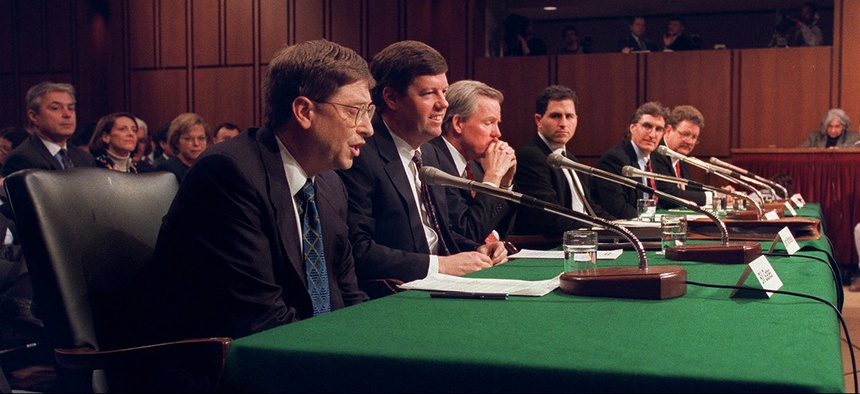
In November 1999 the presiding judge ruled that Microsoft had used its monopoly power and violated antitrust laws. In summer 2000 came a proposed remedy: break Microsoft into two companies, one for operating software and one for applications. "When Microsoft has to compete by innovating rather than reaching for its crutch of the monopoly, it will innovate more; it will have to innovate more. And the others will be free to innovate," said Iowa State Attorney General Tom Miller after the ruling. It never happened: a 2002 appeal reversed the ruling and the DOJ agreed to a lighter consent decree. By then Internet Explorer's market share stood around 90%, and the browser wars were effectively over.
Opera's separate front
"Are you looking for an alternative to Netscape and Microsoft Explorer? Do you like the idea of having an MDI user interface and being able to browse in multiple windows?… Is your browser slow? Try Opera."
That Usenet message, posted in April 1995 to a Windows browser forum, announced Opera — its tone technically meticulous, a little pointed, and genuinely idealistic, reflecting the philosophy of creators Jon Stephenson von Tetzchner and Geir Ivarsøy. Opera began as a project at the Norwegian telecommunications firm Telenor, and once stable, the two spun it out into an independent company renting space there.
The team was small but focused and loyal to the open web. "Browsers are in our blood," von Tetzchner later said. In the mid-to-late 90s, Ivarsøy became the first person to implement the CSS standard in any browser, in Opera 3.5 — enough to convince CSS's creator, Håkon Wium Lie, to join as CTO. Ian Hickson worked at Opera while developing the CSS Acid Test at the W3C.
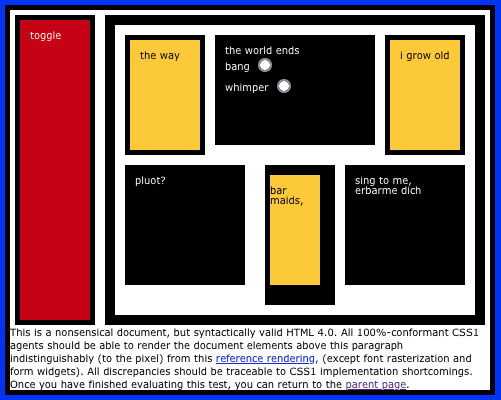
The company began developing a browser for low-powered mobile devices in developing nations as early as 1998, often pushing the web community toward standards by example.
In 2007 Opera filed a complaint with the European Commission alleging that Microsoft abused its monopoly by bundling new versions of Internet Explorer with Windows 7, limiting user choice through opaque additional browser options. "You could add more browsers, to give consumers a real choice between browsers, you put them in front of their eyeballs," Lie said at the time. Opera's summary called on Microsoft to adhere to its own public commitments to standards "instead of stifling them with its notorious 'Embrace, Extend and Extinguish' strategy," and criticized Microsoft for trying to control the standards process.
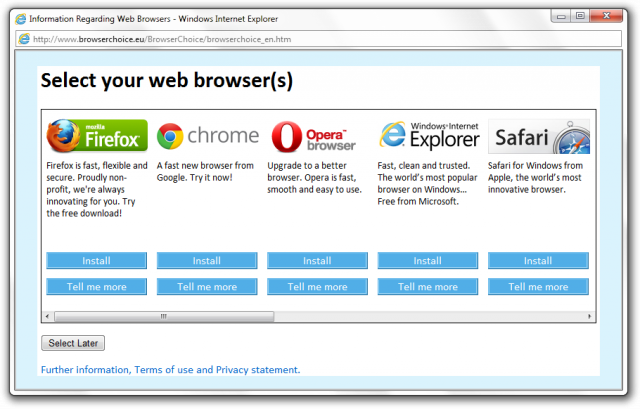
In 2010 the European Commission ruled that Microsoft must show a "ballot box" to European Windows users — a website, seen the first time they accessed the Internet, listing twelve alternative browsers to download, including Opera and Mozilla. Microsoft included it in European Windows installs for five years, until the obligation lapsed.
Vaporware and aftermath
Netscape Navigator 5 never shipped. After the open-sourcing, the company split its focus, caught between acquisition by AOL and continuing pressure from Microsoft. "It's one of the great ironies here," Netscape lawyer Gary Reback later said: "after years of effort to get the government to do something, by [1998] Netscape's body is already in the morgue." Management couldn't decide how to integrate with the Mozilla team and kept maintaining a separate version of Netscape apart from the public project.
In October 1998, Brendan Eich published a post on the Mozilla blog: "It's time to stop banging our heads on the old layout and FE codebase. We've pulled more useful miles out of those vehicles than anyone rightly expected. We now have a great new layout engine that can view hundreds of top websites." Many contributors agreed, but the rewrite — a new rendering engine soon known as Gecko — spelled the project's initial downfall, and Netscape scrapped its planned version 5.
Progress ground to a halt. Zawinski, who opposed the rewrite, described his frustration on resigning from Netscape in 1999: "It constituted an almost-total rewrite of the browser, throwing us back six to 10 months. Now we had to rewrite the entire user interface from scratch before anyone could even browse the Web, or add a bookmark." Scott Collins put it less diplomatically: "You can't put 50 pounds of crap in a ten pound bag, it took two years. And we didn't get out a 5.0, and that cost us everything, it was the biggest mistake ever."
The result was a world-class browser with strong standards support and a fast engine — but it arrived only in April 2000, with Netscape 6, when Microsoft already commanded 80% of the browser market. It would never be enough to win back a significant share. "I really think the browser wars are over," said one IT executive after the release of Netscape 6. Netscape would sputter out for years; Mozilla would soon be reborn as something else entirely.