Web apps need more than deployment
Web applications differ from websites in a fundamental way: they facilitate user-to-data interactions. Dashboards, support portals, and internal tools all require up-to-date, personalized content delivered both quickly and securely. Vercel positions its Frontend Cloud as a managed infrastructure layer for these dynamic use cases, covering the compute, storage, and delivery needs of modern web apps without demanding configuration overhead from development teams.
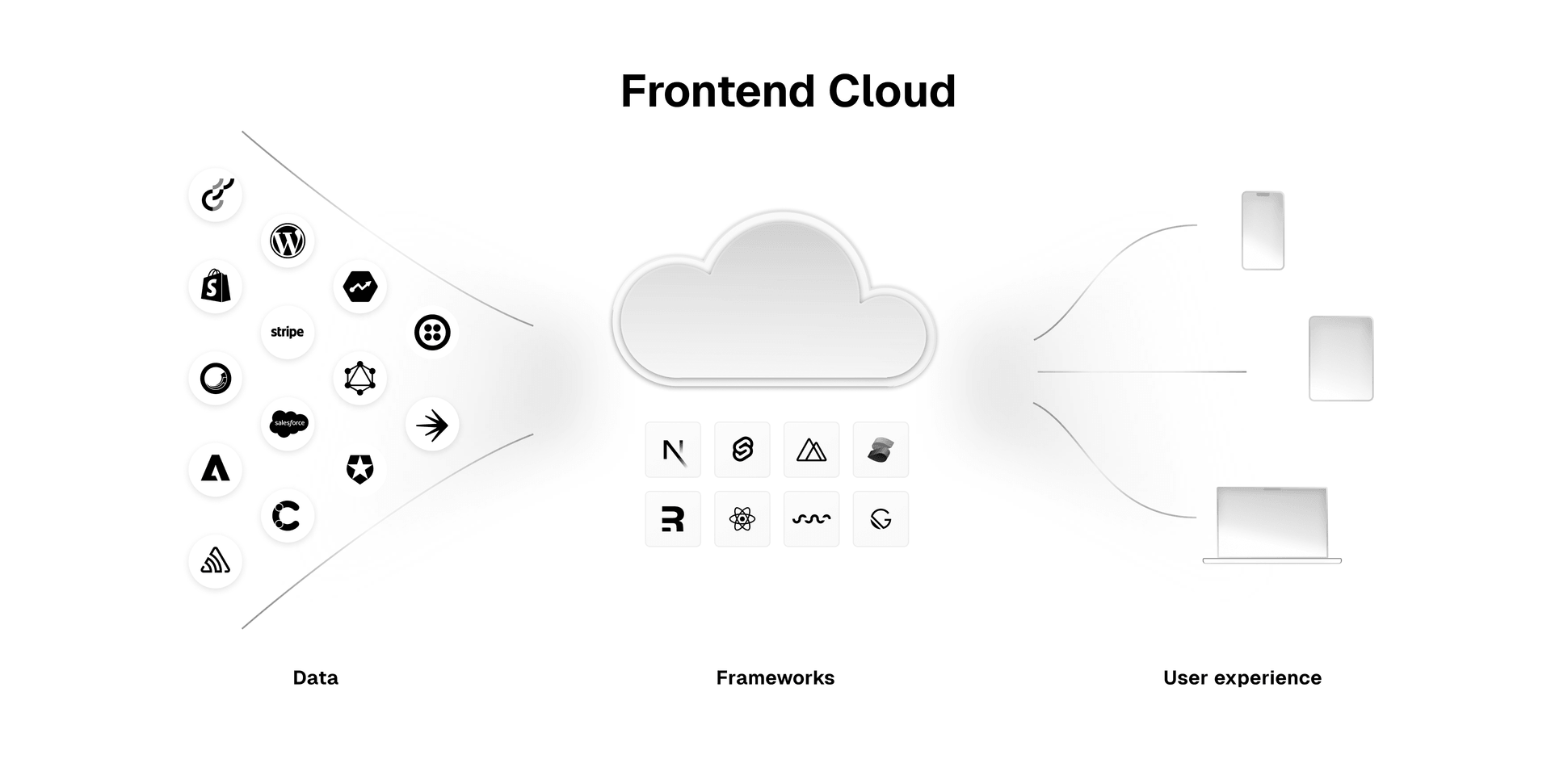
Vercel's Frontend Cloud comprises several integrated capabilities: global infrastructure with caching, observability tooling, and workflow features designed specifically for iteration-heavy application development.
A per-PR workflow instead of staging bottlenecks
Iteration speed often depends on how quickly teams can test and review changes. Traditional staging environments group many changes together and require coordination between teams, which slows feedback loops. Vercel replaces this with per-pull-request Preview Deployments: every commit to a PR automatically generates a fully operational environment in seconds. Teams can review UI changes in a live deployment and leave comments directly on the rendered interface, without merging to production first.
This model also supports faster, smaller releases. Keeping marketing sites and application code in the same repository, while decoupling the frontend compute from backend services, lets teams ship UI updates without waiting on or affecting backend logic.
Deployment and release are separate concerns. Using Edge Middleware, developers can gate features, run A/B tests, or adjust behavior per user location—all without a full redeployment. The experimentation environment stays in sync with the production codebase, eliminating the drift risk of separate staging branches.

Pluggable data and third-party services
Most application builds start with an API or database integration. Vercel supports a range of database options directly from its templates and marketplace, including:
- MySQL
- Postgres
- MongoDB
- Redis
The architecture treats downstream providers as swappable components. Changing a database or other service is often as simple as rotating an environment variable or API key, giving teams freedom to adjust their stack without rework.
Securing the full request path
Application security spans more than just the code itself—you need authentication, protected APIs, and private connections to your data plane. Vercel offers a managed authentication layer that can integrate with Okta, AWS Cognito, and Google Sign-In. For teams exposing APIs to external callers, the platform's API gateway provides rate limiting, authentication controls, and SSL encryption out of the box.
Enterprise teams that cannot expose backend infrastructure publicly can use Secure Compute, which establishes private connections between Serverless Functions and resources such as databases in your own cloud. This design allows compliance teams to keep sensitive infrastructure isolated while still using managed functions for application logic.
Compute without the capacity planning
Serverless compute on Vercel removes the operational chores of provisioning, scaling, and server maintenance. The platform auto-scales in response to traffic, eliminating both manual capacity planning and the risk of downtime from sudden spikes. Developers can write in any of the supported runtimes—Node.js, Python, Ruby, and Java—and deploy without considering the underlying host configuration.
Observability for complex systems
Debugging distributed applications can otherwise consume hours across multiple tools. Vercel provides built-in Monitoring for real-time visibility into application health and performance, including CPU and memory usage plus request and response headers. This visibility helps developers identify bottlenecks before they lead to outages.

Monitoring pairs with Instant Rollbacks: when a production incident does occur—a breaking change or bug slip-through—teams can revert to any previous production deployment quickly, without rebuilding or hunting through history.
Adopting without a big-bang migration
Teams don't have to move everything at once. The Frontend Cloud can support incremental migration paths, meaning teams can shift workloads over time rather than managing a single disruptive rewrite. The argument is straightforward: the scalability, reliability, and performance of the platform are available to web apps of varying complexity, and the transition can be paced to the team's own schedule.


