
From Flywheel to Cloudways
CSS-Tricks runs on Cloudways, the managed hosting arm of DigitalOcean, to which both the site and Cloudways now belong. The site had previously been hosted on Flywheel, a boutique WordPress host acquired by WP Engine some years back. Flywheel served CSS-Tricks well, but the site eventually outgrew what that setup could scale to, which could have pushed a move to WP Engine had Cloudways not been an option.
Changing hosts means switching contest — different server names, configurations, user accounts and controls.

What Managed Hosting Removes
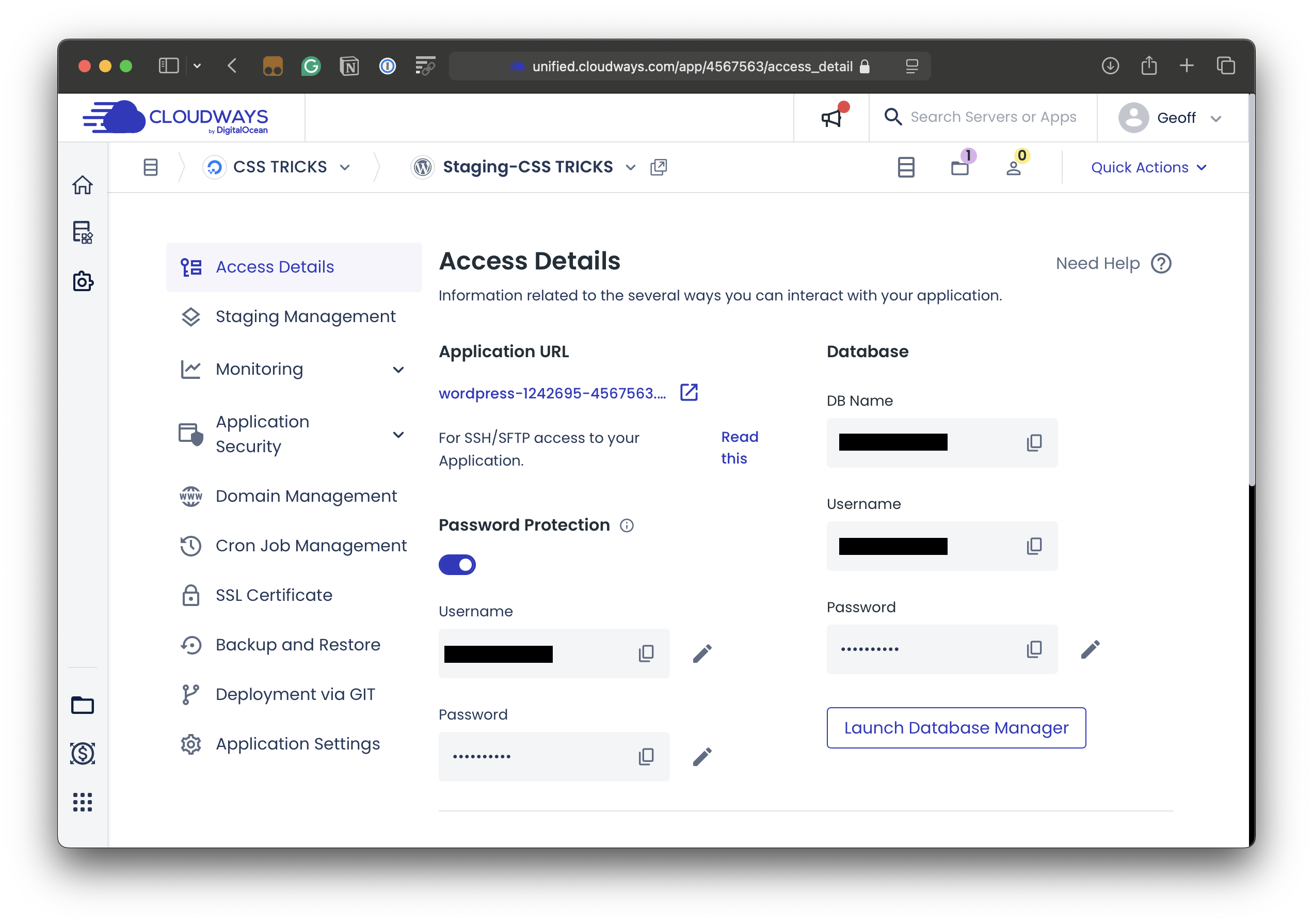
With a low-maintenance operation, a fully managed host keeps day-to-day server detail out of the way. The Cloudways team handled the migration and set up what was needed: SFTP accounts, database access, a staging environment and deployment points.
How the Deployment Flow Changed
The old workflow was simple: start Local (Flywheel's local development app), work locally, push to main, and let a CI/CD pipeline publish the changes. The simplicity came with errors, since publishing did not always follow a push — particularly around WordPress updates — and there was no staging environment to catch problems before they reached production.
The current flow adds a step between local work and production:
- Start Local (still in use)
- Work on local development
- Push to main
- Publish to staging
- Publish to production
This separation was possible on Flywheel but trivial to set up with Cloudways. Some automation is traded for quality assurance: switching environments is a single click, and a small amount of manual friction keeps the process under control. That approach suits a small team rather than a large enterprise project, which is where DigitalOcean comes in.

Branch testing through the GitHub integration
GitHub is integrated directly into the Cloudways UI, so a branch such as baseline-status-widget can be tested in any environment before it is merged into staging or master. That makes experimentation easier and avoids the error-prone habit of triggering auto-deployments in multiple places.
Monitoring and Diagnosis
Cloudways monitoring gives a clear view of differences between environments. During an attempt to update the Gravity Forms plugin, the update worked locally but caused a fatal error in staging. The Vulnerability Scanner showed staging was running an older version of WordPress than local and production — WordPress core is not version-controlled here, so the gap was easy to miss.

The hypothesis was a conflict between the newer Gravity Forms release and the older WordPress version, and it was easy to test. The hypothesis held, which gave confidence that pushing to production was safe — and it was.
Bring Your Own Cloud
Cloudways suits WordPress sites of any size or type. It is one of the few hosts that lets you bring your own cloud: work can sit on a cloud server such as a DigitalOcean droplet while Cloudways manages the hosting, leaving room to scale as needed on top of the managed-host benefits.



