
When the “right” fix is too risky
For years, the Dropbox Android app struggled with files and folders that had non-standard names — Cyrillic characters, trailing spaces, or unusual Unicode. In some cases folders simply didn’t appear; in others the app crashed outright. The root cause was easy to trace to path normalization logic, but the obvious corrective step — making Android match the server’s normalization exactly — would have touched code used in nearly every file operation. That kind of change, applied blindly, could break the app for users who were not currently affected, with potential data loss as the worst case.
The team’s solution was to accept a temporary, inelegant engineering compromise: a global static variable used strictly as a feature gate. It ran counter to standard practice, but it was the only approach that met all constraints.
Two server decisions created the mismatch
Dropbox has long identified files by normalized paths — paths converted to a standard, platform-agnostic format (e.g., /Documents /CAT.jpg becomes /documents/cat.jpg). Normalization must be byte-for-byte consistent across server and client, or the two sides can disagree about which file a path refers to. The Android client, it turned out, disagreed with the server in two specific ways.
Decision #1: Spaces stripped, tabs retained
Early on, Dropbox chose to strip trailing spaces from folder names but left other whitespace characters, like tabs, intact. Android, however, strips all leading and trailing whitespace. A folder whose name is a single tab character is valid per the server’s rules; Android would normalize it to an empty string, breaking the path entirely.
Decision #2: Python 2.5’s unicode handling
The Dropbox server was originally built on Python 2.5 in 2007, and its path normalization logic still uses that version’s unicode.lower(). That function predates proper Unicode support: it does not account for context, and for some characters its lowercase mapping is simply missing. Example: the Cyrillic character Uk (Ꙋ) has the lowercase form ꙋ, but Python 2.5 leaves it unchanged.
The consequences on Android were concrete. For a folder named with three Sigma characters (ΣΣΣ), Android’s Java-based lowercasing correctly returns σσς, since the final Sigma is word-final. The server, using Python 2.5, returns σσσ. The two sides end up referring to the same folder by different normalized names — the folder never displays in the app.
Why the obvious fixes fell short
The normalization code touches at least 12 source files and nearly 100 call sites in the Android app. A direct rewrite of the normalization logic to mirror the server’s behavior was the natural fix, but the blast radius made it prohibitive. Three alternatives were considered.
Moving to an ID-based file system
Replacing path-based identity with unique IDs would eliminate normalization mismatches entirely — and is where Dropbox is heading long-term. But the change is deeply invasive; this proposal dates to 2016 and still hadn’t been prioritized at the time of writing. It would take multiple engineers several months and would introduce risk for all users, not just those currently affected.
Using the Stormcrow feature-gating system
Dropbox has an internal tool, Stormcrow, that can enable or disable app behavior on the fly without shipping a new build. That sounded ideal for gating a normalization fix. But Stormcrow initializes too late in the app’s startup sequence: path normalization runs while managers reload paths from disk, and that very reload is a prerequisite for Stormcrow to be available.
One could thread the Stormcrow interactor through the normalization functions explicitly, but the search showed over 100 production call sites and more than 600 test call sites — roughly 700 changes before considering the engineering risk of modifying a widely used constructor. It was, effectively, a nonstarter.
The pragmatic compromise
The team needed state that was readable at app launch and from any code location without any refactoring. That points to one thing — a global static variable. Using one is normally discouraged for good reason:
- Too much scope: Anything can read or modify it, which makes reasoning about code harder.
- Hard to test: Static state leaks between unit tests, introducing nondeterminism.
Those drawbacks, however, only apply when the global is permanent. Here, it was intended only as a temporary gate: set it once Stormcrow becomes available, and let the normalization fix activate or deactivate accordingly. Once the fix proved stable, the global and the gating logic could be removed altogether.
Neither pure engineering elegance nor a path-based or ID-based overhaul could satisfy the timeline. The global static variable, inelegant as it was, was the only solution that met the requirement of a low-risk, low-cost change — written to be temporary from day one.
Making the Gate State Available at Launch
Having the global static variable in place only solved part of the problem. The code still needed access to the gate state before the Stormcrow interactor was ready. The key realization was that we needed a value before we could compute it — so we used the last computed value instead. The gate state is cached to disk once the interactor is ready, and that cached value is read at the next app launch.
- On first launch, check for a cached gate state on disk. If present, read it and set the global static variable accordingly. Otherwise, default to the old path normalization logic.
- Once the Stormcrow interactor is initialized, register a listener and cache the gate state on disk.
- Use the modified path normalization code conditionally, based on the global static variable.
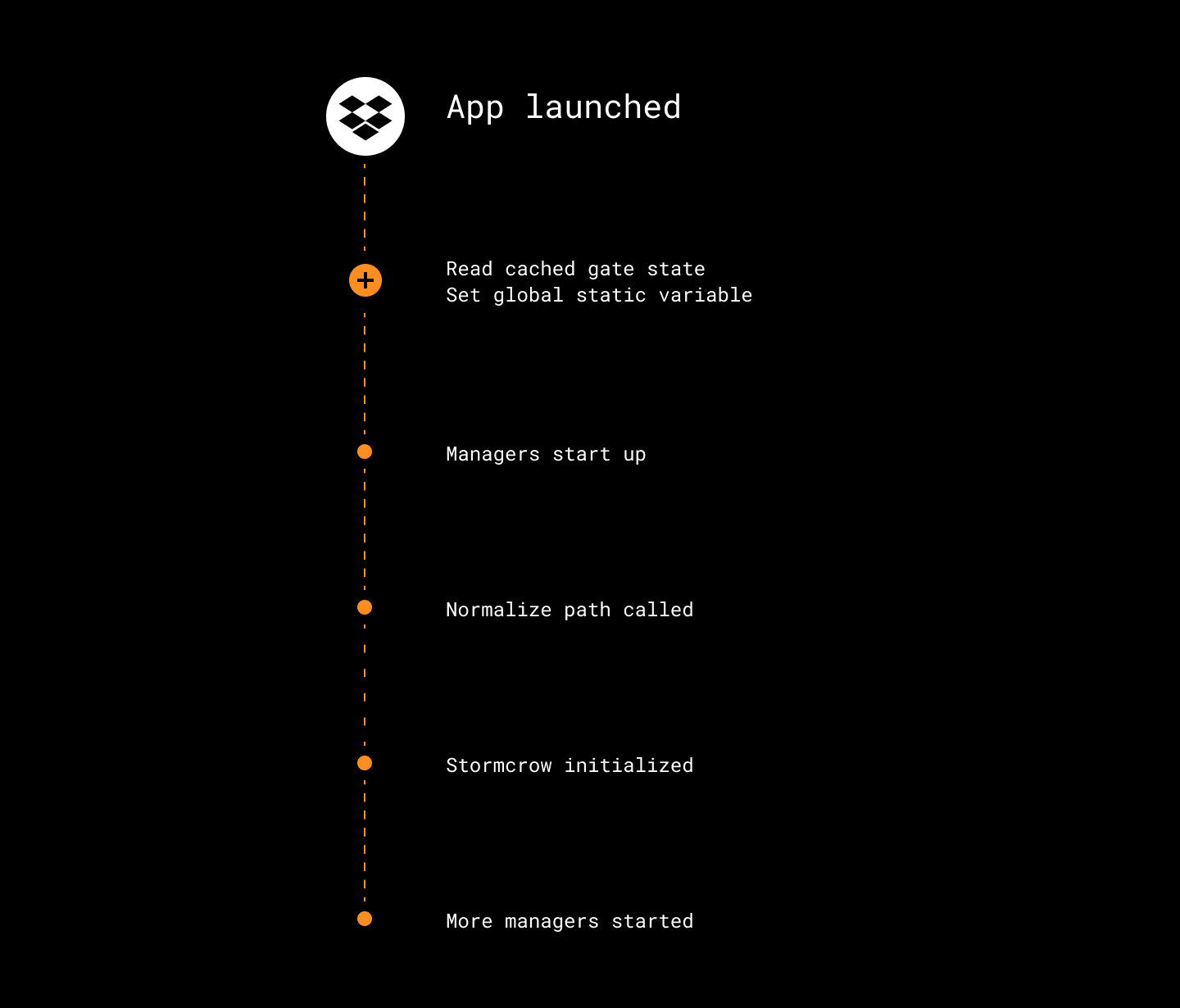
With customer data at risk, the global static variable made the code considerably simpler and safer than redesigning file storage or adding invasive code into Stormcrow. Stepping back, it was clear this short-lived variable enabled the best long-term path: deploy the simplest fix in a way that could be instantly rolled back, avoid major refactoring of Stormcrow for a one-off change, and buy time to build better ID-based file management.
Global static variables are almost never the right answer. Almost. In this case, resolving Android crashes quickly and safely — for customers and for us — justified the inevitable omg a global static reactions.
Verification and Rollout
Implementation itself was simple; most of the work went into proving the gating approach would hold up. The critical behavior to verify was that toggling the feature gate on and off caused no issues with Dropbox paths already persisted to disk.
An audit of every data source containing a Dropbox path showed that all but one already accounted for the unreliability of client-stored Dropbox paths. The exception was the metadata database, which caches a user’s entire file system. The fix: clear the metadata database each time the gate state changed, an approach already proven in earlier projects.
Analytic events were added to flag cases where the new and old normalization logic disagreed. For privacy, those events only reported that an inconsistency was detected — never the actual paths or file names involved. The new path normalization received full unit test coverage, and a small bug bash turned up no major issues.
Staged Launch
After the release build shipped to 100% of customers, we ran a test of the new logic without enabling it. During this run, every path normalized with the old code was also normalized with the new logic; the two results were compared and logged, then the new result was discarded. Inconsistency reports hovered around 0.1%, a reasonable figure given we didn’t expect many folders with Cyrillic names.
Satisfied with the test results, we rolled the fix out gradually via the Stormcrow feature gate while monitoring analytics. Crashes involving empty folder names dropped to zero, strongly suggesting the fix worked, and no new customer support tickets related to the issue appeared. After enough time passed to confirm success, all gating logic — and the global static variable — was removed.
Lessons Learned
Three takeaways from this project will sound familiar to any engineer, but they only truly stick once applied under pressure with time and resource constraints:
- Keep things simple
- Challenge what you believe
- General guidelines are general
The global static variable kept everything simple. It violates common guidelines, but that’s precisely the point: guidelines have exceptions by definition. We often form mental shortcuts when learning — a failed approach X becomes “X is bad,” when the accurate lesson is that X was wrong for that situation. Over time, the context fades and the generalization hardens.
Those generalizations are useful; they help us quickly discard bad solutions and focus on promising ones. But they occasionally rule out a good solution too. When facing a difficult problem, it’s worth pausing to examine which assumptions you’ve been carrying. The complexity of the solution scales the potential payoff. Ask yourself: is there something far simpler that I’ve convinced myself isn’t an option? It might be the best one of all.


