Tracing a request through Vercel's infrastructure
Understanding what happens between a user pressing Enter and seeing a response helps developers appreciate how their framework code maps onto cloud resources. Vercel's framework-defined infrastructure analyzes a codebase at deploy time and provisions resources accordingly; at request time, traffic is routed through a dedicated network designed for speed, reliability, and scalability.


The entry point for every request is the globally distributed Vercel Edge Network. Anycast routing picks the optimal Point of Presence (PoP) among 100+ locations based on proximity and live network conditions, minimizing latency over a congestion-free private fiber backbone.


Multi-layer defense at the edge
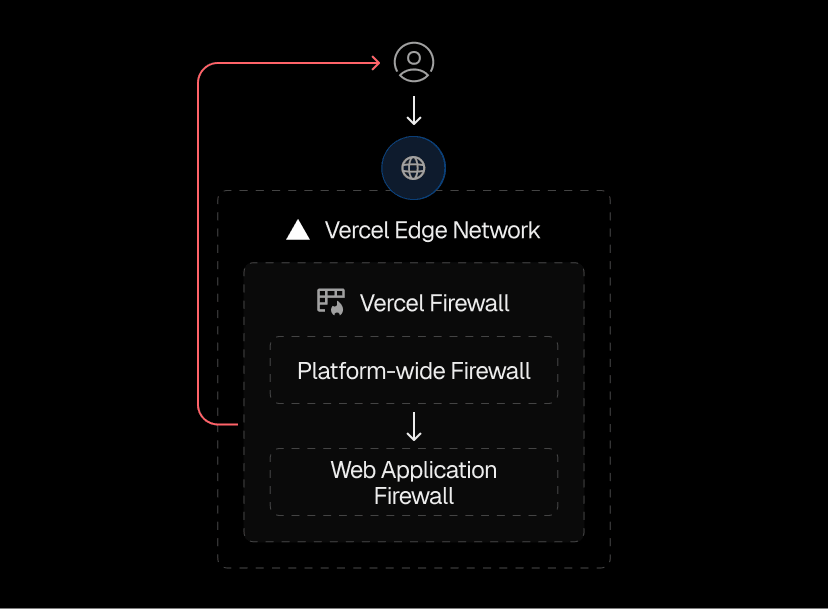
Once a request arrives at a PoP, it hits Vercel Firewall's defense-in-depth system, which operates at the network (L3), transport (L4), and application (L7) layers. The first stage applies platform-wide intelligence gathered from all deployments to block volumetric threats such as DDoS, SYN floods, and UDP attacks as close to the source as possible—before they can reach application resources.
Requests that pass this layer are forwarded in milliseconds to the nearest of 18 global Edge Regions, where application-layer protections against threats like HTTP floods and Slowloris attacks kick in. This system-level filtering runs automatically for all customers, blocking over 1 billion malicious TCP connections weekly.




After these system-level checks, requests become application-aware, carrying full context about deployments and routing rules. They then face the Web Application Firewall (WAF), which gives projects control over their own security posture. Teams can define IP blocking, rate limiting, and deep inspection rules via managed rulesets targeting risks like the OWASP Top 10, all configurable through Vercel's interface and APIs.
The WAF is synchronized with upstream firewall layers. When a rule with a persistent action triggers, earlier stages of the firewall intercept repeat offenders before they reach the WAF again—saving both compute and cost.


Routing logic: predefined and dynamic
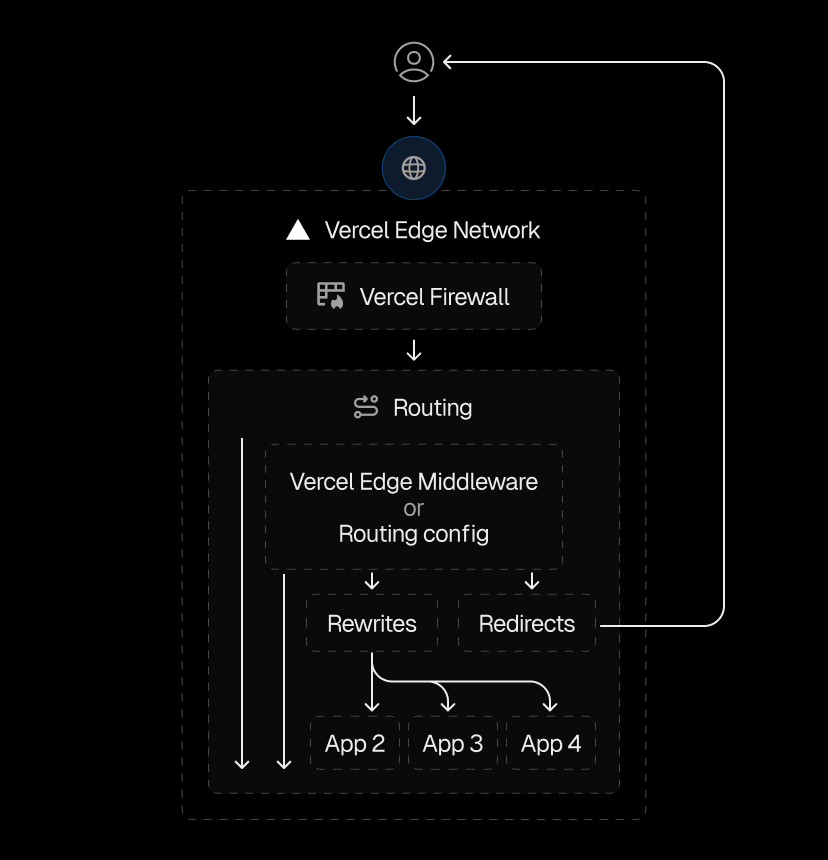
Once security checks pass, Vercel's router takes over. Redirects send browsers to new locations; rewrites adjust request paths without changing the visible URL. These can be hard-coded in framework configuration for known URL changes, while Edge Middleware handles dynamic decisions.
Middleware lets developers inject logic about user identity or location, modify headers, authenticate users, and conditionally route requests. That allows filtering of unnecessary traffic before it reaches backend resources. In complex setups such as microfrontends, routing coordinates multiple services under a single domain.


Edge caching and dynamic compute
After routing, requests reach the Edge Cache, which is optimized for high hit ratios and configured automatically based on framework code—no manual management needed. Content freshness is maintained through revalidation cycles tied to content status: fresh, stale, or due for regeneration.
Static assets such as images, CSS, and JavaScript, as well as dynamic API responses, are cached near users. With Incremental Static Regeneration (ISR), content is regenerated on-demand or at scheduled intervals when stale.

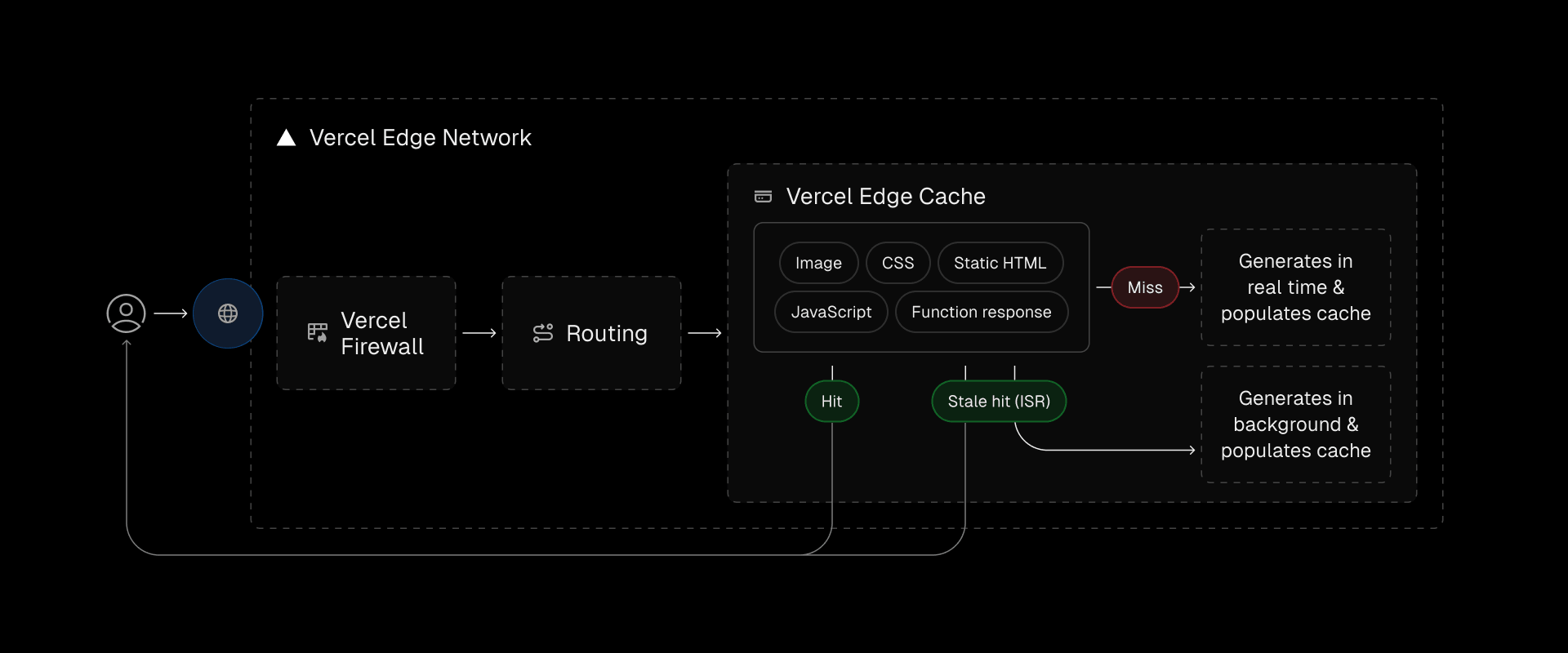


When a request needs fresh data, Vercel Functions handle the compute. For server-side rendering, functions generate and stream HTML per request, with responses cacheable for subsequent visits. Functions also serve API routes and scale automatically with traffic. Optimizations like bytecode caching and pre-warming reduce cold starts and improve response times.


The result is a delivery pipeline that turns framework code into globally available, secure, and fast application responses—coordinated automatically by the platform from the moment code is pushed.




