Cloud Computing Explained in Rhyme and Cartoons
Explaining cloud computing to someone without a technical background usually ends in glazed eyes and a polite nod. Forrest Brazeal’s new book, The Read Aloud Cloud: An Innocent's Guide to the Tech Inside (Wiley), attacks that problem with the tools of a different trade: hand-drawn cartoons, verse, and a willingness to admit it’s all pretty abstract.
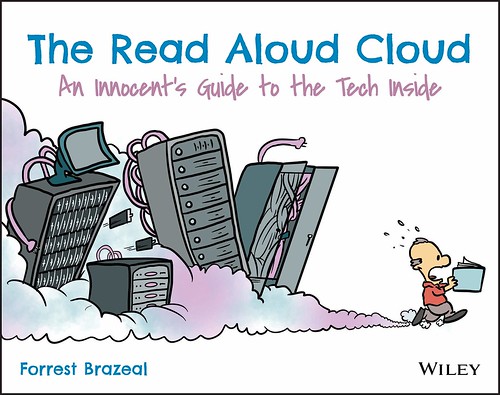
Brazeal, an AWS Serverless Hero and cloud architect at A Cloud Guru, says the book is aimed squarely at the non-technical people in your life. At over 160 pages of illustrated explainers, it is a way to bridge the gap between professionals and everyone else who has heard the term "the cloud" but cannot say what it does.
A Spiritual Successor to a Webcomic
The book grew out of the "FaaS and Furious" webcomic, and it shows. Brazeal says the hardest material to draw was not the section on how the internet works, but the prehistoric computers in a chapter on the evolution of the cloud. Getting mainframes to look recognizable is surprisingly difficult, he says. Keen-eyed readers might spot a Control Data 6500, an IBM 401, a PDP-10, and an Apple 2 among the vintage hardware. The wooly mammoth on page 20 carries his first computer, a 1992 Apple Powerbook, between its tusks.
The decision to write the book in rhyme was one he regretted almost immediately after signing the contract, according to Brazeal. He admits to cheating wherever possible: the chapter on reliability deliberately falls apart into bad rhyme and meter as a thematic excuse, and doubles as an homage to Ogden Nash. Still, that was apparently easier than rhyming 168 AWS services.
What People Should Be Asking About the Cloud
People are confused about the cloud for an understandable reason: it is everywhere in their lives but has almost no intuitive frame of reference. Brazeal makes a comparison to doctors or lawyers. Most people may not understand the details of those jobs, but they at least understand why they exist. With cloud professionals, that baseline is missing.
The point he hopes readers take away is a shift in the question being asked. Instead of the opening line of Chapter 1 — "Is my data, like, up in the sky, or what?" — he wants people to ask what a cloud architect actually builds and why it matters. The book weaves in job examples like security engineer, architect, and developer alongside the technical content, which Brazeal says has helped several readers make the topic feel more concrete.
He does have one regret about the presentation. The subtitle "An Innocent's Guide to the Tech Inside" makes the book sound like it is only for children. It is safe for kids (with the exception of the chapter on smart devices, which he calls "pretty scary"), and he hopes weird children find it on their parents' desks. But its real audience is adults who want to chuckle and learn something
The Cloud Is Changing Who Is Allowed In
Two recent shifts stand out to Brazeal as flip sides of the same coin. First, Azure is now a legitimate preferred cloud provider, rather than just leverage in AWS contract negotiations. Second, AWS is finally acknowledging that other workloads belong elsewhere by offering high-level tooling for other clouds. He argues the latter move is necessary for AWS to keep its primary status in many enterprises.
Asked whether S3 is the best or the greatest cloud service, Brazeal does not hedge: it is the greatest, defined as having the biggest impact for the largest number of people. What is the best service? That is also S3, for himself at least.
The Publishing Math
Brazeal went into traditional publishing with full knowledge of the economics, and his experience confirmed what he had been told. A nonfiction proposal spends most of its length explaining how you will sell the book through your own connections, since you cannot expect marketing support from the publisher. Royalties sit at 10-15% of a small pie, so self-publishing starts to look attractive for anyone who treats writing as a money-making side gig.
He still chose Wiley for three reasons. He wanted physical copies in front of the largest possible audience and lacked a "stupid-large" following. The social proof of being traditionally published, he admits, was part of the decision. The most important factor, though, was practical: the book is highly graphical and only works in print and full color, which required the resources of a traditional publishing house to look right.
"The Wiley experience was overall positive for me and I don't regret it," he says. A future text-based info product, however, would get a hard look at the ROI of self-publishing.
Not Everything Ends Up in the Cloud
Two categories of software will never fully move to the cloud, according to Brazeal. Greenfield applications with low-latency or intermittent-connectivity requirements need to function client-side, even if they eventually send data to a cloud backend. For legacy systems, the barriers are more absolute. He cites a 40-year-old insurance app that will never leave its mainframe because the hardware handles floating point differently than modern processors, and nobody trusts the code anywhere else. In that case, the math of a cloud migration does not add up.
Quick Fire Round
On rapid-fire topics, Brazeal offered these takes:
- Lift and shift: A great start, but a dangerous place to stop.
- Multi-cloud inevitability: True at the organizational level, a fantasy at the workload level.
- Serverless still having servers: They are there, but "Azure told."
- The Great Cloudini’s next act: Leaving a few GPU instances running and making your budget disappear.
- AWS Lambda as a platform: More use cases for serverless and more wallets for AWS.
- Will Cloud Comic become a job title? "The future is here, it’s just not evenly distributed," he says, citing his $2.50 royalty check from Wiley.
- Will his forthcoming AWS musical outdo Hamilton? "Wait for it!"