Why Distributed Systems Need Gossip
Distributed systems constantly wrestle with two fundamental problems: keeping track of which nodes are alive and enabling communication between them. The two broad solution categories are centralized state management and peer-to-peer state management. A centralized service like Apache Zookeeper provides strong consistency but introduces a single point of failure and struggles to scale in very large deployments. Peer-to-peer management, by contrast, favors high availability and eventual consistency, and the gossip protocol is the standard algorithm for implementing it.
Gossip protocol is also called the epidemic protocol because message propagation mirrors how epidemics spread: each node periodically sends a message to a random subset of other nodes, and eventually, with high probability, the entire system receives it. In essence, gossip lets nodes build a global view through limited local interactions, making it useful for maintaining node membership lists, achieving consensus, and detecting faults. Application-level data can also be piggybacked onto gossip messages.
The approach is resilient because if one node fails, another can retransmit the message. It supports FIFO broadcast, causality broadcast, and total order broadcast. Key parameters like cycle and fanout can be tuned to strengthen the probabilistic delivery guarantees. Several simulators, including the Serf convergence simulator and a standalone gossip simulator, can help visualize these dynamics.
Gossip suits large-scale systems because it limits per-node message counts, constrains bandwidth consumption, and tolerates network and node failures. A caveat: it keeps nodes consistent only when operations are commutative and serializability isn't required. Deletions are handled with tombstones — special markers that invalidate matching data entries without actually removing them until the deletion propagates.
Comparing Broadcast Methods
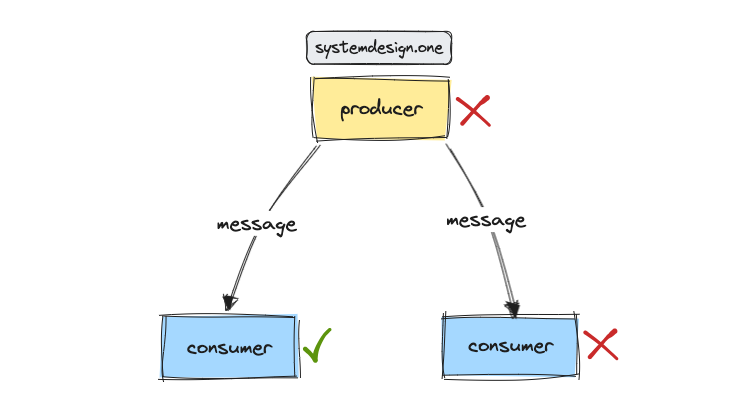
Point-to-point broadcast has a producer send messages directly to consumers. Reliability comes from retries on the producer and deduplication on consumers, but messages are lost if the producer and consumer fail at the same time.
Eager reliable broadcast improves fault tolerance by having every node re-broadcast to every other node over reliable links, so remaining nodes can re-broadcast even if both producer and consumer fail. The tradeoffs are significant:
O(n²)messages for n nodes, consuming substantial network bandwidth- the sending node becomes a bottleneck due to
O(n)linear broadcast - every node stores the entire node list, increasing storage cost
Gossip protocol sits between these extremes, offering decentralized, scalable dissemination without the centralized failure modes or the quadratic message overhead.
Gossip Variants
Choosing a gossip variant depends on the time needed to propagate a message and the network traffic generated. The three main categories are anti-entropy, rumor-mongering, and aggregation.
Anti-Entropy Model
The anti-entropy algorithm was created to reduce divergence among replicas of stateful services such as databases. In each gossip round, replicas are compared and differences are patched — the node with the newest message shares it with others. Because the model typically transfers entire datasets, it can waste bandwidth. Techniques like checksums, recent update lists, and Merkle trees help identify differences and cut unnecessary transfer. However, anti-entropy sends an unbounded number of messages and never truly terminates.
Rumor-Mongering Model
Also called the dissemination protocol, rumor-mongering runs its cycles much more frequently than anti-entropy and can flood the network at worst-case load. It is more resource-efficient in normal operation because only the latest updates are transferred. Messages are marked as removed after a few rounds to bound the total message count, with a high probability that every node receives each message before removal.
Aggregation Model
The aggregation model computes a system-wide value by sampling information across nodes and combining the results — useful for deriving global statistics without a central coordinator.
Message Dissemination Strategies
Within anti-entropy and rumor-mongering, three strategies control how updates spread. Each has tradeoffs in bandwidth, latency, and reliability:
- Push model — a node with the newest message sends it to a random subset of other nodes. Efficient when updates are few because traffic overhead stays low.
- Pull model — every node actively polls a random subset of peers for updates. This suits environments with many updates, since it becomes highly likely to find a node with the latest message.
- Push-pull model — combines both. Push works best early when few nodes have the update; pull is more effective later when many nodes hold it. Together they disseminate messages quickly and reliably.
Measuring Gossip Performance
The effectiveness of a gossip protocol is governed by two key parameters: fanout, the number of nodes a given node forwards a message to, and cycle, the number of gossip rounds required for a message to reach the entire cluster. The relationship is logarithmic:
cycles necessary to spread a message across the cluster = O(log n) to the base of fanout, where n = total number of nodes
With a fanout that achieves this bound, a cluster of roughly 25,000 nodes can converge in about 15 rounds. Setting the gossip interval as low as 10 ms can propagate a message across a large data center in approximately 3 seconds. Messages should age out automatically to prevent unnecessary load. The standard metrics for evaluating a gossip implementation are:
- residue – the number of nodes that have not yet received the message should be minimal
- traffic – the average number of messages exchanged between nodes should be minimal
- convergence – every node should receive the message as quickly as possible
- time average – the average time to deliver the message to all nodes should be low
- time last – the time for the final node to receive the message should be low
Resource costs are modest: a case study of a 128-node system showed the gossip protocol consumed under 2 percent of CPU and less than 60 KBps of bandwidth.
Core Properties and the Gossip Algorithm
There is no formal definition of the gossip protocol, but implementations generally share these traits:
- node selection for fanout is random
- nodes rely only on local information and are oblivious to the overall cluster state
- communication is periodic, pairwise, and interprocess
- each gossip round has bounded transmission capacity
- all nodes run the same protocol
- unreliable network paths are assumed
- node interaction frequency is low
- interactions result in a state exchange
The high-level algorithm is straightforward:
- each node keeps a list of a subset of nodes and their metadata
- periodically gossip to a random live peer
- on receiving a message, inspect it and merge the highest version number into the local dataset
A node increments a heartbeat counter each time it participates in an exchange. If the counter keeps advancing, the node is healthy; if it stalls for an extended period, the node is presumed unhealthy due to failure or partition. Peer selection can use a language library such as java.util.random, target the least-contacted node, or use a network-topology-aware strategy.
Implementation Details
Messages travel over UDP or TCP with a configurable but fixed fanout and interval. A peer sampling service identifies candidate nodes via a randomized algorithm, exposing two endpoints:
/gossip/init– returns the list of nodes known at startup/gossip/get-peer– returns the IP address and port of an independent peer
The service runs by initializing each node with a partial view of the system, then merging that view with a peer's view during each gossip exchange. Probabilistic peer selection can reduce duplicate transmissions to the same node.
Application state is transferred as versioned key-value pairs; when multiple changes hit one key, only the most recent value is sent. The orchestration API includes /gossip/on-join, /gossip/on-alive, /gossip/on-dead, and /gossip/on-change. Seed nodes, based on static configuration, must be known to every node to prevent logical cluster divisions.
When a node receives gossip containing a peer's metadata, the workflow is:
- compare the incoming message to find values missing locally
- compare it to find values missing on the peer
- when a value exists locally, keep the higher version
- append missing values to the local dataset
- return the peer's missing values in the response
- update the peer's dataset from the response
Full node metadata is typically exchanged at startup; afterwards, an in-memory version number supports incremental updates. A generation clock—a monotonically increasing number bumped at every restart—is combined with the version number to detect metadata changes correctly across restarts.
The gossiper timer ensures that every node eventually receives crucial peer metadata, including information about partitioned nodes. Heartbeat state carries a generation and version number, while application state consists of key-value pairs with version numbers. A node initiating an exchange sends a gossip digest synchronization message, a list of gossip digests containing endpoint address, generation number, and version number. The acknowledgment carries a digest list and endpoint state list.
A sample gossip digest schema looks like:
EndPointState: 10.0.1.42
HeartBeatState: generation: 1259904231, version: 761
ApplicationState: "average-load": 2.4, generation: 1659909691, version: 42
ApplicationState: "bootstrapping": pxLpassF9XD8Kymj, generation: 1259909615, version: 90
Where Gossip Is Used
Gossip appears wherever eventual consistency is acceptable, including database replication, information dissemination, cluster membership, failure detection, aggregation, overlay network generation, and leader election.
Failure detection is a prominent use case: declaring a node dead based on a single client's inability to reach it is unreliable, since a partition or client fault may be the real cause. When several nodes confirm liveness via gossip, failure can be asserted with confidence, conserving CPU, bandwidth, and queue space.
Gossip is often more reliable than TCP for data exchange and command-and-control traffic. It abstracts node and subsystem properties—like average load and free memory—out of application logic, improving local fanout decisions. Queue depth, configuration changes, and request-response traffic can all ride gossip messages; batching updates into single chunks reduces communication overhead.
Because decision-making stays local without a centralized service, gossip scales well. Vector clocks can version messages so nodes discard stale versions. Notable production deployments include:
- Apache Cassandra – cluster membership, node metadata, Merkle tree repairs, failure detection
- Consul – swim-gossip variant for group membership, leader election, agent failure detection
- CockroachDB – node metadata propagation
- Hyperledger Fabric – group membership and ledger metadata in a blockchain
- Riak – consistent hash ring state and node metadata
- Amazon S3 – spreading server state
- Amazon Dynamo – failure detection and membership tracking
- Redis cluster – node metadata propagation
- Bitcoin – disseminating nonce values across mining nodes
Advantages of the Gossip Protocol
The primary strengths are scalability, fault tolerance, robustness, convergent consistency, decentralization, simplicity, interoperability, and bounded load.
Scalability comes from logarithmic convergence and the fact that each node talks to a fixed set of peers regardless of cluster size. Nodes also do not wait for acknowledgments, which keeps latency low.
Fault tolerance is inherent: gossip tolerates unreliable networks, and its redundant, parallel, random message paths mean a node failure is simply routed around. The symmetric, decentralized node structure reinforces this resilience.
Robustness against crashes and transient partitions follows from node symmetry. However, gossip is not robust against malicious actors unless data is self-verified; a score-based reputation system can help, and encryption, authentication, and authorization are needed for security.
Convergent consistency is achieved in logarithmic time through exponential data spread. The decentralized model of peer-to-peer information discovery is a natural fit for gossip, and most variants are simple—implementable in little code with low complexity. The protocol integrates cleanly with databases, caches, and queues, provided common interfaces and data formats are defined. Finally, gossip produces a strictly bounded worst-case load on individual components—practically negligible compared to available bandwidth—avoiding the surge loads typical of classic distributed protocols.
Disadvantages and Trade-offs
Gossip's weaknesses are the flip side of its strengths.
It is eventually consistent only, generally slower than multicast, and dependent on network topology and node heterogeneity. The cluster will experience delay before recognizing new nodes or failures.
The protocol is unaware of network partitions—sub-partitions continue gossiping internally, which can significantly delay message propagation cluster-wide.
Bandwidth can be wasted through duplicate retransmission to the same node. Though bounded message size and periodic exchange limit usage, effective fanout degrades when information volume exceeds that bound. The saturation point depends on message generation rate, size, fanout, and protocol variant.
Latency rises because nodes wait for the next gossip interval; messages do not trigger exchanges, only the interval timer does. Spread time is logarithmic, but not immediate.
Debugging and testing are difficult due to non-determinism and distribution, requiring simulation, tracing, and monitoring tooling. Many variants also depend on a membership protocol that is not itself scalable. Finally, the system is prone to computational errors from malicious nodes unless self-correcting mechanisms are added, though well-configured gossip systems remain extremely reliable with outcomes converging with probability one.
Further reading on gossip protocols
The mechanics of gossip-based dissemination are well documented across academic papers and engineering write-ups. For a deeper look into the distributed systems patterns behind this approach, Martin Kleppmann's lecture on broadcast algorithms is a solid starting point for understanding how epidemic protocols compare with other dissemination methods (source [3]).
For practitioners, Unmesh Joshi's piece on gossip dissemination at martinfowler.com breaks down the pattern in the context of real distributed systems, complementing the Cassandra architecture docs with practical detail (source [12], source [6]). Those working on failure detection and monitoring will also find value in earlier coverage of the subject at highscalability.com (source [11]).
Theoretical foundations
The canonical reference for epidemic algorithms remains the 1987 Berkeley paper by Demers et al., which introduced the idea of leveraging epidemiological principles for replicated database maintenance (source [10]). For a critical perspective on the approach and its limitations, Ken Birman's 2007 essay is still highly relevant (source [7]).
Introductory material
Several accessible introductions cover the basics, including a gentle walkthrough at analyticssteps.com and Prateek Gupta's 2022 write-up at medium.com (source [4], source [1]). For video walkthroughs, Gabriel Acuna's parallel & distributed computing lecture provides a practical overview (source [5]).
Two additional resources round out an understanding of how gossip fits into broader system design: a LinkedIn article on integrating gossip with other distributed components (source [2]) and a review of distributed systems fundamentals from Baeldung (source [9]). Felix Lopez's blog post offers yet another angle on the basic mechanics (source [8]).