A Brief History of Scaling Search
Search engines today are so embedded in modern application stacks that their architectural evolution is easy to overlook. Information retrieval has been a research topic since the earliest days of computing, but the field accelerated dramatically in the early 1990s with the introduction of the Text REtrieval Conference (TREC). In the three decades since, engine designs have been pushed through several distinct phases — each driven by new data volumes, query loads, and operational requirements.
What follows is a view of those phases, grouped into four broad architectural categories. This is necessarily a simplification: real-world engines often blend characteristics from several eras. But the categories help isolate the core engineering trade-offs that still shape how systems are built.
The Inverted Index Era
The first major architectural breakthrough was the adoption of the inverted index. Borrowing from the index at the back of a book — which maps a word to the pages that mention it — a search engine builds a dictionary of every token it sees. For each token, it stores a sorted list of document identifiers containing that token. When a user submits a multi-word query, the engine scans the relevant inverted lists, computes their intersection, and ranks the surviving documents.
This core concept remains universal. What followed was a long line of research into how to represent inverted indexes efficiently: which compression algorithms to apply, and how to structure inverted lists as they accumulate more entries. Manning’s Introduction to Information Retrieval is a standard reference for these techniques.
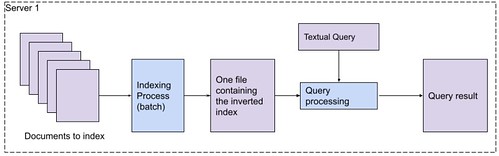
Architecturally, early engines were simple. There was one indexing process that consumed a list of records and emitted a binary file representing the inverted index. A separate query process read that binary file to resolve queries. There was no scaling concept at all — adequate only for small datasets.
The rapid expansion of the web in the early 1990s made this approach untenable. Website counts exploded from roughly 130 in 1993 to 23,500 by 1995, quickly exceeding what manual directories could handle. The first web search engines appeared in 1993, but it was Alta Vista in 1995 that demonstrated true parallelization, indexing on the multi-processor 64-bit Alpha servers from Digital Equipment Corporation.
The Sharded Architecture
Parallelizing search is conceptually straightforward. Instead of maintaining a single inverted index over all documents, you split the document set into N smaller subsets. Each shard holds a fraction of the documents and produces its own inverted index. Indexing runs concurrently across shards, and querying does likewise — the system issues N queries and merges the partial results.

With sharding, search engines began to handle serious volumes. Early implementations fixed the shard count in advance. A hash function allocated each document to exactly one shard, guaranteeing no duplication across shards. The architecture came with important operational constraints:
- A fixed number of shards spread across servers.
- Indexing and searching for a given shard had to run on the same machine, since inverted indexes lived on local storage.
- There was no distributed commit; an indexing operation could not be made atomically visible across shards. Changing a record structure such as indexed attributes required building a fresh index.
- The merge step struggled with non-algebraic aggregations, such as collapsing jobs by company name on a job board and then ranking within groups.
Refinements emerged quickly. Batch indexing was replaced by incremental data structure builds, borrowing database techniques to avoid rebuilding entire inverted lists after every write. Sharding itself became a permanent fixture of search architecture, though later joined by other mechanisms aimed at availability. That was the next frontier.
Replication and High Availability
By 1995 there were roughly 16 million internet users; five years on, that number exceeded 5 billion. Query volume posed a different problem than raw data size. Sharding solved scale of data; handling massive query traffic required allowing any query to be answered by multiple independent sets of machines. The answer was replication: keep the same sharded architecture but instantiate N complete groups, each able to serve any query. Replica groups can be added or removed depending on traffic, and each group sits in its own availability zone in cloud deployments to improve the service level objective (SLO). A load balancer routes requests across the groups and retries on failure.
The architectural families share properties, but replication adds its own constraints:
- Handling effectively unbounded query volume by replicating data. Scaling still takes time — often hours, since it requires copying inverted indices from existing machines. This only works when traffic growth can be anticipated.
- A multi-provider deployment usually shifts away from copying on-disk structures. Inter-provider bandwidth becomes a bottleneck when transferring large binaries. Instead, the primary shard receives indexing operations, appends them to a log, and replicates that log to follower locations. Applying the operations elsewhere is generally faster than copying entire binary data files.
Generational data structures are common in this design, minimizing the amount of data that needs to be transferred during replication. The internals of the LevelDB key-value store offer a useful illustration of these concepts, and the same principles frequently appear in search engine storage layers.
What this era did not fix were the deeper constraints carried over from sharded designs: the coupling between indexing and searching per shard, the lack of atomic atomic cross-shard operations, and the need for downtime-heavy reindexing when schemas change. Those limitations set the stage for the next generation of search engine design.
Indexing joins the high-availability club
The architectures described so far made search itself resilient to hardware failure, but the rapid-growth use case of ephemeral content—Snapchat being the canonical example—pushed indexing into the critical path too. That content must be searchable almost immediately, which means indexing can no longer be a single point of failure. The solution across modern search engines is to ensure that at least two machines can build any given shard.
Elasticsearch, introduced in 2010, is the most prominent example of this approach. Its headline contribution was not high availability per se, but elasticity: the ability to add machines to a running cluster and have shards automatically redistribute across them. That capability marked a genuine step change in how search infrastructure could be operated.
The model extends the primary/replica scheme from earlier designs. Each shard has a single primary, which guarantees a unique ordering of indexing operations, plus N replicas. Replicas must apply those operations in the same order to converge on identical state. Should the machine hosting a primary fail, a leader election algorithm promotes one of the replicas to primary, preserving global consistency.
Consider a concrete configuration: one index with four shards, a replication factor of three (one primary and two replicas per shard), spread across four machines. Each machine hosts one primary and two replicas. An indexing operation is routed to the correct primary shard—any of the three machines holding a copy can accept the operation—and the primary then replicates it to its replicas, applying the change on three machines in parallel.
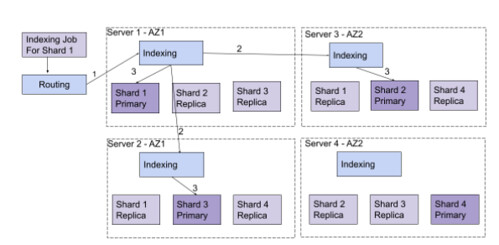
Queries are load-balanced across the three copies of each shard, tripling the achievable queries-per-second compared to a single copy. For fault tolerance, the copies are distributed across two availability zones (AZs): the first copy lives entirely in AZ1, the second entirely in AZ2, and the third is split across both zones.
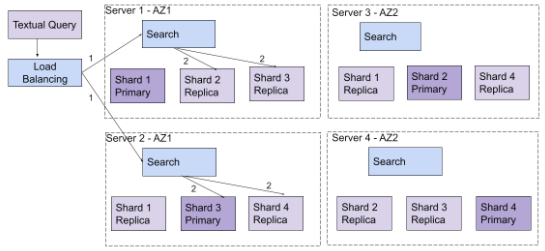
Elasticity works by adding or removing machines; the system automatically migrates shards to maintain even load. After adding a new machine in AZ2, the allocation algorithm rebalances shards accordingly. Note that the number of shards itself remains static—it is a configuration decision with significant performance implications. Too few shards and you cannot use all available CPU resources; the standard remedy is to increase the replica count to support more queries. Too many shards, and you risk having more shards than available threads to process them in parallel, which hurts response time.
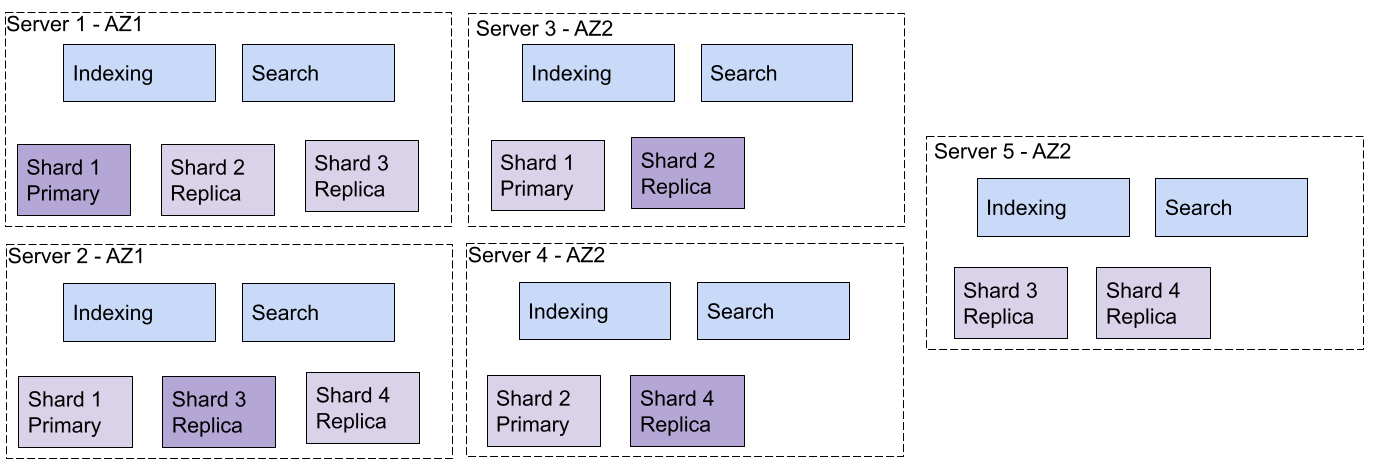
This architecture tolerates two broad classes of failure. A single machine going down has no impact on availability: replicas remain for both search and indexing, and leader election promotes a new primary. The only cost is reduced search capacity due to fewer available CPU threads. An entire AZ failing is more severe: search remains available but with diminished capacity, while indexing stalls for shards that have lost their primary and now hold only one of three copies—too few to trigger a leader election.
This generation of architecture establishes the current state of the art, characterized by:
- Data scaling bounded by the configured number of shards
- Query-volume scaling through the addition of replicas
- Tolerance for individual machine failures and, to a degree, AZ failures
What the next decade demands
More than a decade has passed since this architecture became the norm. Fast-growing marketplaces and multi-tenant SaaS platforms have since exposed its limits. Five challenges stand out for the next generation.
Sub-minute machine elasticity. Adding and removing machines already works, but takes too long for true dynamic scaling—particularly for absorbing unplanned traffic spikes before new capacity comes online. One large marketplace described a flash-sale event where customers hunted for a discounted product hidden in a vast catalogue; the announcement email triggered 160 times their average daily traffic. Such virality is, by definition, impossible to provision for in advance.
A dynamic number of shards. Shard count is fundamental to performance and scalability, yet it is fixed at configuration time. Ideally it would change as needs evolve. The next generation should allow dynamic adjustment—and ultimately automatic tuning—of the shard count to maintain optimal performance.
Independent scaling of search and indexing. When both query volume and data volume grow, the cost of replicating indexing work across every replica becomes prohibitive. If each shard is indexed only once, search capacity and indexing capacity can be scaled separately, so that scaling one subsystem no longer burdens the other—especially when the system is already near its limits.
Exploiting faster networks. Ten years ago, 1 Gbps links between machines were typical. Today public clouds offer up to 100 Gbps, a hundredfold increase that far outpaces CPU and storage improvements over the same period. Realizing that potential requires architectures built around far more parallelized data transfer from the ground up.
Native multi-tenant isolation. SaaS providers commonly house many customers in a single index to keep costs manageable. The trade-off is that no tenant can be given guaranteed performance. A next-generation architecture must present one logical index while giving the largest tenants dedicated shards and resources, shielding them from noisy neighbors.
These five challenges were identified in 2019 as the basis for a new architecture, now in testing with early customers. Details on how that design addresses each of them will follow.