
An 18-Year-Old Storage Behemoth
Since its launch in 2006, AWS S3 has evolved from a simple backup and media-hosting service into the foundational storage layer for massive data lakes powering analytics and machine learning workloads. The scale numbers are staggering: over 280 trillion objects, 100 million requests per second, and 400 terabits per second of throughput across 31 regions and 99 availability zones.
Key milestones in its evolution include the introduction of Glacier in 2012, Intelligent-Tiering in 2013, strong read-after-write consistency in 2020, Object Lambda in 2021, and S3 Express in 2023 with its 10x latency improvements and 50% cheaper request costs.
The Four-Layer Architecture
Despite its complexity—over 300 microservices—S3's architecture distills into four high-level components: a front-end REST API fleet, a namespace service, a storage fleet of hard disk-backed nodes, and a management fleet handling background operations like replication and tiering.
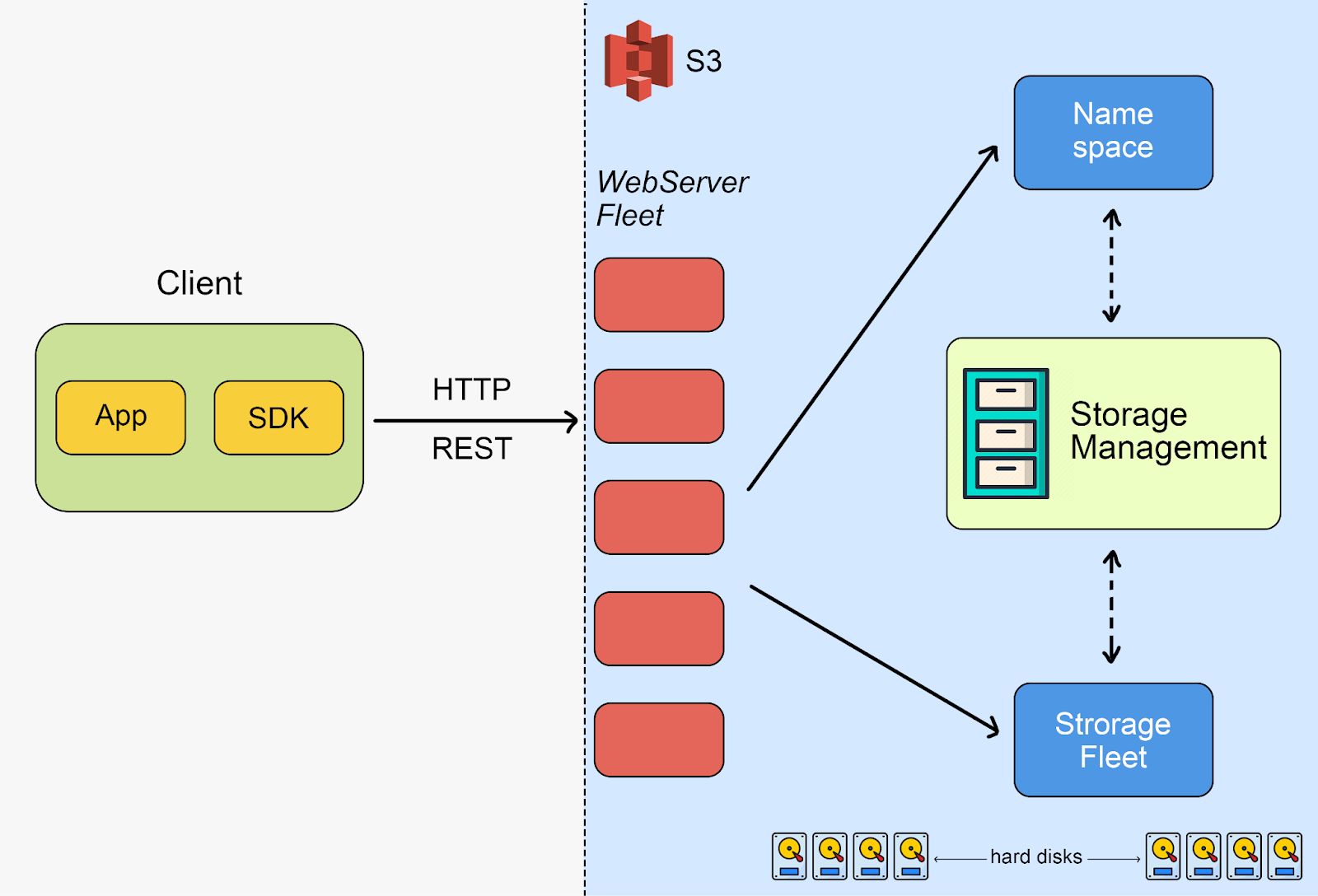
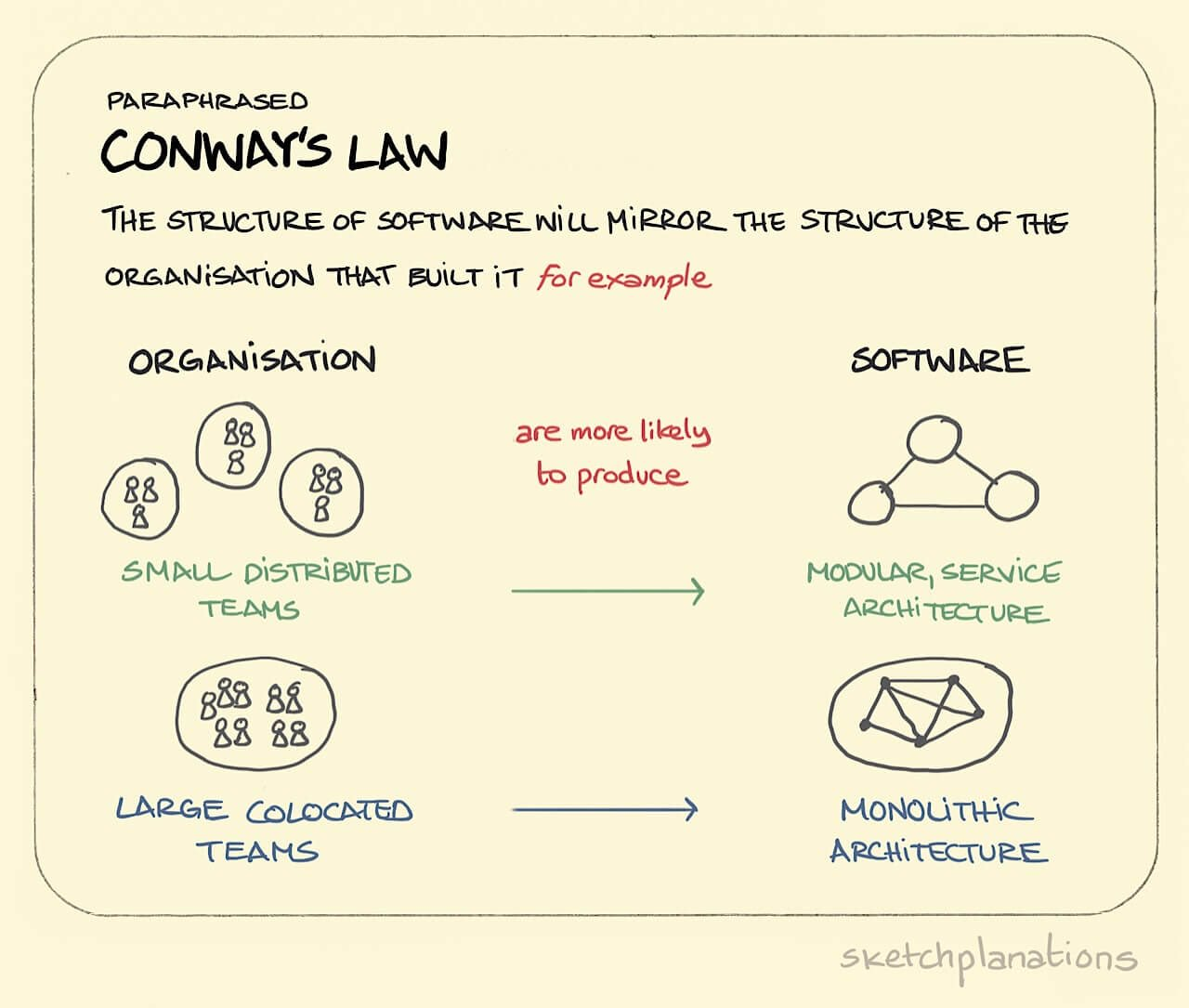
This structure reflects Conway's Law, with the organization chart mirroring the technical architecture. Each component operates like an independent business with its own nested teams, communicating through formal API-level contracts.
The Physical Storage Layer
At its core, S3 remains a massive collection of millions of hard drives. The storage nodes themselves are simple key-value stores persisting object data, with shards replicated across many nodes by the control plane.
AWS has invested heavily in their newer ShardStore backend, written initially in about 40k lines of Rust. It functions as a log-structured merge tree with data stored externally to reduce write amplification, featuring a soft-updates-based crash consistency protocol designed for extensive concurrency and efficient HDD I/O scheduling and coalescing.
The Persistence of HDDs
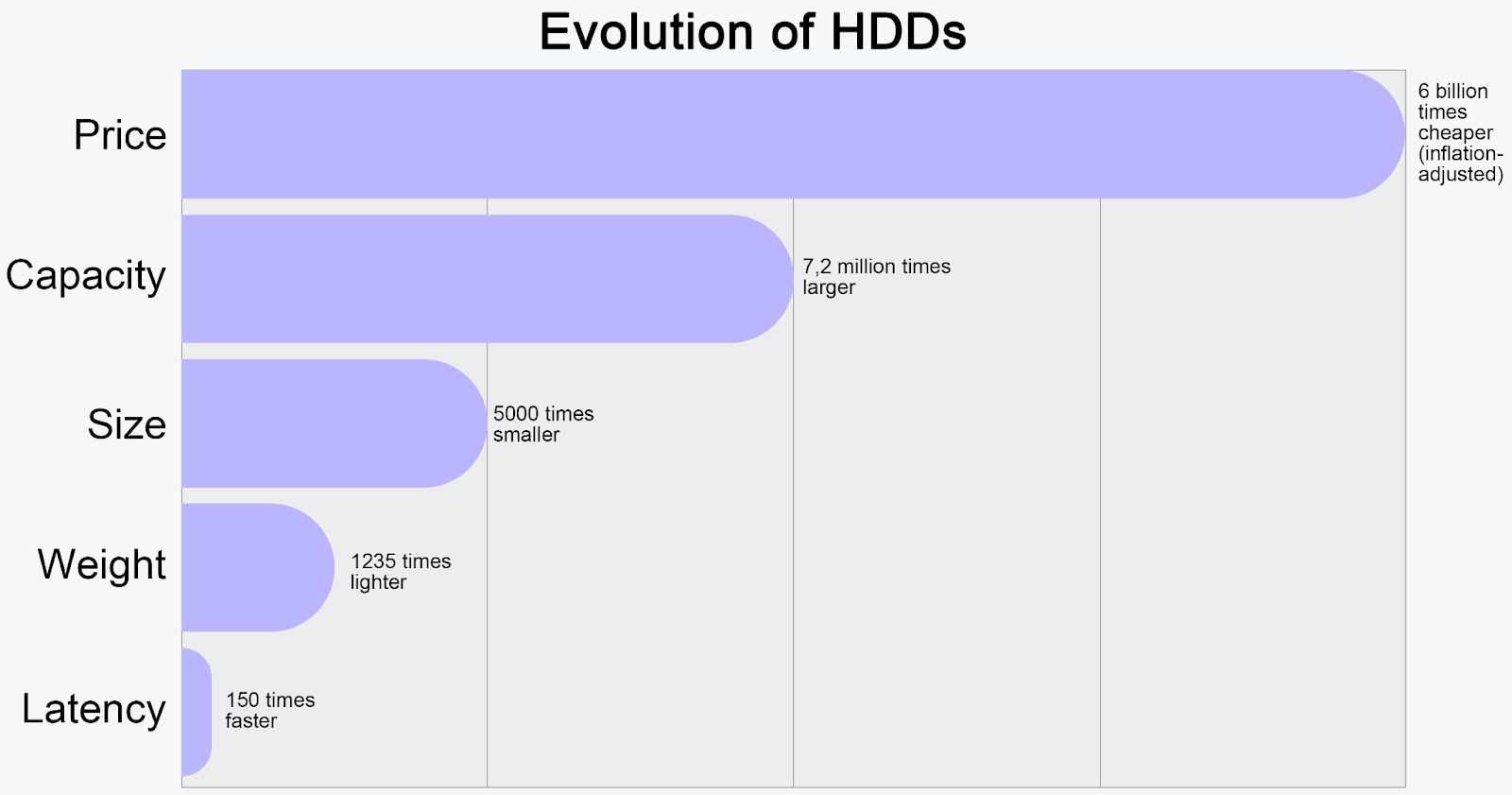
Hard drives have seen dramatic improvements since the 3.75MB drive priced at $9k in 1956. Today's 26TB drives cost roughly $15 per TB, representing a 6-billion-fold price reduction per byte. Capacity has grown 7.2 million times, while size and weight have shrunk by factors of 5,000 and 1,235 respectively.
Yet IOPS performance has stalled around 120 per disk, making HDDs relatively slower per byte over time. S3 works around this fundamental constraint through heavy parallel I/O, delivering acceptable latency despite the underlying hardware limitations.
Redundancy and Erasure Coding
Redundancy schemes serve two purposes: durability against hardware failures and managing "heat"—spreading load to balance read traffic across the system.
S3 employs Erasure Coding (EC), which breaks data into K shards plus M parity shards, allowing recovery from any K out of K+M total shards. For instance, 10 data fragments with 6 parity shards tolerates losing up to 6 shards. EC provides a middle ground: better capacity efficiency than triple replication near-standard durability with flexible I/O opportunities.
Spreading Data Broadly
S3 distributes shards across tens of thousands of customers' data over millions of physical drives. This broad spread provides four key benefits:
- Hot Spot Aversion: No single customer can create troublesome cascading hot spots in the shared infrastructure.
- Burst Demand Support: Greater parallelism across drives enables higher burst I/O than naive replication on a few disks.
- Enhanced Durability: More distributed shards mean the system survives more individual machine failures.
- Reduced Read Amplification: While a single read still causes disk seeks, those seeks occur across different drives rather than concentrating on one disk, keeping latency low.
Managing Heat Through Workload Decorrelation
Balancing I/O demand across vast numbers of hard drives is among S3's most significant operational challenges. The goal is minimizing requests hitting the same disk simultaneously, preventing exhaust capacity, stalling, and amplified delays through the request stack and erasure coding operations.
Since S3 cannot predict access patterns at write time, initial placement is inherently tricky. However, S3's multi-tenant scale creates workload decorrelation: individual storage workloads typically stay idle, spiking only when accessed, but aggregated across millions of workloads, traffic flattens into smooth, predictable throughput.
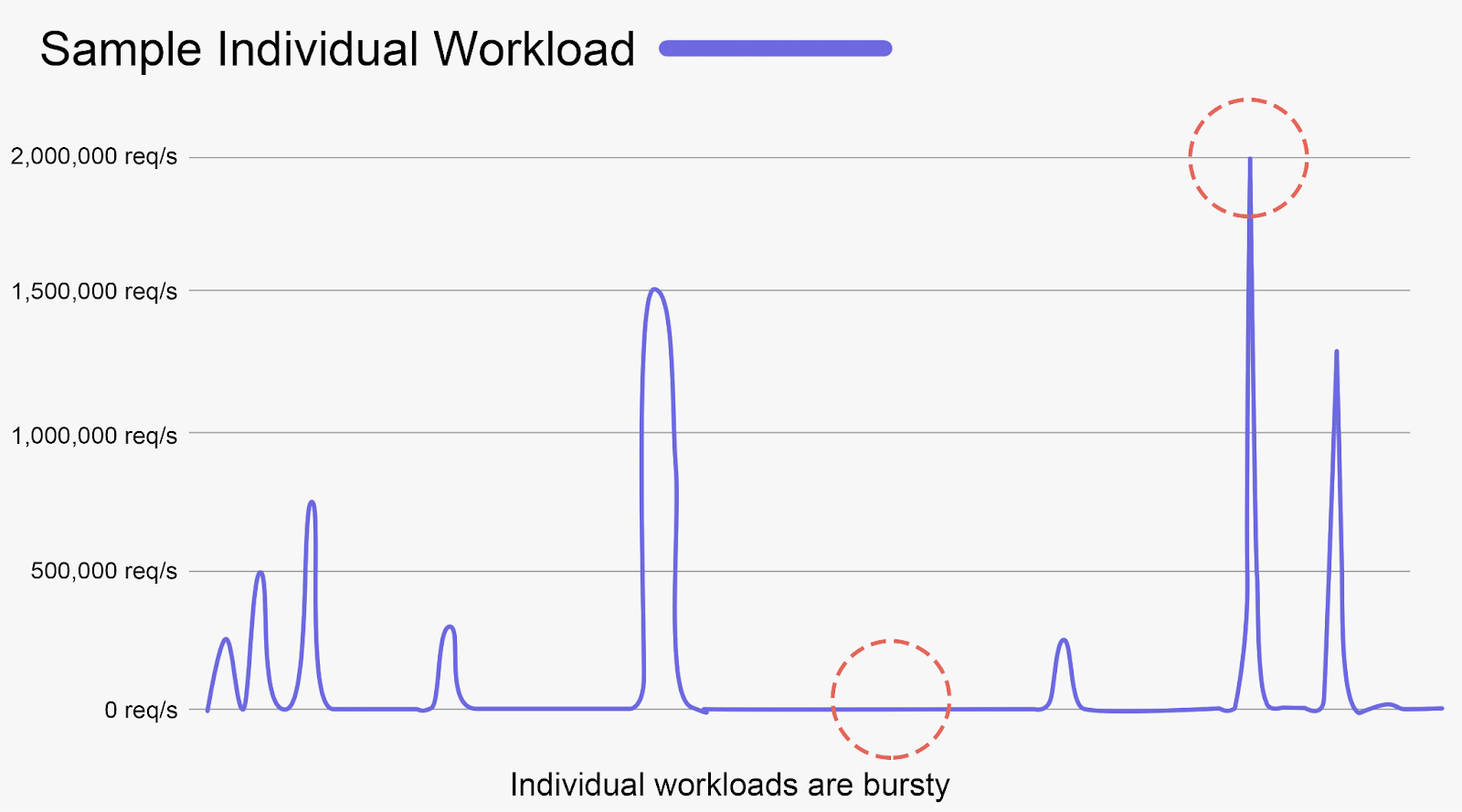
At sufficient scale, any single workload cannot influence aggregate demand. The problem simplifies to balancing a smooth request rate across available disks.
Parallelism as a Core Strategy
Parallelism benefits both AWS and its customers—unlocking better performance while enabling workload decorrelation optimization.
Contrasting Capacity and I/O Demands
Consider two workload types:
- A 3.7PB bucket with 2.3 million IOPS needs only 143 drives for capacity using 26TB disks but requires 19,166 drives to meet the I/O demand—a 13,302% gap.
- A 28PB bucket with just 8,500 IOPS needs 71 drives for I/O but 1,076 drives for capacity—a 1,415% gap.
These extremes, 134x and 15x imbalances respectively, demonstrate why parallelism is essential to achieving necessary throughput without excessive capacity over-provisioning.
Parallelism Across Servers
Parallelism starts with the client. Users are encouraged to create multiple clients with numerous parallel connections to various S3 endpoints, distributing load across the infrastructure and preventing hotspots in components like caches.
Parallelism Within Operations
Individual operations also leverage parallelism:
- PUT requests: Multipart upload enables multiple threads to maximize write throughput.
- GET requests: The HTTP Range header allows reading specific object byte ranges, achieving higher aggregate throughput than whole-object reads.
Consistency: From Eventual to Strong
The most significant shift in S3's history came in 2020 with the introduction of strong read-after-write consistency. After a write or overwrite completes, every subsequent read returns the most recent version. This was achieved without any degradation to performance, availability, or cost — a considerable feat at S3's operational scale.
The root of the prior eventual consistency lay in S3's dedicated per-object metadata subsystem. The persistence tier for this metadata leans on a highly resilient caching layer to keep the critical data path fast. Because writes and reads could pass through different parts of that cache infrastructure, a read might occasionally see a stale value.
The fix arrived via new replication logic in the persistence tier that established a per-object ordering of operations. This ordering became the cornerstone of the cache coherency protocol, allowing the system to determine definitively whether a cache's view was outdated. A new component now serves as a witness for writes and a read barrier for reads. When it detects that a cached value may be stale, it invalidates the cache and forces the read to pull directly from the persistence layer.
Durability Is a Process, Not a Number
S3 advertises 11 nines of durability (99.999999999%). In practical terms, if you store 10,000 objects, you can expect to lose just one every 10 million years. But behind that figure is a constant war against hardware entropy.
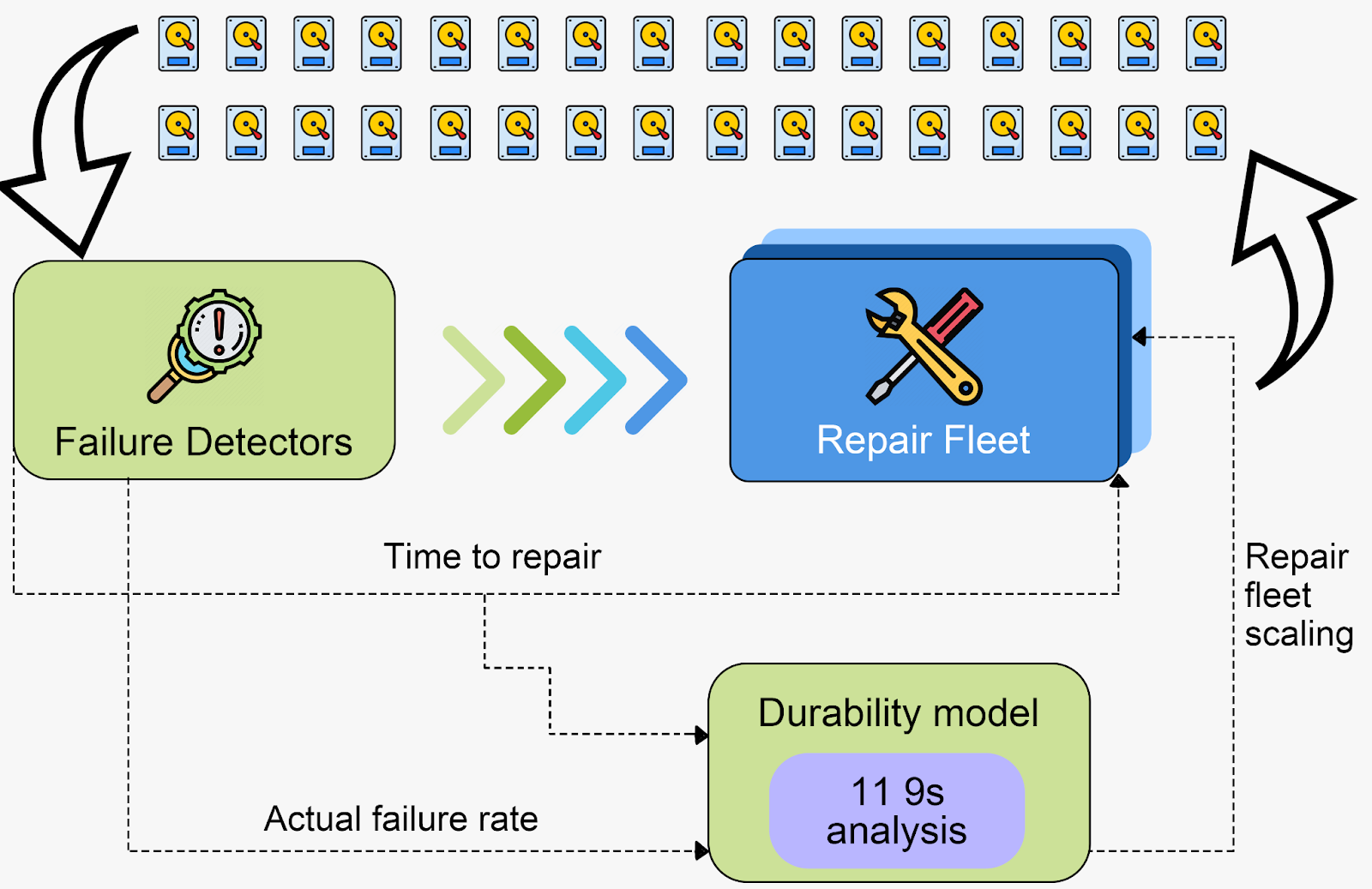
Disk failure at S3's scale is an hourly event, not a rare anomaly. The theoretical model is simple: as long as the repair rate exceeds the failure rate, data survives. The practical challenge is ensuring that holds under unpredictable stress. AWS cites a telling scenario: a data center in a hot climate loses power, the cooling stops, and drive failure rates spike dramatically.
To handle such compounding failures, AWS runs a self-healing system with detectors that track failure rates and dynamically scale the repair fleet. A background durability model continuously evaluates whether the service actually meets its stated durability targets. The core principle is that durability is never a static snapshot; it requires relentless, continuous assessment.
The Long Tail of Data Loss
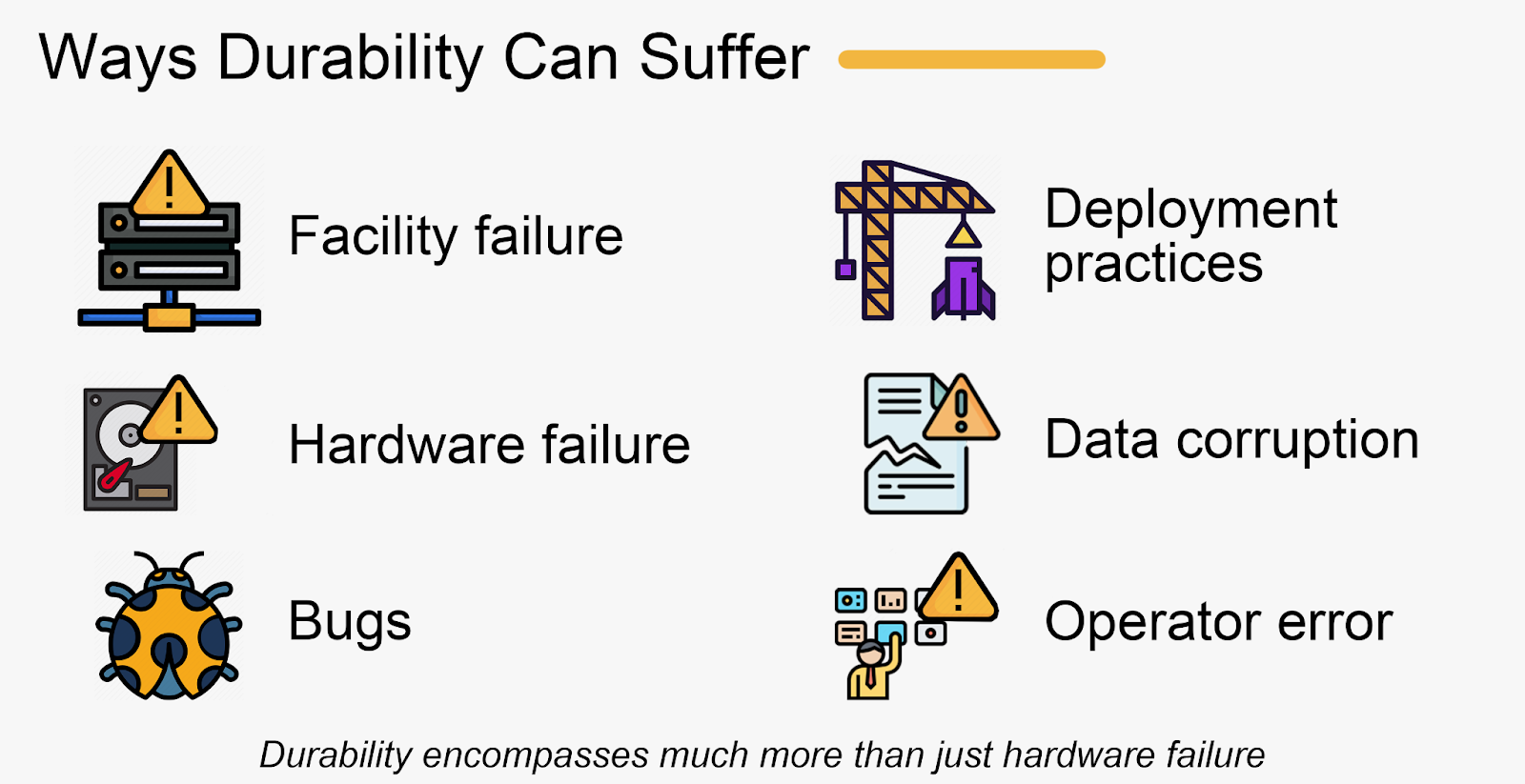
Durability covers more than just drive failures. A working disk doesn't protect you from software bugs that corrupt data, human operator errors that delete it, or network corruption that alters bits before they even arrive at the data center.
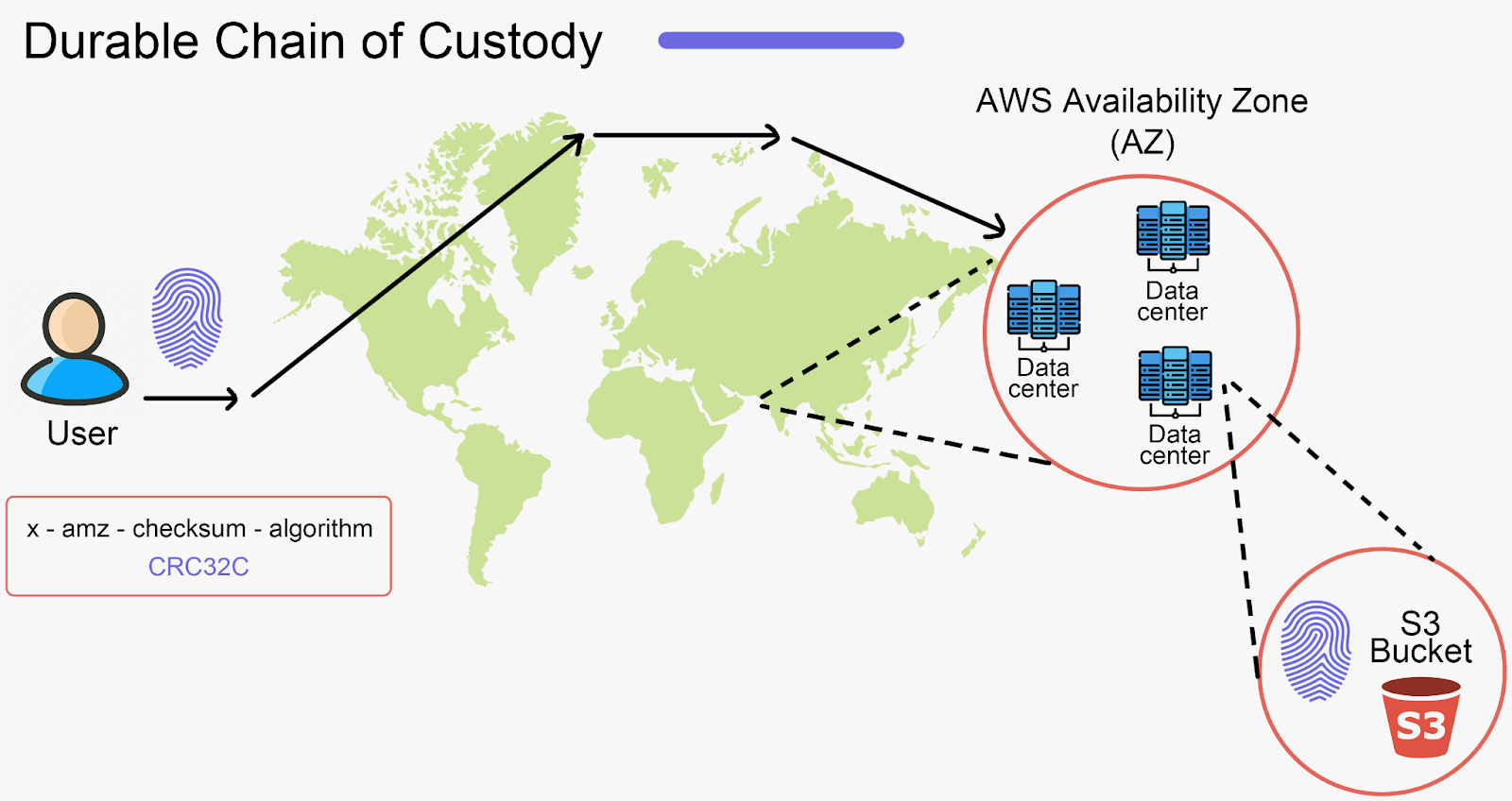
In response to the network corruption edge case, AWS introduced what it calls a "durable chain of custody." The S3 SDK now calculates a checksum and attaches it to the HTTP request as a Trailer. This design choice was deliberate: adding the checksum as a trailer avoids requiring a full second scan of the payload. At the volume S3 processes, the philosophy is that if a failure mode can be theorized, it has probably already manifested or soon will.
Considering the trajectory from eventual to strong consistency, the immediate question is why this simpler, stronger model wasn't the original design. The answer lies in the historical constraints of building at immense scale, and more recent architectural advances—such as the development of more flexible distributed consensus systems alongside enhancements in data plane replication infrastructure—that made the transition feasible.
Operational Culture
S3's success is as much an exercise in social engineering as it is in distributed systems design. With constant onboarding of new engineers and attrition of experienced ones, AWS leans heavily on automation to maintain velocity and reliability.
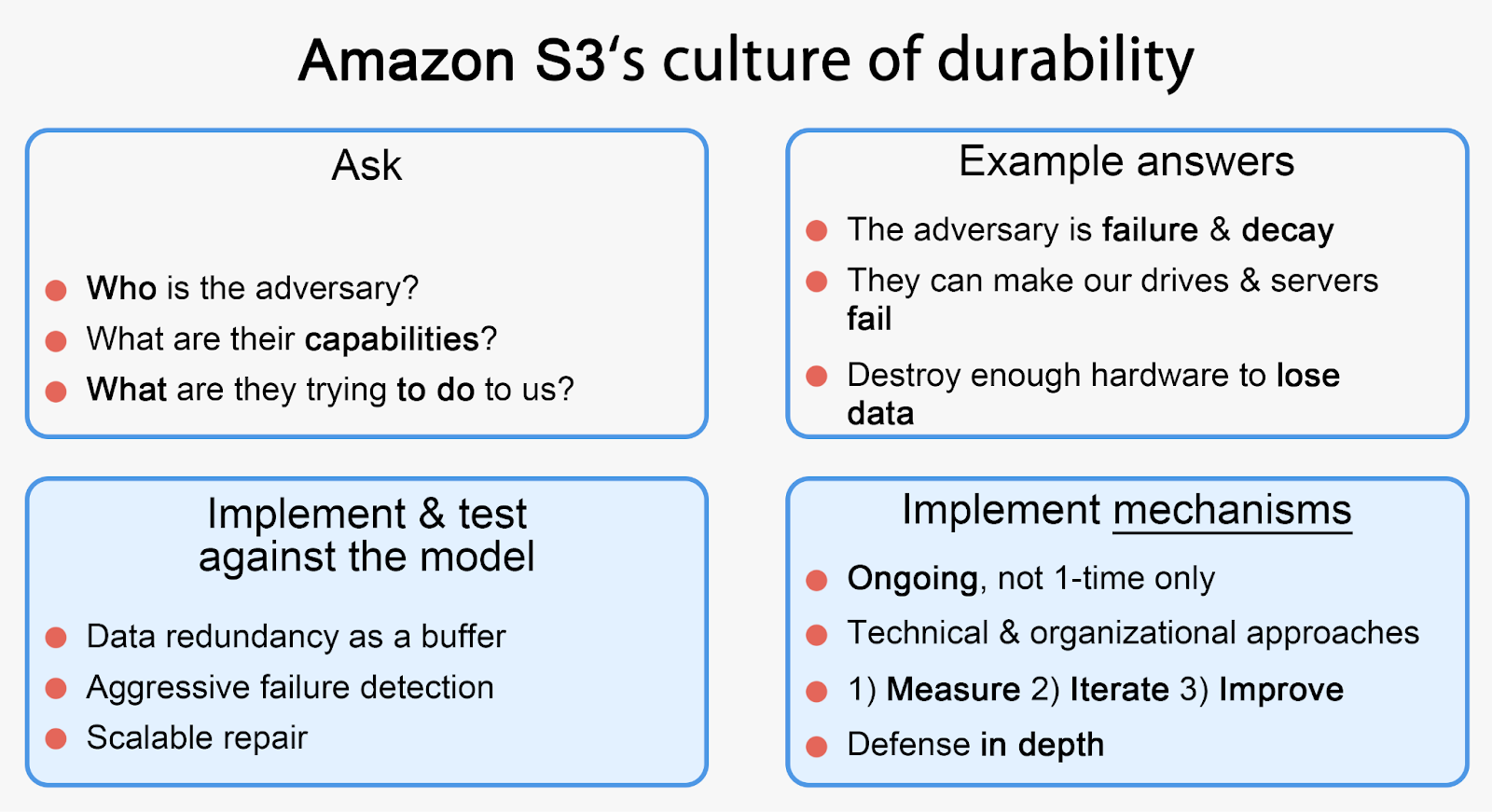
Their development pipeline has baked in extensive property-based testing that iterates through a large space of request patterns, alongside lightweight formal verification integrated directly into the CI/CD process. When designing new features, teams apply a "Durability Threat Model," a concept borrowed from the security world, to systematically enumerate and mitigate every conceivable threat to durability.
The overarching goal is to fold durability considerations directly into the corporate culture, ensuring that the organizational processes protecting data are as resilient as the technical ones.
Lessons from the Scale
S3 represents the ultimate expression of a multi-tenant storage system: a huge network of individually slow, fallible machines that, when stitched together, provide enormous throughput and capacity. The true payoff is economic. By aggregating demand across millions of customers, AWS can offer capacity that makes previously infeasible use cases practical — consider the genomics lab storing petabytes of data it won't touch for months, then processing it all in a burst.
Without the massive shared infrastructure, such workloads would require paying full price for idle drives. S3's architecture demonstrates how scale fundamentally transforms the economics of data storage, turning a cost-prohibitive problem into a managed service available to anyone.