

Time series data in PostgreSQL raises a common question: how do you compute the difference between the current row and the one before it? The queries below sketch out the general techniques — this is an introduction to what windowing and analytics functions make possible, not a full tutorial.
Getting data in place
The examples start with a small sample set:
|
1 2 3 4 5 6 7 8 9 10 11 12 |
cypex=# CREATE TABLE t_oil ( region text, country text, year int, production int, consumption int ); cypex=# COPY t_oil FROM PROGRAM 'curl /secret/oil_ext.txt'; COPY 644 |
A superuser can pull the data in with COPY ... FROM PROGRAM; everyone else needs another route for loading the text file.
The lag function and the ordering problem
Differences between rows go through lag, but using it forces a prior question: what counts as "the previous row"? That only means something once an order exists, which is what the OVER clause supplies.
|
1 2 3 4 5 6 7 8 9 10 11 12 13 14 15 16 17 18 |
cypex=# SELECT country, year, production, lag(production, 1) OVER (ORDER BY year) FROM t_oil WHERE country = 'USA' LIMIT 10; country | year | production | lag ---------+------+------------+------- USA | 1965 | 9014 | USA | 1966 | 9579 | 9014 USA | 1967 | 10219 | 9579 USA | 1968 | 10600 | 10219 USA | 1969 | 10828 | 10600 USA | 1970 | 11297 | 10828 USA | 1971 | 11156 | 11297 USA | 1972 | 11185 | 11156 USA | 1973 | 10946 | 11185 USA | 1974 | 10461 | 10946 (10 rows) |
Ordering by year is what guarantees the preceding year actually sits in the preceding row.
Computing the delta
Once the right row is reachable, the calculation itself is straightforward:
|
1 2 3 4 5 6 7 8 9 10 11 12 13 14 15 16 17 18 |
cypex=# SELECT country, year, production - lag(production, 1) OVER (ORDER BY year) AS diff FROM t_oil WHERE country = 'USA' LIMIT 10; country | year | diff ---------+------+------ USA | 1965 | USA | 1966 | 565 USA | 1967 | 640 USA | 1968 | 381 USA | 1969 | 228 USA | 1970 | 469 USA | 1971 | -141 USA | 1972 | 29 USA | 1973 | -239 USA | 1974 | -485 (10 rows) |
Note the NULL in the first row: no previous row exists, so no difference is known.
Measuring against the first row
A related need is the gap between the current row and the first row of the set. PostgreSQL and ANSI SQL provide first_value, which returns the first row according to the ordering you specify:
|
1 2 3 4 5 6 7 8 9 10 11 12 13 14 15 16 17 18 19 20 |
cypex=# SELECT t_oil.country, t_oil.year, t_oil.production, t_oil.production - first_value(t_oil.production) OVER (ORDER BY t_oil.year) AS diff_first FROM t_oil WHERE t_oil.country = 'USA'::text LIMIT 10; country | year | production | diff_first ---------+------+------------+------------ USA | 1965 | 9014 | 0 USA | 1966 | 9579 | 565 USA | 1967 | 10219 | 1205 USA | 1968 | 10600 | 1586 USA | 1969 | 10828 | 1814 USA | 1970 | 11297 | 2283 USA | 1971 | 11156 | 2142 USA | 1972 | 11185 | 2171 USA | 1973 | 10946 | 1932 USA | 1974 | 10461 | 1447 (10 rows) |
Every value here is expressed relative to that first row.
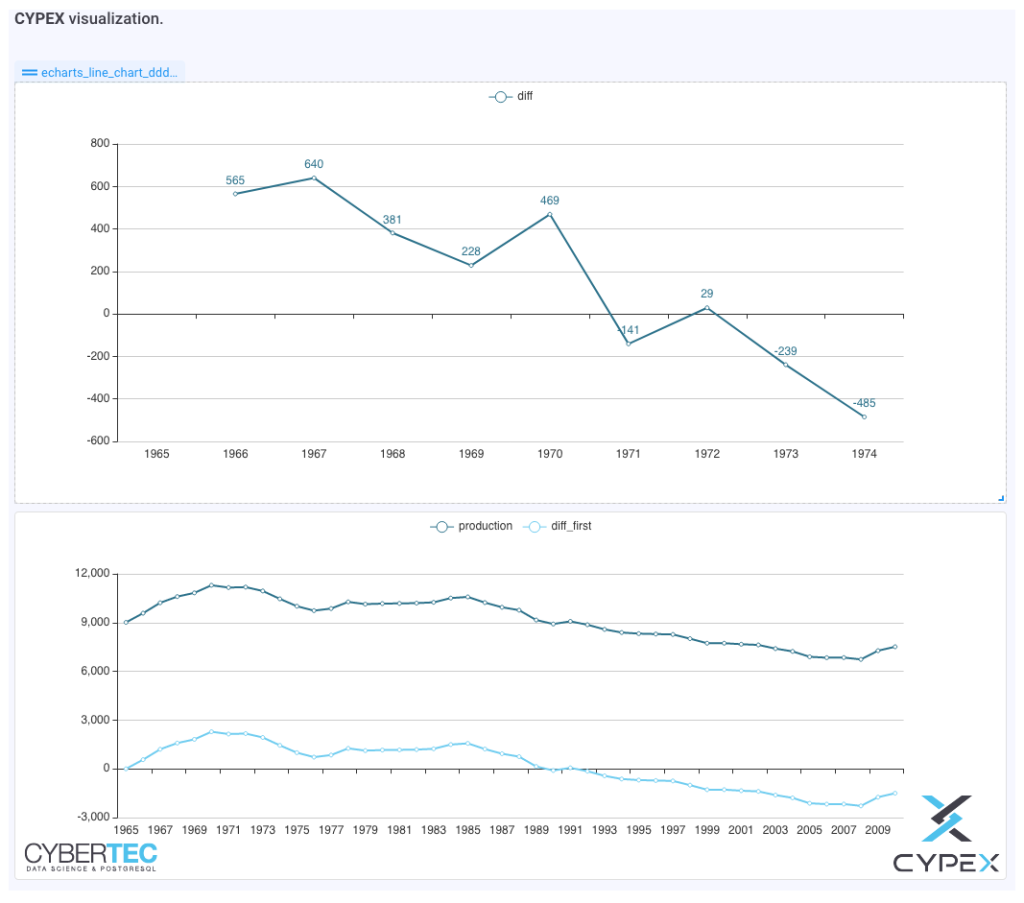
Splitting the data with PARTITION BY
Add a second country and the simple approach breaks down. Ordering by year alone can land on an unrelated row; ordering by both columns still doesn't stop a match against a row from a different country. The PARTITION BY clause is the fix — PostgreSQL divides the data into groups and computes the difference inside each group.
|
1 2 3 4 5 6 7 8 9 10 11 12 13 14 15 16 17 18 |
cypex=# SELECT country, year, production, lag(production) OVER (PARTITION BY country ORDER BY year) AS diff FROM t_oil WHERE country IN ('Canada', 'Mexico') AND year < 1970; country | year | production | diff ---------+------+------------+------ Canada | 1965 | 920 | Canada | 1966 | 1012 | 920 Canada | 1967 | 1106 | 1012 Canada | 1968 | 1194 | 1106 Canada | 1969 | 1306 | 1194 Mexico | 1965 | 362 | Mexico | 1966 | 370 | 362 Mexico | 1967 | 411 | 370 Mexico | 1968 | 439 | 411 Mexico | 1969 | 461 | 439 (10 rows) |
Because each partition has its own first row, each one produces a NULL — evidence that the groups are handled in isolation.
Moving averages via sliding windows
Moving averages come up often enough alongside differences to deserve their own treatment. Application-level implementations are the wrong place for this work on performance grounds, so it belongs in SQL:
|
1 2 3 4 5 6 7 8 9 10 11 12 13 14 15 16 17 18 19 20 21 22 23 24 25 |
cypex=# SELECT country, year, production, avg(production) OVER (ORDER BY year ROWS BETWEEN 2 PRECEDING AND 2 FOLLOWING) AS mov FROM t_oil WHERE country IN ('Saudi Arabien') AND year BETWEEN 1975 AND 1990; country | year | production | mov ---------------+------+------------+----------------------- Saudi Arabien | 1975 | 7216 | 8465.6666666666666667 Saudi Arabien | 1976 | 8762 | 8487.7500000000000000 Saudi Arabien | 1977 | 9419 | 8758.4000000000000000 Saudi Arabien | 1978 | 8554 | 9369.2000000000000000 Saudi Arabien | 1979 | 9841 | 9668.0000000000000000 Saudi Arabien | 1980 | 10270 | 9176.4000000000000000 Saudi Arabien | 1981 | 10256 | 8455.8000000000000000 Saudi Arabien | 1982 | 6961 | 7394.4000000000000000 Saudi Arabien | 1983 | 4951 | 6060.6000000000000000 Saudi Arabien | 1984 | 4534 | 5051.0000000000000000 Saudi Arabien | 1985 | 3601 | 4578.6000000000000000 Saudi Arabien | 1986 | 5208 | 4732.4000000000000000 Saudi Arabien | 1987 | 4599 | 4952.6000000000000000 Saudi Arabien | 1988 | 5720 | 5653.4000000000000000 Saudi Arabien | 1989 | 5635 | 5764.7500000000000000 Saudi Arabien | 1990 | 7105 | 6153.3333333333333333 (16 rows) |
The construct here is ROWS BETWEEN ... PRECEDING AND ... FOLLOWING, which fixes how many rows feed the aggregate — avg in this case. A moving average flattens the curve, producing a smoother line:
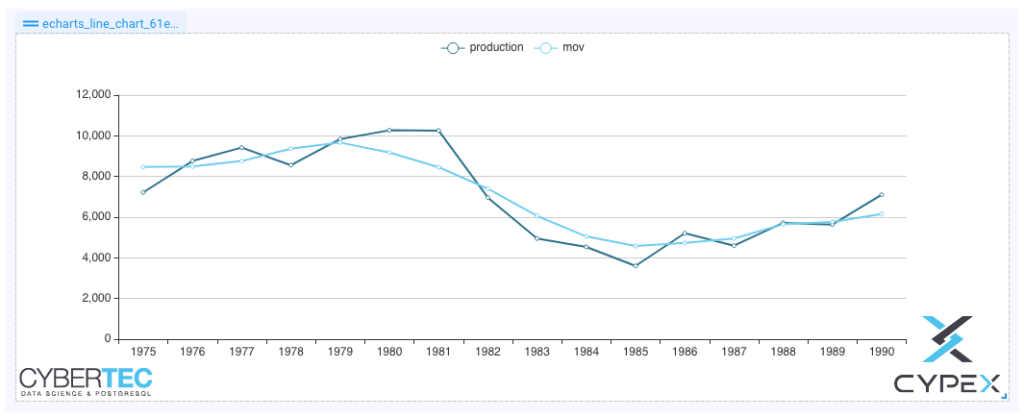
In the visualization the moving average is visibly smoother than the underlying rate. Saudi Arabia acts as a swing producer and its output can shift sharply with the political situation, so smoothing this particular series is a sensible use of the technique.
Row comparison and duplicate detection
PostgreSQL also supports composite data types, meaning a row can be treated as a single element made of several components. Instead of listing fields in the SELECT clause, you can treat the whole table as one field:
|
1 2 3 4 5 6 7 8 9 |
cypex=# SELECT t_oil, lag(t_oil) OVER (ORDER BY year) FROM t_oil WHERE country = 'Mexico' AND year IN (1980, 1981); t_oil | lag -----------------------------------------+----------------------------------------- ('North America',Mexico,1980,2129,1048) | ('North America',Mexico,1981,2553,1172) | ('North America',Mexico,1980,2129,1048) (2 rows) |
All columns of a row are then packed into a single field, and lag still works on it as usual.
The useful part is that = compares two rows directly — handy for spotting a row that was imported twice, or simply confirming that two consecutive rows match:
|
1 2 3 4 5 6 7 8 9 |
cypex=# SELECT t_oil = lag(t_oil) OVER (ORDER BY year) FROM t_oil WHERE country = 'Mexico' AND year IN (1980, 1981); ?column? ---------- f (2 rows) |
PostgreSQL walks field by field and returns true only when all of them are equal. In effect, lag can be turned to the purpose of detecting duplicate rows.


