The Business Case for Developer Experience, Backed by Data
Developer experience (DevEx) has long been framed as a “nice to have” for engineering organizations—something that boosts morale but is hard to justify when budgets tighten. A new research effort, conducted by GitHub in partnership with DX and based on survey responses from more than 20 companies, aims to change that narrative by providing quantitative evidence linking specific DevEx factors to measurable productivity and innovation gains.
The study applies work design theory to analyze how flow state, cognitive load, and feedback loops influence outcomes at the individual, team, and organizational levels. Beyond the findings, the authors published their survey questions and a step-by-step guide for making the business case internally, so other teams can replicate the analysis and track their own progress.
Protecting Deep Work and Engagement
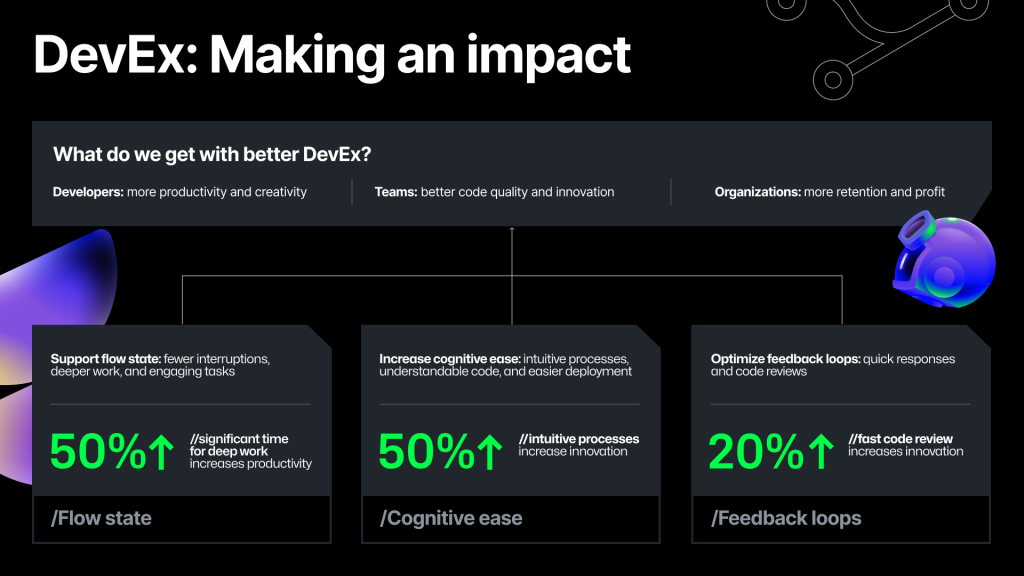
Perhaps the most striking result concerns uninterrupted focus: developers who consistently carve out time for deep work report a 50% productivity boost. Distractions—whether Slack pings, meetings, or ad-hoc requests from colleagues—are the primary culprit. For distributed teams spanning multiple time zones, finding overlapping deep-work hours is harder, but the payoff is substantial.
It’s not just about eliminating interruptions. The research also found that developers who find their work engaging report feeling 30% more productive. That has direct implications for task assignment: if certain developers are consistently stuck with unpopular or mission-adjacent projects, burnout is a likely outcome. Redistributing work so that teams spend at least most of their time on projects they find compelling is a management lever with hard numbers behind it.
Adobe’s CJ Dotson, senior PM of developer productivity, frames this as a strategic necessity rather than a perk: “When technology is what you sell, investments in DevEx are not optional.”
Reducing Cognitive Load Through Clarity
Understanding code is another strong predictor of productivity. The data shows that developers who have a high degree of understanding of their codebase feel 42% more productive than those with low or no understanding. The contributing factors are familiar: poor or outdated documentation, insufficient onboarding, and the fast-moving context introduced by AI-assisted development.
The researchers point to tooling as part of the remedy. GitHub Copilot, for instance, can help developers navigate unfamiliar code more quickly and keep their productivity intact. But the findings extend beyond technical solutions. The study reports that developers with intuitive, low-friction processes feel they are 50% more innovative—regardless of whether the friction comes from a clunky internal tool or an opaque approval workflow.
As Dr. Nicole Forsgren, partner researcher at Microsoft and co-author of the study, puts it: “It’s not always about the technology. If you can find ways to remove friction and blockers for developers, you’ll unlock so many things.”
Feedback Loops: Speed and Documentation as Force Multipliers
The third major lever is the speed of feedback. Developers who report fast code turnaround times feel 20% more innovative than those who don’t. Quick feedback is not merely a matter of developer convenience—it keeps people in the flow and preserves momentum on complex tasks.
There’s an organizational dividend to feedback, too. Teams that respond quickly to developers’ questions report 50% less technical debt. That is a strong argument for investing in documentation and self-service tooling. When common questions are answered in a searchable, well-maintained knowledge base, developers spend less time waiting and more time building—and the cumulative effect is a healthier codebase.
UKG’s VP of developer acceleration, Thomas Newton, describes the dynamic as a “virtuous cycle: by reducing friction and waste from developers’ daily work, developers are able to ship high-quality software faster, while also improving happiness and engagement.”
Making the Investment Case
For organizations that depend on software to meet their business goals—which is to say, nearly all of them—the authors argue that DevEx is a core business lever, not an engineering indulgence. The research is intended to give leaders the evidence they need to justify investments in areas such as documentation, automation, and focused work time.
“If you’re a business leader who’s focused on being profitable and innovative, enabling a good DevEx is one of the key levers at your disposal,” says Dr. Eirini Kalliamvakou, staff researcher at GitHub and co-author of the study.
Read the full research paper: DevEx in action: A study of its tangible impacts.