Open Source’s Next Phase: Global Growth Meets New Frictions
Open source has never been a static movement, and the data from GitHub’s Octoverse 2025 report shows just how much the landscape is shifting. The headline figure—about 36 million new developers joining the platform in a single year—underscores a community that is not just expanding in size, but in geographic and cultural scope. India alone added 5.2 million developers, with notable growth also in Brazil, Indonesia, Japan, and Germany.
This shift carries a structural consequence: for a growing number of projects, the majority of contributors now live outside the regions where those projects originated. The old assumptions about shared work hours, communication styles, or even language no longer hold. Projects that adapt to this reality by making their processes explicit—through contribution guidelines, codes of conduct, review expectations, and governance documentation—will have a clear advantage. These documents act as essential infrastructure, giving newcomers a reliable path in and making the project more resilient over time. Without them, scaling becomes a chaotic exercise in managing confusion.
The Double-Edged Impact of AI on Project Health
AI has played a significant role in accelerating global participation, and in 2025 it notably lowered the barrier to entry for coding. New developers are using it to understand unfamiliar codebases, draft patches, and more quickly make their first contribution. But that same accessibility has generated a rising tide of what’s often called “AI slop”—low-quality or inaccurate contributions that demand more effort to review than they return in value.
Maintainers are feeling the pressure from both ends. The volume of auto-generated issues and pull requests has risen, often faster than the number of people available to review them. Even well-intentioned contributions from developers with vastly different skill levels can overwhelm the system. As one maintainer perspective puts it, the sheer load can start to feel like a denial of service attack on human attention.
The response is not to reject AI entirely, but to use it defensively. Projects are increasingly turning to AI for triage, duplicate detection, and routine labeling—the grunt work that consumes time without requiring deep judgment. Expect the projects that thrive in the coming year to treat AI as part of their community infrastructure, not just as a coding assistant. The goal is to make the maintainer’s workload scalable, freeing human time for the decisions that actually require it.
Planning for Record Growth
Record-breaking growth is only a success if it’s sustainable. The influx of newer developers, many of whom are just learning the conventions of open source, can quickly become a burden. Popular “first pull request” projects show that a significant portion of this new population is still getting comfortable with the basics, which often translates into repetitive onboarding questions and duplicate issues.
This creates a widening gap between the number of participants and the number of maintainers with a true sense of ownership. Bridging that gap will require less reliance on individual mentors—though they remain valuable—and more on durable organizational systems. That means investing in clear, defined paths to move from contributor to reviewer to maintainer, shared governance models that don’t depend on a single timezone, and solid documentation that spells out both project goals and contribution guidance.
Investing in this foundation while maintainer bandwidth is already stretched is difficult, but it’s the difference between a project that can absorb global scale and one that stalls under technical debt and operational chaos.
Beyond the AI Bubble
While roughly 60% of the top growing projects were AI-focused, some of the biggest success stories had nothing to do with it. Projects like Home Assistant, VS Code, and Godot continue to flourish because they meet real, ongoing needs and support broad international user bases.
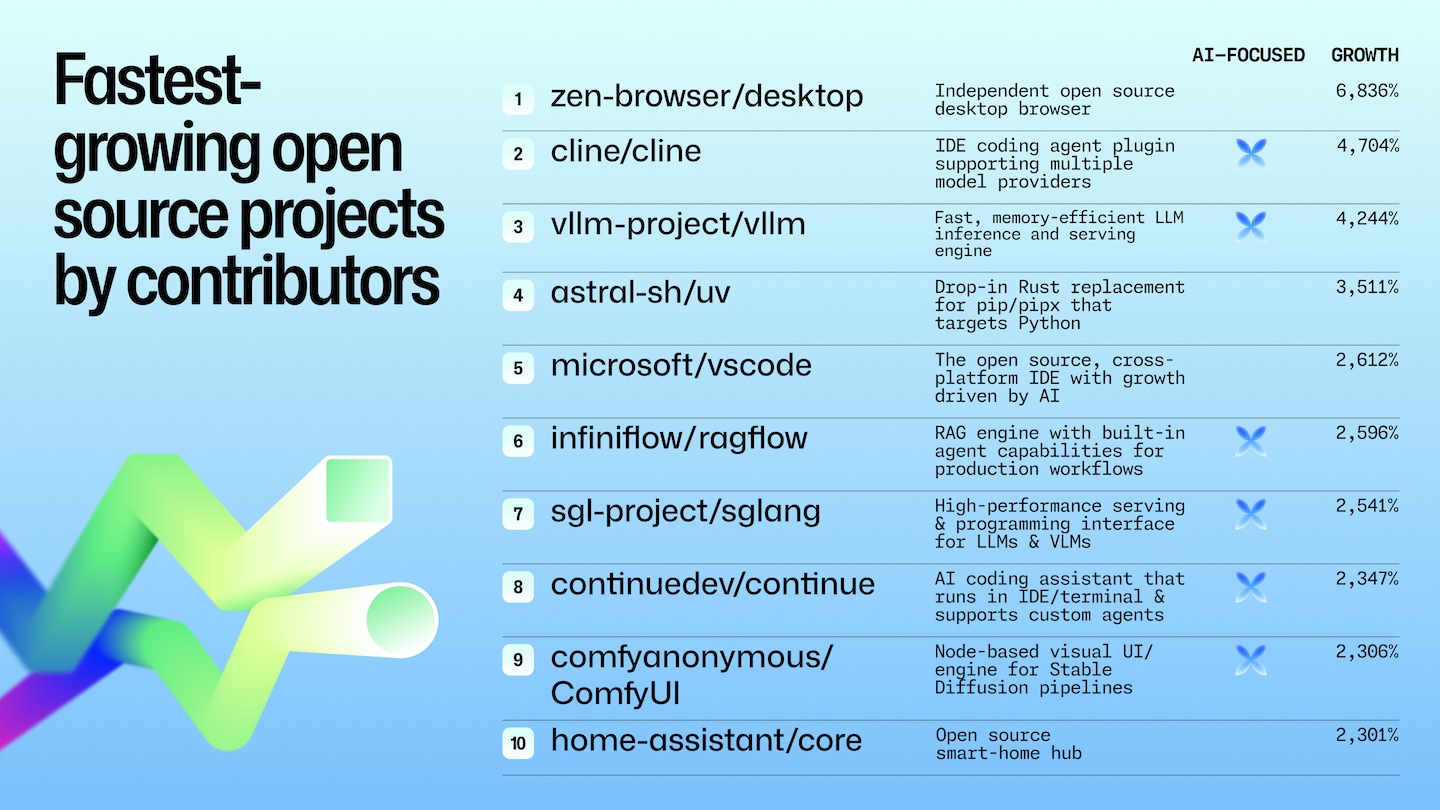
The popularity of these and other non-AI projects is a reminder that for many contributors, the motivation is practical: build something useful, and the community will follow. As long as open source continues to address genuine problems across languages and borders, it will remain a global phenomenon rather than a regional one.
What 2026 Will Test
Open source in the coming year isn’t likely to be defined by a single new trend. Instead, it will be shaped by how the community handles the pressures that surfaced in 2025—the surge in AI-generated activity and the demands of an explosively growing global contributor base.
For developers and maintainers alike, the takeaway is that processes deserve as much investment as code. The challenge isn’t whether open source can grow; it’s whether the structures that support that growth can keep pace.