
Why stale owner data is a project risk
Organizational changes are constant: people join, leave, or shift teams, and repositories change hands. When that churn isn’t reflected in a project’s ownership information, contributors lose the ability to route questions and reviews appropriately. The consequences are severe in edge cases, such as when a high-risk security vulnerability surfaces and no one responds to the fix, leaving teams to patch on their own. Clear, current maintainer information is what keeps collaboration efficient and keeps projects from devolving into silos of control rather than open contribution.
Where ownership lives in the repo
The standard mechanism for documenting ownership is the CODEOWNERS file at the repository root. It assigns individuals or teams as responsible reviewers for specific files or directories. When ownership is defined at that granular level, contributors always know who to contact for feedback, escalation, or approval, and maintainers can distribute coverage across the entire codebase. The file provides both transparency and accountability, but only if it reflects reality.
Automating cleanup with cleanowners
Manual maintenance of CODEOWNERS is easy to defer. The GitHub OSPO built cleanowners, a GitHub Action that checks the file on a schedule and opens a pull request whenever a correction is needed. The workflow configuration triggers on a schedule, which keeps cleanup consistent without requiring human effort each time changes occur.
---
name: Weekly codeowners cleanup
on:
  workflow_dispatch:
  schedule:
    - cron: '3 2 * * 6'

permissions:
  issues: write

jobs:
  cleanowners:
    name: cleanowners
    runs-on: ubuntu-latest

    steps:
      - name: Run cleanowners action
        uses: github/cleanowners@v1
        env:
          GH_TOKEN: ${{ secrets.GH_TOKEN }}
          ORGANIZATION: <YOUR_ORGANIZATION_GOES_HERE>
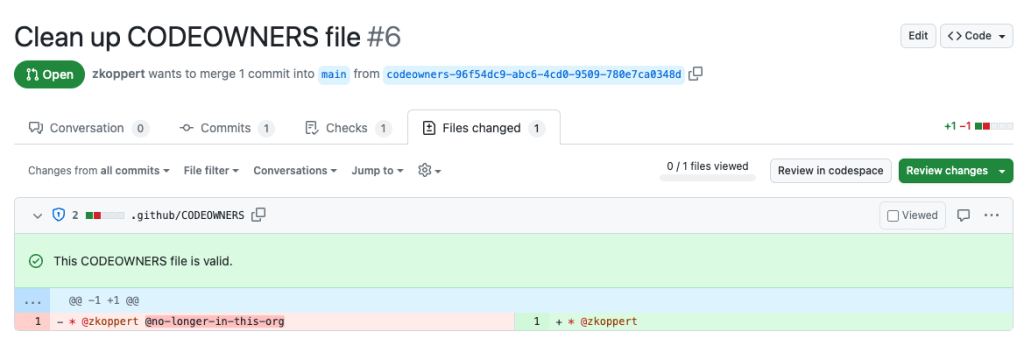
The practical effect is that stale entries are flagged via an automatic pull request, prompting the team to act. For example, if a repository previously listed both @zkoppert and @no-longer-in-this-org as maintainers, and the latter left the company, cleanowners would detect the inactive user and propose an update accordingly.
Keeping projects healthy
Active management of ownership data turns a frequently ignored task into an automated safeguard. With cleanowners, maintainers can rely on accurate files rather than hoping someone updates them. Correct ownership documentation supports long-term project health by ensuring that guidance, review, and decision-making remain clear as teams evolve.
More details on configuration and setup are available in the cleanowners repository.