

A Vault for the Vault
In an abandoned coal mine near the North Pole, a decommissioned chamber now houses 188 sealed reels of hardened archival film. The reels contain a snapshot of every active public GitHub repository as of 02/02/2020—the work of nearly four million developers. The GitHub Arctic Code Vault was built to preserve open source software for a thousand years, an ambition few institutions can seriously entertain.
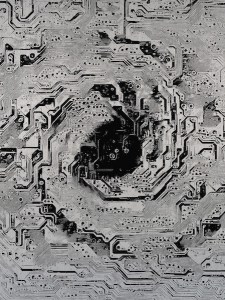
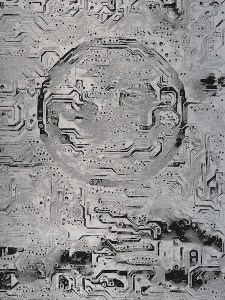
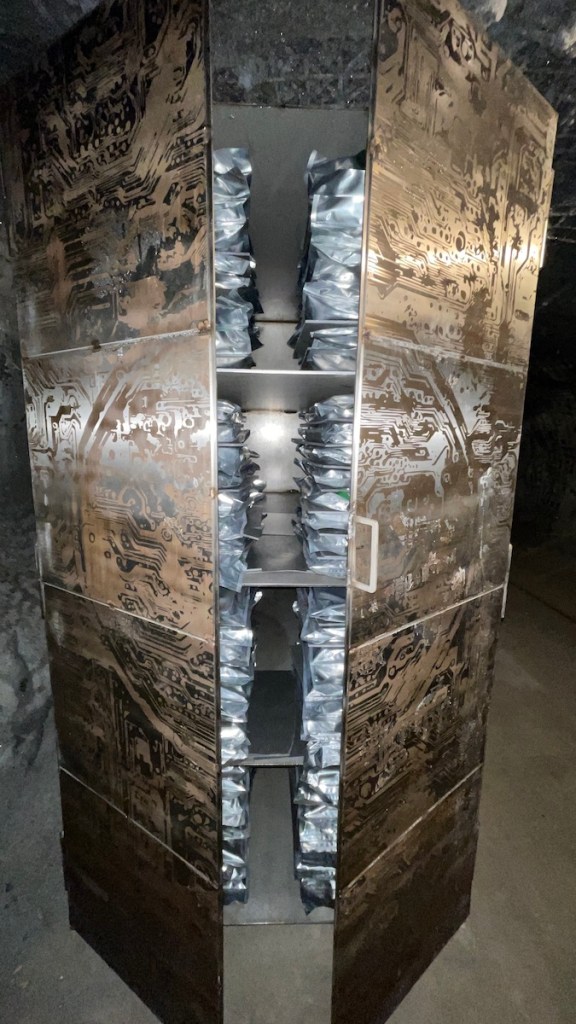
The physical survival of the film is not the real question. Whether anyone will care enough to keep and refer to it centuries from now is. That is why the Long Now Foundation’s executive director, Alexander Rose, put it bluntly: “If you don’t make it beautiful, it’s for sure doomed.” The archive’s “Greatest Hits” reels for institutional partners were already enclosed in museum-quality cases. This month, those efforts went further: the archive’s film reels now rest inside a massive steel vault etched with AI-generated art by artist Alex Maki-Jokela. At 1400kg/3000lb, the vault is installed within the Arctic World Archive itself. Even if its inheritors have no idea what it contains, it will be unmistakably extraordinary.
|
|
Why Keep Software, Anyway?
The archive’s purpose could be practical. Much of the world’s knowledge sits on ephemeral media—hard drives, CD-ROMs with lifespans measured in decades, backup tapes with notional 30-year horizons. When the Space Shuttle Challenger disaster prompted a hunt for outdated Saturn V blueprints, engineers found they had to scour scattered archives for documents that no one thought to preserve. Unexpected needs for “lost” software could easily arise in similar ways.
The archive may also prove historically significant. The 02/02/2020 snapshot already reads as a pre-pandemic time capsule. As advisor and science-fiction author Ada Palmer pointed out, historians have plenty of letters from Renaissance aristocrats but few of ordinary people’s shopping lists. The broad, democratic sweep of millions of repositories may capture a valuable cross-section of modern software culture that more curated collections would miss.
Beyond the Code
Software is not the whole story. The concept itself may be foreign to whoever finds the vault. That is why the archive now includes the Tech Tree—a selection of works, mostly human-readable, that explain how the world makes and uses software today. It covers computers and their foundational technologies, with context from the broader world: a snapshot of Wikipedia in the archive’s five languages (Arabic, Chinese, English, Hindi, Spanish), a small selection of artistic and cultural works, and—of course—a full dump of Stack Overflow data.
Each of the archive’s reels also contains a human-readable guide in five languages, describing the archive and its contents. The Tech Tree goes further, offering context for what computers are for: the human activity they serve.

|

|
Version 1.0, Complete
With the steel vault installed, the Tech Tree deposited, “Greatest Hits” reels safeguarded in three libraries on three continents, and warm backup partnerships in place with the Internet Archive and Software Heritage, version 1.0 of the GitHub Archive Program has met essentially all of its objectives. The Archive Program continues, but the groundwork for a thousand-year archive is now laid—beautifully, and deliberately so.