Ground-breaking products start with focus
Shipping a product that customers actually love comes down to one thing: clarity. When teams understand what they are building, why they are building it, and how they will get it done, the path to a great product becomes much easier to navigate. As a manager, your primary role is to act as curator, helping your team zero in on the most promising solution and clearing away everything that distracts from it.
"It boils down to: How are we improving the customer's journey and driving value?" says Manbir Sodhia, Vice President of Growth at Oura Ring. "Can we do that and make a positive impact on ROI? If we can do that, it's ours for the taking."
Design for customers, not for your org chart
One of the most common pitfalls in product development is designing for the internal structure of your company rather than the needs of your users. When product roadmaps are dictated by organizational silos and locally optimized goals, the result rarely serves the customer.
Shopify focuses on avoiding this trap by making the value proposition visible to everyone. Teams do roadmapping and planning in Figma and FigJam to get a clearer picture of where their efforts fit into the bigger picture. According to Senior UX Manager Katarina Batina, "Designs fall over when they're developed in a vacuum of product requirements that are narrowly focused on a locally optimized goal."
Digital prototypes also play a key role in keeping leadership aligned with the true problem to solve. "Prototyping has shown itself to be a way of making decisions quickly with leadership," adds Senior UX Manager Sebastian Speier. "It's about letting people explore their idea all the way to the end state so that they can decide whether it's the right solution to the problem."
Turn customers into co-creators
Some of the strongest product directions come directly from those who will use the product. When the pandemic shifted how customers interacted with Ironclad's digital contracting platform, the company didn't rely on internal assumptions. Instead, it convened a round table of 10 to 15 customers to gather insights that shaped the majority of its product roadmap for the next 18 months.
These customers weren't just sounding boards; several participated from concept to launch, reviewing design concepts in FigJam and beta-testing new features. "We were building alongside our customers in a way that kept us grounded and kept them excited about the direction we were going in," says Chief Product Officer Steven Yan.
When ideas pile up, ask three questions
Digital collaboration tools can break down barriers and generate a flood of concepts. That can be a good problem to have, but it can also stall progress. When developing an R&D platform for IBM Research, Work & Co. found itself with close to 50 potential ideas in just a few weeks.
"We can't take 50 ideas to a client," says Design Partner Casey Sheehan. His solution was to filter every option through a disciplined set of questions: Why does this platform need to exist? What does it need to do? And how are we going to build it?
Good ideas are easy to produce, but it’s really important that the ideas we generate are ideas that we can ship.“Good ideas are easy to produce, but it’s really important that the ideas we generate are ideas that we can ship.”
Use the Eisenhower Matrix to stay on task
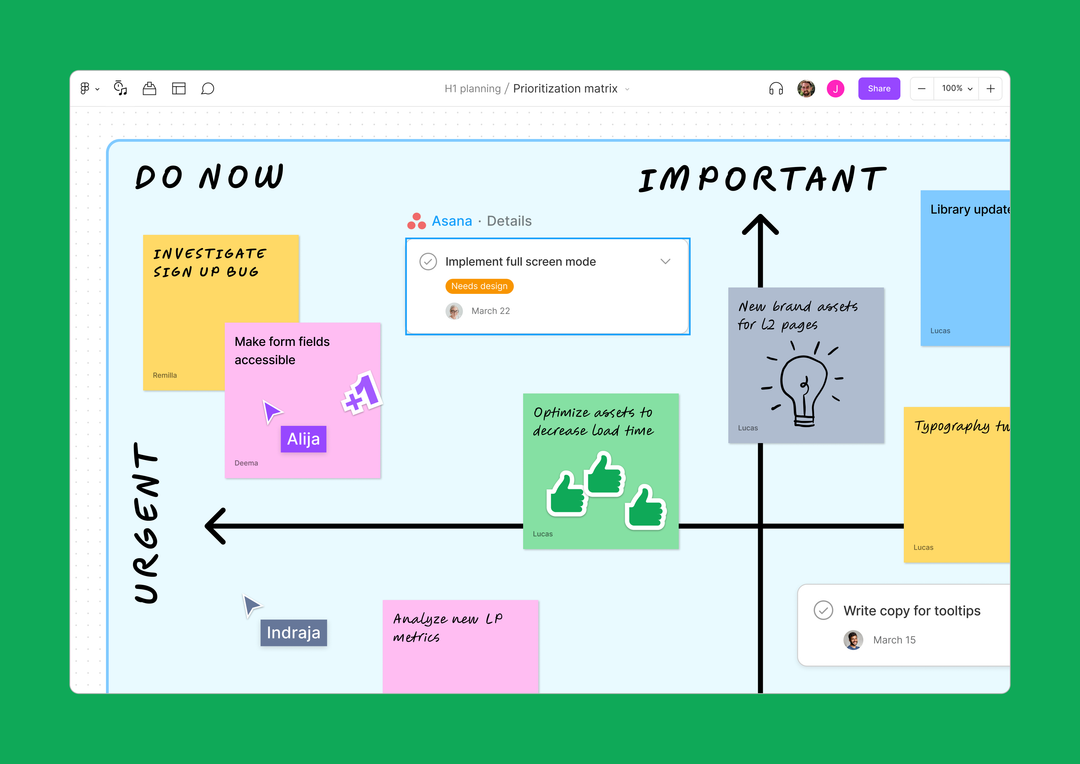
Once direction is set, the challenge of maintaining focus begins. Oura Ring's Manbir Sodhia uses the Eisenhower Matrix to rank project goals across four quadrants: major impact, quick wins, thankless tasks, and fill-ins. The framework helps teams prioritize essential work while making it easier to discard the fluff.
The model also encourages productive pushback. "Maybe there's one task you never get to," Sodhia says. "After two to three weeks, I just ask my team, 'Was this important in the first place?' It's okay to say no, it's okay to challenge the norm. That makes us a healthier team."
Avoid chasing vanity metrics
Not all metrics deserve a place in your product strategy. Vanity metrics can make your product look compelling but fail to reveal whether it's delivering real, sustainable value. The building management startup Super keeps every major product decision tied to a single fundamental question.
"When building a SaaS product, the bottom line is: Are people going to pay for the product?" says co-founder Vika Kovalchuk Zamparelli. We aren't chasing numbers that aren't tied to the essential value that we're providing in the market."
Visualize failures to learn from them
Retrospectives are a crucial ritual, but they can lose their impact in a remote environment. To keep conversations honest and useful, Oura Ring's Manbir conducts project retrospectives in FigJam. The team collectively retraces its steps in a shared visual space, building an at-a-glance trail of what happened and why.
"That interactive visual element really helps us break the mold of remote work, where it can be tough to have frank conversations about mistakes," Sodhia says. Visual retrospectives also serve as a team-building exercise, he adds, because they "allow everyone to have a voice and a shared experience."