Two years after first publishing the Engineering Career Framework, Dropbox refreshed it and ran the updated version through the 2022 review and calibration cycle. Feedback suggests the changes improved clarity and accuracy, though some issues remain. The framework defines Core Responsibilities (CRs)—key behaviors describing what impactful work looks like and how it is delivered—and is used in interviewing and hiring, performance reviews and calibrations, and rating and promotion. The published framework was updated in place; the summary of changes:
- Added technical craft expectations for engineering managers, and business acumen expectations for managers and many higher-level roles.
- Clarified and expanded expectations for decision-making, collaboration, and contributions to organizational health.
- Strengthened and clarified expectations for ownership over code, processes, and operational systems.

The problem the update addressed
At the late-2021 staff engineer summit, where the state of engineering was assessed, two initiatives emerged: update the CRs to promote engineering efficiency, and provide clearer paths and CRs for senior engineers. Both stemmed from a perception that reviews and promotions were too heavily biased toward big, complex, or high-profile achievements. Taking ownership, making tough decisions, and keeping-the-lights-on (KTLO) work matter no less but were often deemed less impactful—something that, per feedback, led to building the wrong things or building them the wrong way. The CRs were also repeatedly described as insufficiently helpful for senior engineers trying to understand their performance against expectations, especially those seeking a path to promotion.
A working group of senior engineers and engineering managers updated the framework in coordination with a Dropbox-wide refresh of CRs covering Virtual First and the role managers play in building and sustaining successful cultures. Because the CRs state expectations at every level, they can be a lever for cultural change; the explicit goal was to better reward desired engineering behaviors and to define the archetypes more senior engineers can function in and how those map to the CRs, so promotion evaluations favor a variety of contributions rather than over-indexing on building large, complex things.
What changed in the contents
A survey of engineers asked how well the CRs mapped to their work and how they were evaluated. Of 106 respondents, more than a quarter said the CRs did not reflect their daily work, and more than a fifth did not clearly understand what was expected to reach the next level. Although the framework explicitly states it is not a promotion checklist, it remains the canonical source of level expectations, so some people use it that way. Feedback centered on unclear weighting of CRs at review time, under-valuing of on-call toil, KTLO, glue work, and documentation, and a lack of clarity on how IC4+ engineers in different roles—say, a tech lead versus an architect—could be evaluated fairly against each other.
To address this, numerous minor updates were made to CRs and descriptions, particularly at higher levels. Examples:
- IC3 software engineers had no clear ownership expectations at that level, so a craft CR was added: “I look for ways to reduce future toil and tech debt for existing components my team owns.”
- IC4 security engineers are often asked to collaborate early with other teams for security-by-design, but this was not expressed in the CRs and was not assessed consistently in calibrations. A culture CR was added: “I am effective at working with cross-functional stakeholders to identify technical blindspots and clarify ambiguity in their ideas.”
- IC3+ software engineers lacked guidance on their role beyond their team, so a business acumen CR was added, tailored per level. For an IC4: “I have a working knowledge of Dropbox’s org/team structure and how teams work together across Dropbox, and am able to help my team effectively collaborate effectively with other teams across our org.”
A sample of some of the updates to the IC4 Software Engineer CRs that shows the level of thought and work that goes into modifying each line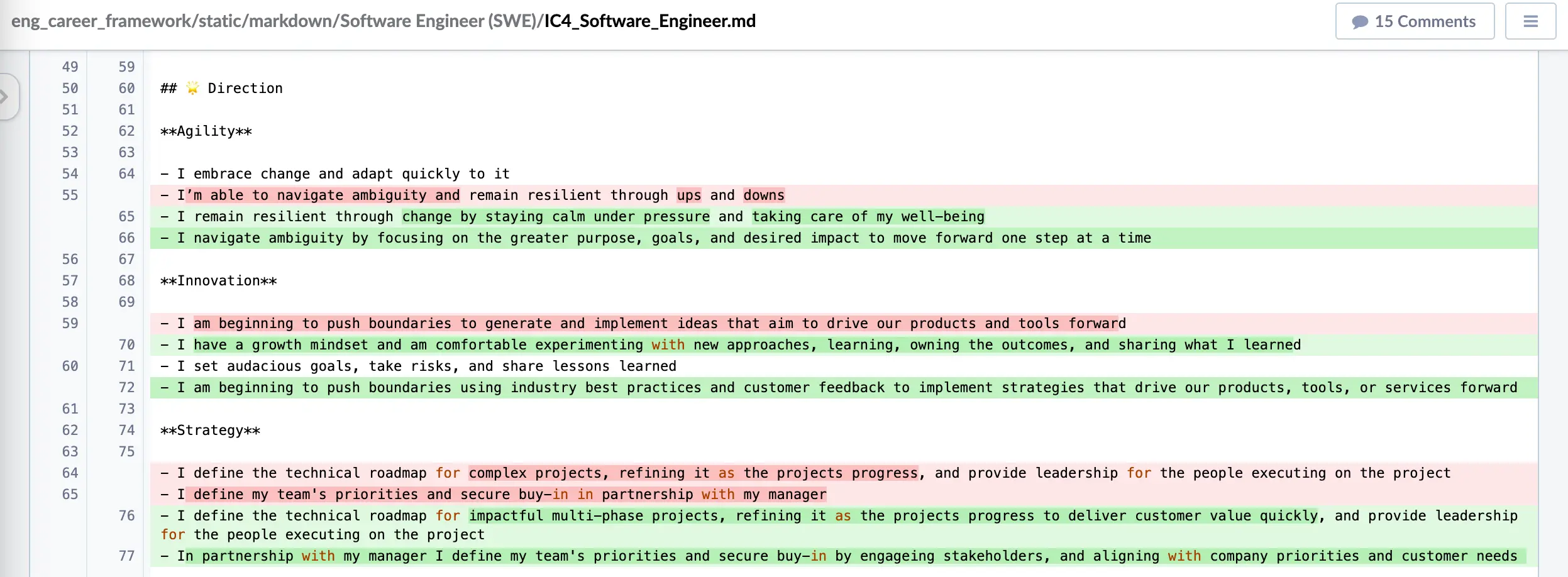
Two special sections were added to the appendix: one covers different Engineering Archetype behaviors—heavily derived from Will Larson’s definitions—and maps them to levels and CRs; the other gives context and clarification on the CRs generally and dispels myths about their use. Together they add archetype language to how growth and evaluation are discussed at Dropbox and serve as a single source for clarity on how evaluations actually work.
Rolling it out without moving the goalposts
The updated framework was deployed quickly so the benefits could be realized, but changing evaluation criteria suddenly mid-cycle would feel like moving the goalposts and would conflict with the company value Make Work Human. The working group coordinated with the People team on a plan to preview changes early, before the mid-year lightweight review cycle, to gather feedback and encourage ICs and EMs to start aligning with the new descriptions. After the mid-year cycle, feedback was incorporated and the updates were heavily promoted via Slack announcements, emails, and engineering all-hands meetings, giving everyone lead time to update their models of how they and others would be evaluated. The plan, from the working group coordination doc:
Establish working group and work streamsCollect feedback via surveyUpdate and iterate on CRsShare with VPs and HR to get early feedback and updateCollect feedback from engineering leadership team and updateShare internally with all of engineeringIncorporate any feedback and publish final updates- Publish externally
How the documents are managed
For future iterations, a better way to manage updates was needed—one that would facilitate review and approval, preserve change history and allow comparison between versions and related roles, regenerate content from controlled source files, and support multiple simultaneous independent updates in various stages. Early proposals were elaborate; at one point each role was nearly modeled as a class hierarchy with comparisons generated programmatically. In the end the team followed its own advice—impactful work need not be big or complex—and kept it simple: an internal git repository holds the text content, with a bare-bones Django site for internal hosting. Documents are markdown files in a folder hierarchy organized by role; each file is a complete, self-contained description of the CRs for one role and level (for example, “IC5 Staff Security Engineer”).
Using a comparison tool to assess changes to the framework in the process of writing this article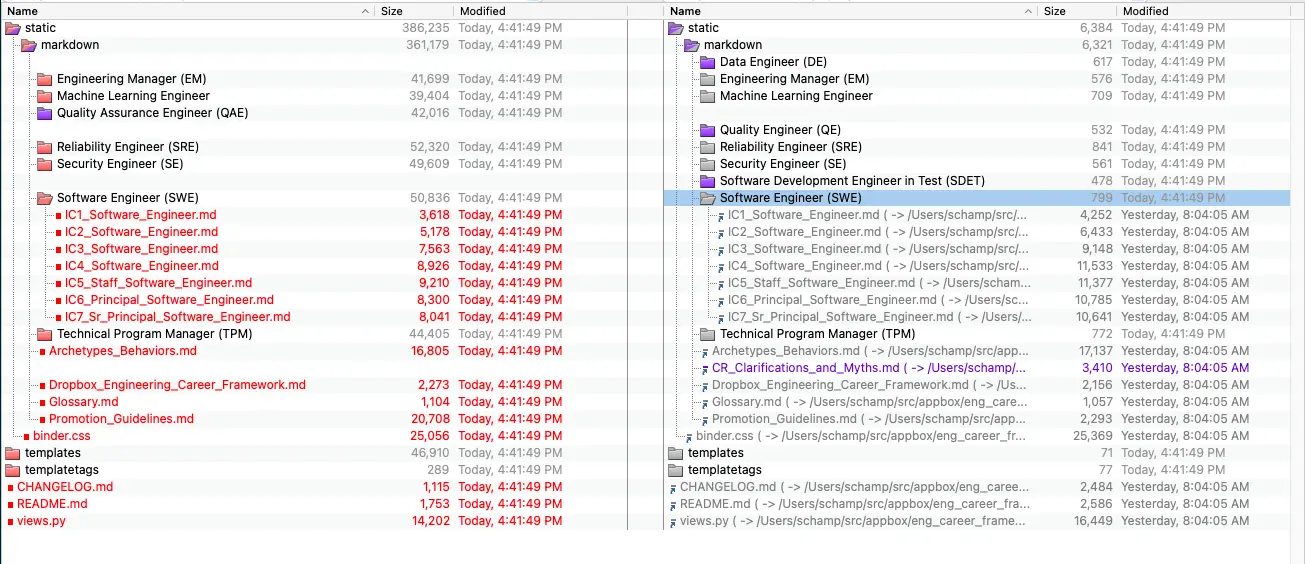
Markdown in git makes the CRs easy to render while remaining human readable and diff-able. No external database or other system is needed to maintain the contents beyond the source tree; updates follow normal source code review processes; and the files are portable to any number of static site generation systems if presentation needs to change. The README.md guidance for anyone proposing an update:
The Engineering Career Framework is a living document that will evolve over time, and anyone within engineering at Dropbox should feel empowered to suggest changes.
For lightweight changes such as syntax or formatting changes, a simple diff should be reviewable by the members of the Engineering Career Framework working group and result in changes being visible by the next deployment [of our the internal tool].
Larger-scale changes such as significant rewording, adding/removing copy, or level/role changes will involve multiple levels of approvals. While these cannot be merged through a single diff approval, the diffs themselves can be used as the first step in surfacing where the engineering community at large feels there is a gap between the CRs and their day-to-day responsibilities.
Each update follows this process:
- Create a diff with the desired changes and circulate to stakeholders.
- Review the changes with stakeholders and respond to feedback.
- Update the changelog with a description of the changes, then merge the diff.
- Deploy the updated source to the internal mini-site.
Example of a diff correcting a typographical error
Minor, non-material changes such as typographical fixes or removing duplication could be applied with relatively light review, while substantial updates were reviewed with increased rigor. For publication, a static version was exported and the externally facing repo and site updated. The external version exists for transparency and community benefit; no pull requests are taken on it.
Post-launch feedback
The framework shipped internally, then went through a full-year review cycle. Afterward the working group surveyed the engineers who had used it. The second survey drew fewer respondents than the first, but nine out of ten agreed the updated framework better reflects the work they do at their level.
The comments were more mixed. Engineers found the new archetypes valuable but wanted more clarity on how they show up at lower levels. Others called the CRs still too wordy and vague — most of the update cycle went into adding clarification rather than trimming text. And the distinction between levels remained hard to see; the files are structured so a comparison tool can line them up, but reviewers wanted that capability built into the presentation system itself.
What markdown cost us
Markdown turned out to have real drawbacks at this scale. Its table syntax is easy for a person to read but poorly suited to tracking changes across large tables full of prose. Reformatting pages to avoid tables reduced that pain, though plenty of feedback said the text became harder to ingest and compare without them.
Keeping big blocks of text in source control raised its own question: should each paragraph be a single line or wrapped? Late in the process the team found SemBr, which inserts line breaks at semantic boundaries to make comparison easier. The intention is to adopt it as the framework keeps evolving.
Duplicate wording is the remaining maintenance problem. Many CRs across roles share similar language, so a wording change is costly to implement and to review. Storing each role as separate text makes tailoring simple but keeping things consistent expensive. The team is still looking for a way to get both and has not settled on one.
Where the system stands
Updating the CRs was only part of the mandate. The larger goal was a system that makes future updates easier to run, so the CRs can change faster as the engineering organization's needs change. The working group considers that goal met. Since adoption, two roles have been added — Software Development Engineer in Test (SDET) and Data Engineer — along with a number of minor corrections gathered during the review cycle.
The twice-yearly review cadence holds, as does the need for a slow, internally publicized rollout for major changes. What is new is a system for proposing and reviewing changes, either together or in batches, which can shorten the time an update takes and leave more room for publishing and reorienting teams before the next review.
The updated framework is published for anyone who wants to read it.