
Open Source Governance Moves Into Government
Open source software is so pervasive that most users never think about it. But when a government decides to adopt open source as a strategic foundation for public services, the complexity multiplies. Questions about licensing compliance, maintenance capacity, and cross-ministerial coordination rarely have straightforward answers.
Ghana is currently wrestling with those questions. The Ministry of Communications, Digital Technology, and Innovation (MoCDTI) is pushing forward with a digital reset aimed at job creation, enterprise growth, and youth empowerment. The agenda includes more than a dozen simultaneous legislative reforms touching cybersecurity, data protection, electronic communications, data exchange, and emerging technologies. Some are new laws; others replace existing ones. Together they are reshaping the country's ICT legal framework.
The underlying concern: will the systems built on these foundations be open and auditable, or will they end up locked behind proprietary walls with only a handful of vendors able to assess and support them?
The OSPO Model Comes to the Public Sector
Open Source Programme Offices (OSPOs) have long been a fixture in the private sector, providing structured governance for open source initiatives: policies, compliance, community engagement, and skills development. Universities and civil society groups have increasingly adopted the model. Now it is moving into the public sector, driven by a recognition that readiness matters before adoption can succeed at scale.
The Open Source Programme Office Readiness Assessment, or OSPORA, is UNDP's diagnostic framework for countries considering this shift. Supported by the government of France, OSPORA evaluates a government's readiness for open source adoption through structured interviews and workshops. It examines what policies are in place, the state of technical capacity, who the champions are internally, where coordination is breaking down, and whether procurement practices discourage open source. It also assesses what is politically realistic given current government priorities. Think of it as an institutional audit before a migration—except the architecture being reviewed is governance, not software.
Assessing Ghana's Open Source Landscape
In Ghana, the GitHub Policy team joined UNDP to run this assessment over the course of a week. Interviews and workshops brought together senior officials from MoCDTI, the National IT Agency, and the Kofi Annan-India Center of Excellence; heads of IT departments across ministries; community tech groups building open source in Ghana's developer ecosystem; and the local Linux user group.

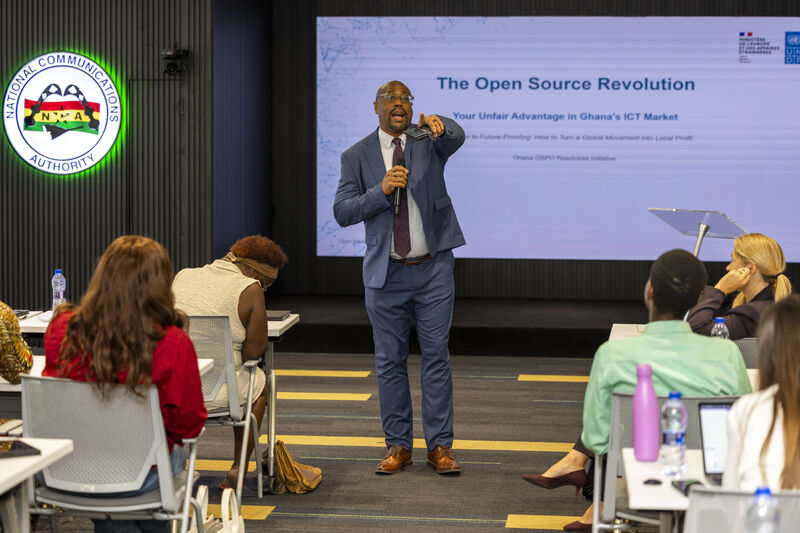
The OSPORA methodology draws on Public Digital's framework for open source in government, which covers technical readiness, institutional structure, procurement, legal frameworks, and political will. What emerged from the Ghana assessment was a mixed picture.
Ghana has political commitment to digitalization and clear champions with more than a decade of open source delivery experience. The case for open source is being made from within government, by officials who see it as a route to digital sovereignty and to growing national tech capabilities. The country also has a growing developer community eager to contribute.
Yet there are significant gaps. There is no clear, centralized open source policy. Coordination between the National Information Technology Authority (NITA) and individual ministries is weak, with departments operating in silos. IT teams are under-resourced, particularly in rural areas. And where progress has stalled, the reasons are rarely technical—institutional inertia and resistance to change are the greater obstacles, especially where procurement patterns and vendor relationships are well established.
Building on a Digital Foundation
Ghana's tech ecosystem gives it something to build on. It is home to one of West Africa's fastest-growing tech communities and some of the region's first accredited Digital Public Goods. The country also has the second highest number of GitHub developer accounts in West Africa. The One Million Coders initiative, which aims to skill up a massive developer workforce by 2028, is adding to the pipeline.
How open source is governed shapes what gets built on these foundations. UNDP, for example, maintains open source projects on GitHub that governments deploy directly, such as its National Carbon Registry for implementing and managing carbon markets. Decisions being made today in Ghana and elsewhere about data exchange standards, content liability, and emerging tech regulation will determine whether open source expands choices for countries on their digital transformation paths.
Ghana's experience illustrates what open source sustainability looks like at the national level. Conversations about open source often focus on maintainer burnout and funding models, but OSPORA addresses a different problem: how institutions sustain adoption over time and across administrations. That is also why GitHub and UNDP are participating in the United Nations Open Source Week in New York City.
Open source offers a structurally different path—one that relies on institutional readiness as much as technical capability.