
From Kenya to the Marketplace: Daniel Dennis on Building Ruby Gemer
GitHub Actions has grown into a hub for automation, with developers publishing everything from deployment pipelines to chat integrations. Yet behind the workflows are people who turn a practical annoyance into a reusable tool. Daniel Dennis, a developer based in Kenya, did exactly that with his Ruby Gemer action.
Dennis’s path into development began before university, with a high school boot camp that introduced him to Java for Android and PHP for web. From there he expanded into Flutter, Node.js, Ruby, and open source, relying largely on online courses and YouTube tutorials. Today, much of his GitHub work is built on Ruby on Rails, and it was that environment that produced the idea for Ruby Gemer.
Why Ruby Gemer Exists
The action is a response to notification fatigue. Before Dependabot became a standard part of the workflow, Dennis was receiving email alerts each time a gem in his projects was updated—often a noisy stream. Ruby Gemer was born out of a desire to consolidate that information:
I created Gemer so that I could stay up to date with my gems with every push and also, keep my application secure even in production. I also wanted to test my code and check whether future updates would break my code.
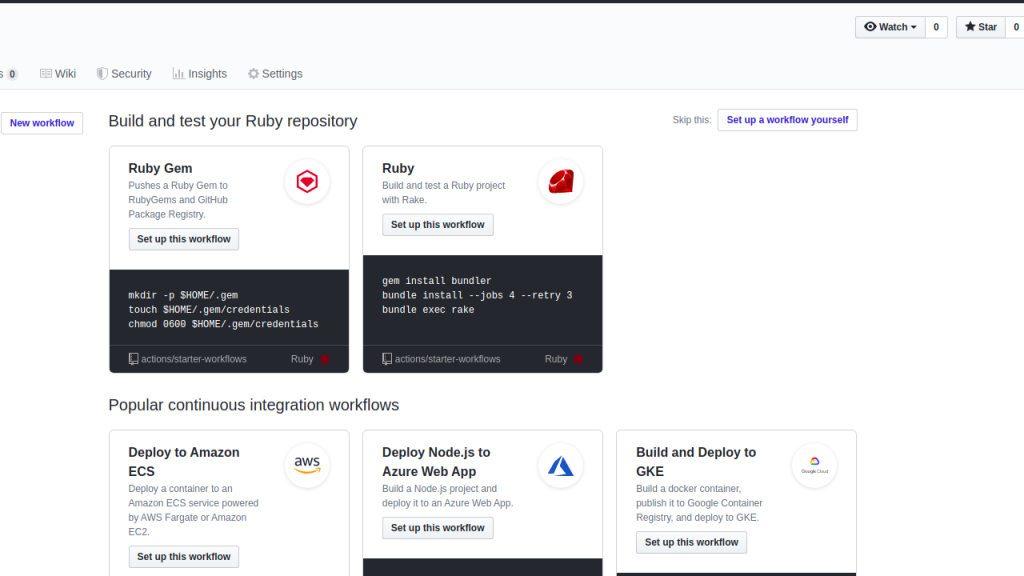
The action runs on the latest version of Ruby and gives developers a clear view of dependency changes. Dennis isn't stopping there, either. His plans for the project are focused on deeper testing support:
I plan on adding more testing capabilities for Ruby developers. I also hope that the action will be well accepted within the Ruby community as they continue to make the action grow to serve everyone.
What He Learned About Actions
For Dennis, the appeal of GitHub Actions is the low barrier to entry. Finding a pre-built tool is as simple as browsing the marketplace, which suits developers who want utilities without assembling everything from scratch:
I love GitHub Actions because they are very easy to install. I love the idea that all I need to do is go to the market and I can get free tools to suit all my needs in development and production.
That simplicity does not extend to every part of the process, though. Building a working action, Dennis said, involved more than expected. The stumbling block was YAML and the relative lack of documentation at the time:
The biggest challenge for me was learning the workings of yaml and how to create a GitHub action with minimal documentation on how to do so. It took me a while figure it out, [but] the experience was amazing… When I started, I figured everything would be easy to do since it was only yaml. Getting the Action to work took me days of debugging. It was a good learning opportunity in the long run.
Since then, the ecosystem has matured considerably, with far more guidance available through the GitHub community forums and official documentation. The GitHub Actions Hackathon, Dennis’s first virtual event of that kind, was an experience he wants to repeat. Future hackathons are planned, with announcements coming on the GitHub blog and social channels.
Developers looking to follow a similar path can start with the Learning Lab course on Actions basics, or browse the GitHub Marketplace, where tools like Ruby Gemer are available alongside hundreds of other actions.