A new bar for responsiveness
Chrome's Web Vitals program has always aimed to surface the metrics that matter most to real user experiences. For responsiveness, that metric has been First Input Delay (FID) since 2020. FID was a meaningful step forward, measuring input delay as real users experience it rather than approximating interactivity through lab-based proxies like Total Blocking Time (TBT) or Time To Interactive (TTI).
But FID has a couple of naming clues about its limitations: it only captures the first interaction of a page visit, and it only measures the delay component of that interaction, not the full handling time. That first interaction may not reflect how the page responds throughout its lifetime, and the delay alone misses what happens after the browser finally starts processing the event.
Interaction to Next Paint (INP) addresses both of these gaps. Instead of just the first interaction, INP evaluates all interactions over the page's lifespan and reports one of the slowest. It also measures the complete duration—from the start of the interaction, through the event handler, and until the next frame is painted. This makes INP a much more accurate reflection of perceived responsiveness.
INP moves to pending status
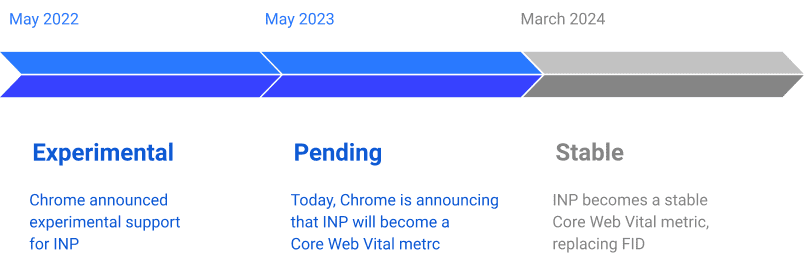
After extensive testing and community feedback since it was announced in 2022, INP is now considered a pending Core Web Vital. This new designation means INP has proven ready to replace FID, but the transition won't happen overnight. INP will officially become a stable Core Web Vital in March 2024, giving the ecosystem time to prepare.

Tools across Chrome will begin showing INP without the experimental label. Developers who consume INP data programmatically from APIs will need to switch to the new non-experimental field. To minimize disruption, the experimental field will remain available for 90 more days, with support ending on August 8, 2023.

Until March 2024, FID remains a Core Web Vital alongside Largest Contentful Paint (LCP) and Cumulative Layout Shift (CLS). At graduation, INP will join those two as the stable Core Web Vitals trio. Details about the precise timing and FID's post-replacement status will be announced later.
Assessment and optimization
Don't wait for March 2024 to start working on INP. Although an estimated 93% of mobile sites perform well on FID, only 65% have good INP on mobile devices. The gap highlights the room for improvement that INP's fuller measurement exposes.
The best way to determine your readiness and begin the optimization journey is the INP optimization guide. It offers entry points whether you're new to responsiveness metrics or a veteran performance engineer. Earlier this year, Chrome also published a post covering three high-impact techniques that apply to both FID and INP: minimizing or breaking up long tasks, avoiding unnecessary JavaScript, and reducing large rendering updates.
Chrome continues to invest in diagnostics, tooling, and documentation to ease the transition. The team is also soliciting feedback at [email protected], and will announce the exact graduation date as it approaches.