Independent proof of zero data retention
Audited ZDR is a new provider label on AI Gateway. A provider earns it only when an independent security firm tests its zero data retention claims against its code, infrastructure, and live traffic and publishes the report. Baseten, Modal, and Wafer are launch partners whose audits are already under way; additional providers are invited to follow.
The label extends earlier governance work: team-wide Zero Data Retention (ZDR), which lets teams send traffic only to providers with a stated ZDR policy, and Vercel's own ISO/IEC 42001:2023 certification, which put its AI systems under a third-party audit. Inference providers are now asked to meet the same standard.
Why self-attestation falls short
ZDR promises today rest on contracts: a provider agrees not to retain prompts or completions, and customers take that on faith. For teams sending proprietary code, customer records, or regulated data, that raises questions a contract cannot answer:
- Are prompts reaching debug logs, crash dumps, or tracing pipelines?
- Can a rate limit divert a request marked ZDR to a non-ZDR endpoint?
- Can a support engineer's debugging tools expose a customer prompt?
Resolving these per provider and per hosted model requires bespoke security reviews. An audit answers them publicly.
What the audit covers
To qualify, a provider engages an independent security firm from among respected third-party auditors. The firm tests the ZDR policy across the serving path for every model, endpoint, feature, and tool that handles AI Gateway traffic.
The audit confirms that customer data is never written or retained on durable storage in any system. Customer data covers prompts, completions, system prompts, embeddings, files, images and audio, tool and function-call payloads, and any derived data that could identify them. Coverage extends to request logs, traces, metrics, crash dumps, prompt caches, abuse monitoring, analytics, backups, support tools, and training, fine-tuning, and evaluation datasets.
Content must be deleted from the provider's systems once a response returns to AI Gateway. A request using a cache such as a KV cache must keep it in volatile storage only for the duration of the request, never on durable storage, and this behavior must be disclosed. The audit further confirms that:
- A request marked ZDR never fails over to a non-ZDR endpoint, tool, or feature
- No human or automated process touches customer data outside handling the request itself
- Sub-processors with access comply with all of the above
- No training on customer data occurs
Verification combines review of the provider's serving-path source code and infrastructure configuration with live tests: marked prompts go through AI Gateway, and auditors search the provider's logging, caching, and storage systems for any trace of them.
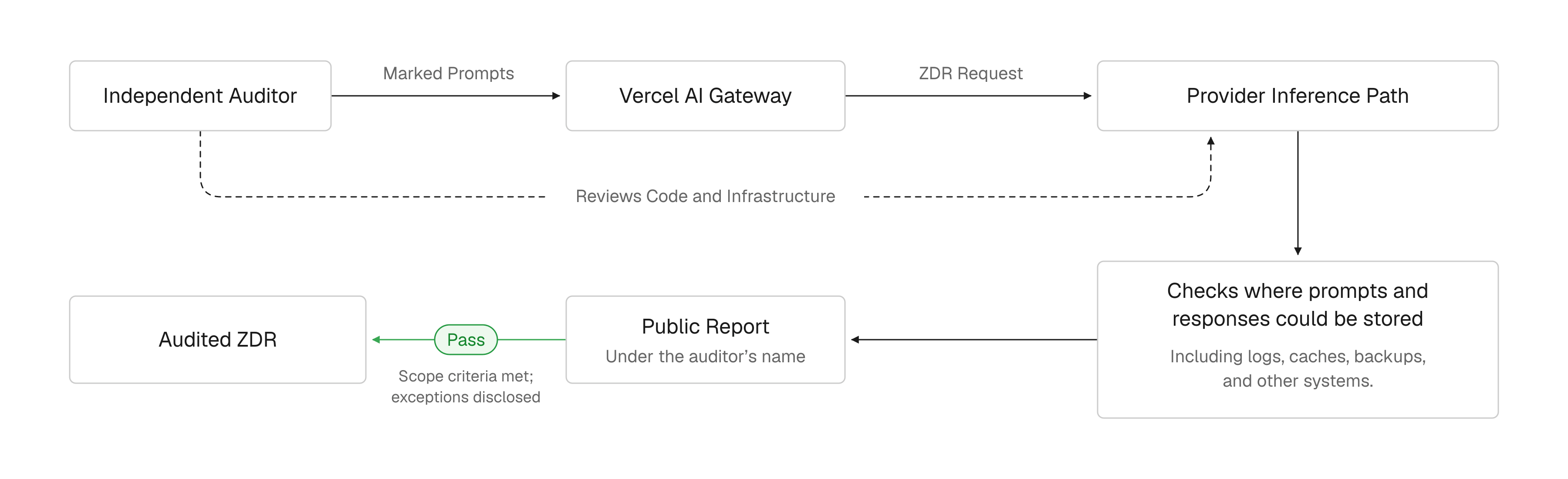
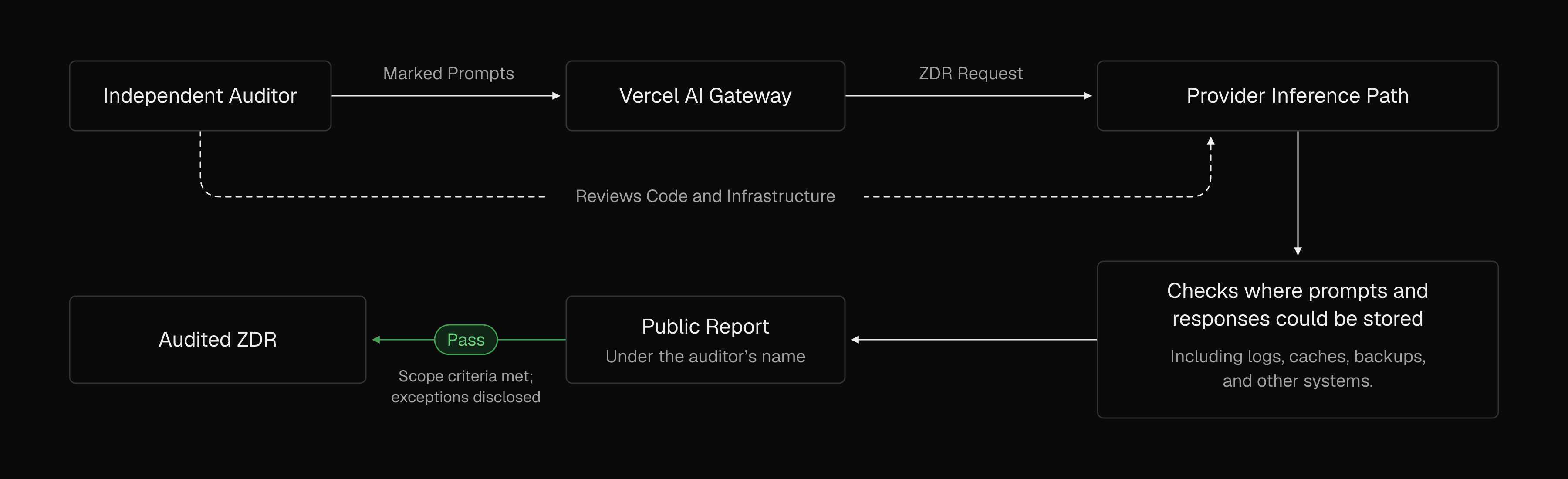
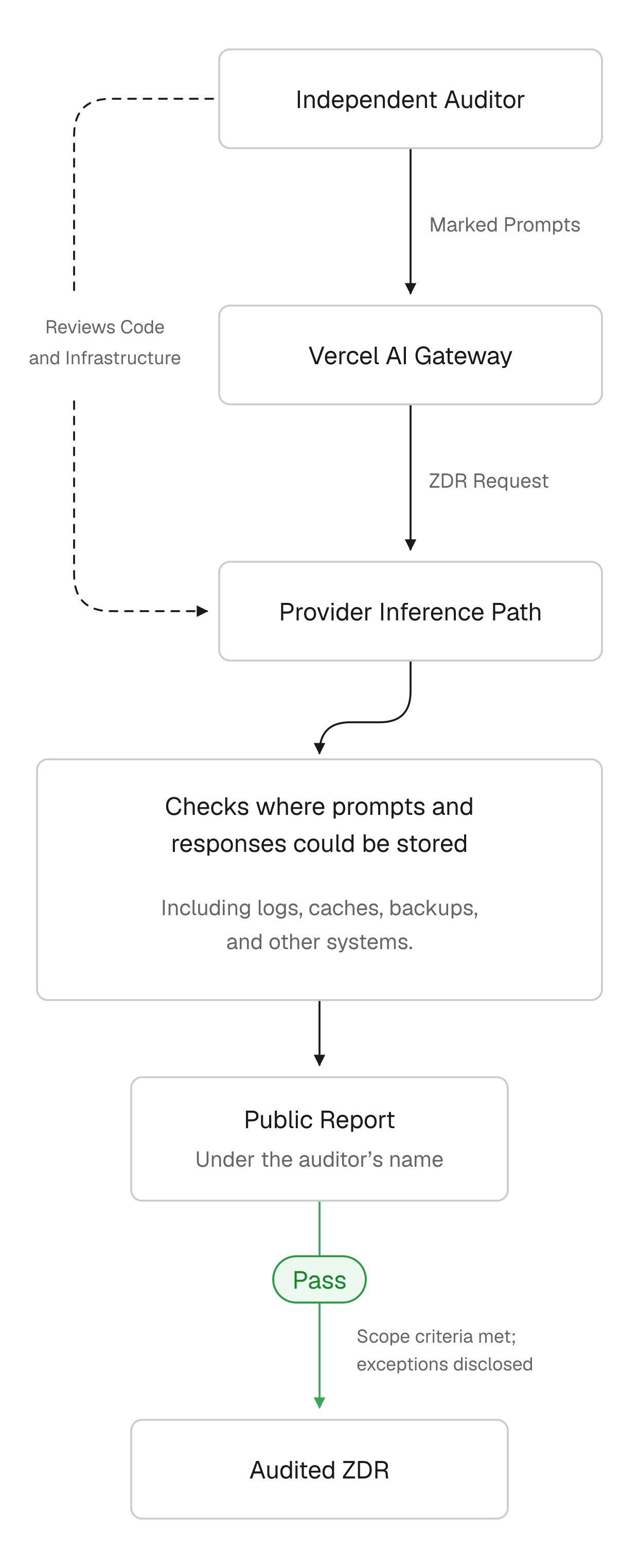
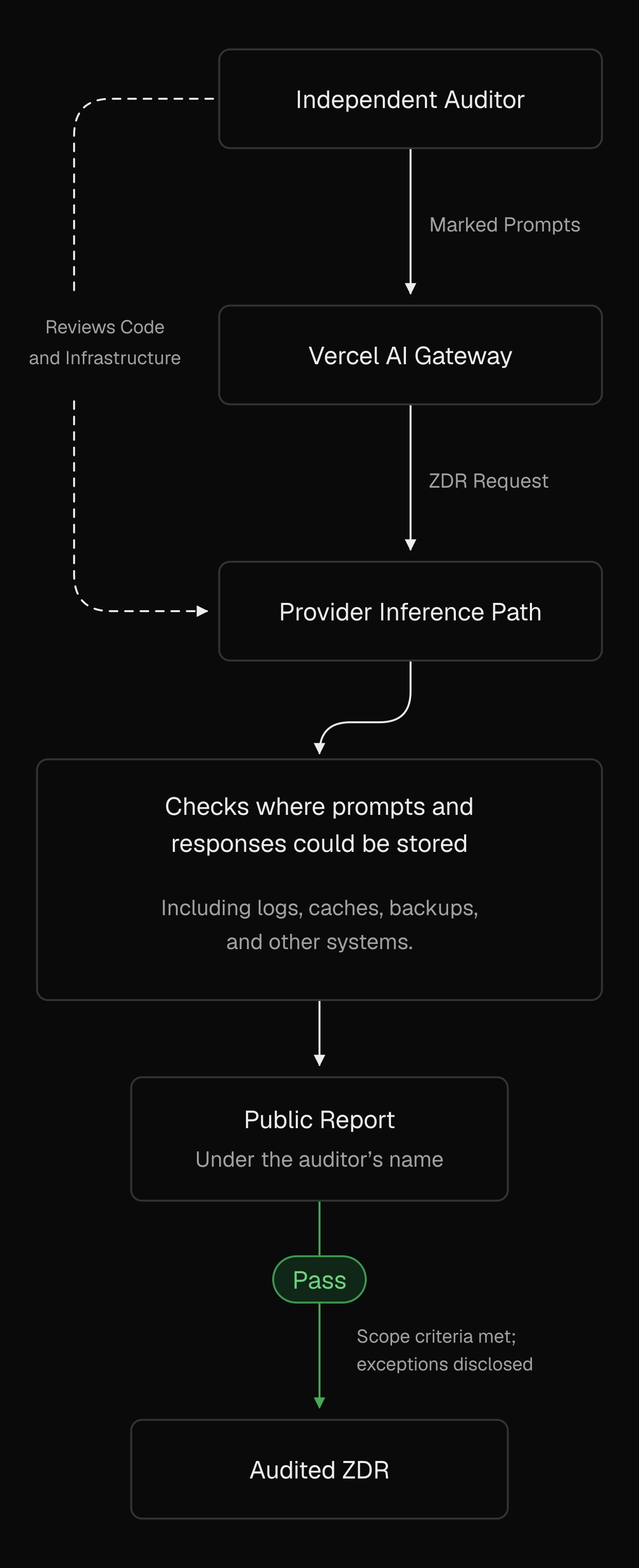
Every passing provider publishes its report under the auditor's name, covering scope, methodology, dates, findings, and fix status. Exceptions are disclosed and redactions are limited to exploit detail. AI Gateway links directly to each report.
Canary checks between audits
An audit captures a point in time, while production systems change. As a detection layer between audits, Vercel runs canary audits against AI Gateway inference providers. Each run sends prompts containing unique, unindexed URLs mapped privately to a provider, model, and run. A ZDR provider should never retain, inspect, or crawl prompt content, so any request to a canary URL triggers an investigation. Because canary checks cannot detect prompts written to disk and never read, they complement independent code and infrastructure audits rather than replace them.
Using the audited tier
AI Gateway adds an independently Audited ZDR provider tier and a team-wide toggle in policy settings. With the toggle on, requests route and fail over only across providers whose published audits meet the bar. Launched partners enter the tier as soon as their report is published, with launch partner reports expected by December 8, 2026.
Alongside other routing controls
AI Gateway offers a unified API for calling models, tracking usage and cost, and configuring retries and failover. It mirrors provider pricing with no markup and no platform fee on inference, including Bring Your Own Key (BYOK) requests; see the AI Gateway documentation for setup. The audited tier works with the existing compliance controls:
- Regional inference pins where a provider runs inference — US, EU, Australia, or Japan — per request or team-wide, and any data stored at rest stays in that region. If the region can't be honored, the request fails rather than running elsewhere.
- Provider headquarters filtering routes only to providers whose parent company is headquartered in an allowed country.
- Private inference connects self-hosted or fine-tuned model endpoints, called as
private/<slug>, with the same SDKs, auth, and observability as catalog models, scoped to your team.